The Dark Knight Rises, lighting how-to?

Scott W

Member
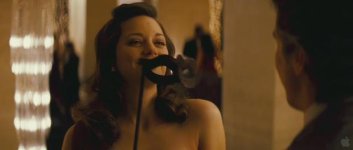
I like the color correction, the deep yellows and warm colors, but what I am wondering is how to achieve the light glints from the eyes you see in a lot of the dialogue scenes. Also the cinematography I think is brilliant, and I saw the BTW TDKR with the chinese lantern, it's interesting, but obviously not the only light they're using. I want to shoot a short film and I need all the BTW information I can get to achieve a film look of TDKR on a RED or Black Magic camera. If anyone can give any input it is definitely appreciated! :)
I attached some of the stills from a trailer below, thank you.
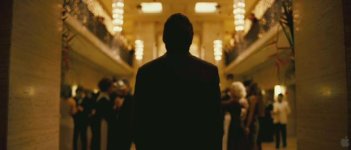
2.jpg3.jpg4.jpgUntitled.jpg
 
Those are called eye-lights. Any large and very dim source as close to the lens as possible.

Remember, the eye is glassy-water like reflective, so you just need something very large and very dim, as to not throw that much light onto the scene but still reflect in the eye.
 
Those are called eye-lights. Any large and very dim source as close to the lens as possible.

Remember, the eye is glassy-water like reflective, so you just need something very large and very dim, as to not throw that much light onto the scene but still reflect in the eye.

I was curious for awhile I was thinking it was either very dim and far away for awhile and then maye a very harsh spotlight shining just past the subject as to not get in the way of current lighting.

Do you have any advice on lenses that'd suit the feel of this movie, obviously I don't have the means to get anamorphics, but would Zeiss CP,s or Ze's or even possibly Canon L series lenses suffice? Or is it the bokeh that gives this movie it's unusual dark mysterious feel? (opinion only)

Also what would be the best way of doing one of these lights for the eyes, chinese lantern? or Something much larger?
 
Its not always about the gear but the way the gear is used and how the scenes are lit... The choice of angle... Movement etc. One could almost go so far as to say you cant be taught, you gotta have the initial feel yourself.

Giving a man 50 hmis, a panavision and great actors doesnt mean he can automatically make magic happen. That comes from the inside (god.. How snobbish I sound.....)


Thank you! I wish people understood this more :/
 
Its not always about the gear but the way the gear is used and how the scenes are lit... The choice of angle... Movement etc. One could almost go so far as to say you cant be taught, you gotta have the initial feel yourself.

Giving a man 50 hmis, a panavision and great actors doesnt mean he can automatically make magic happen. That comes from the inside (god.. How snobbish I sound.....)

Not snobbish at all, but with the bokeh of particular lenses, dynamic range or latitude of film, it's definitely a different feel than an iPhone, though Zacuto may disagree with that, it's definitely a different level to be playing with.
 
> The choice of angle...

That's the key to a good eye light. Ever played pool? Ever pull off a bank shot off the side? Same thing.

As for sources, I've used big diffusion panels, china balls, christmas lights, whatever. One of the best eye light reflections I ever got was from a par64 dimmed all the way down and up close about a yard from the subject. It was warm, strong, punchy... Whatever light you choose though, it's all about the angle.
 
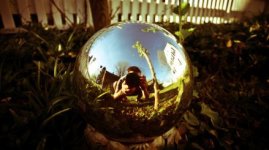
The eye is a reflective spherical object... think about the back of a spoon or a lawn globe.

Picture 8.jpg

You can see how even when very close, the reflection isn't that large.

So in order to get a healthy eye light, you need a dim but large light. I usually use a very large china ball over the lens, or a white bounce card with a little inky on it. Again, if you are shooting very close to the subject, you don't need it very big. If you are on a very long lens, you'll need to cheat the eye light in above the frame line or make it very large.

I like larger eye-lights. You can use a dimmed down inky pointed right at them, but that gives the tiniest little spec in the eye. I live big reflections.
 
I was curious for awhile I was thinking it was either very dim and far away for awhile and then maye a very harsh spotlight shining just past the subject as to not get in the way of current lighting.

Do you have any advice on lenses that'd suit the feel of this movie, obviously I don't have the means to get anamorphics, but would Zeiss CP,s or Ze's or even possibly Canon L series lenses suffice? Or is it the bokeh that gives this movie it's unusual dark mysterious feel? (opinion only)

Also what would be the best way of doing one of these lights for the eyes, chinese lantern? or Something much larger?

The "bokeh" (out of focus) shape is deturmined by the shape of the iris assembly, while the amount of out of focus area is determined by what focal length is being used, what the focus distance is to subject and the aperture t-stop. What is in the background/foreground deturmines how much of the effects of the bokeh we created is seen.

You can have a man against a completely black background and have a wide open 100mm lens at T/1.4, focused on the mans face 5 feet away. This would have zero effect if there is nothing to see. Throw some Christmas lights in the background and suddenly you can see the effect of shallow DoF.

Regarding lenses, it's not all about out of focus area, although that is important. It is about matching sharpness, color, contrast and other elements to what you want. Sometimes vintage lenses are a good choice, sometimes newer and more modern ones are. It all depends what you want.
 
Angle ..ABSOLUTELY.

What we see or photograph is actually the REFLECTION of light. Light falls or strikes a surface of an object and REFLECTS to our eye or our lens .

It is key knowledge for the "lighting cameraperson"....that light reflects from a surface at 90 degrees. That is any surface or any point on that surface.
It is called the "angle of incidence" (physics).

It is also key knowledge that light does not bend. Never ever ever... Light rays always travel in a straight line.

The straight rays srtike a surface and reflect (exit) at 90 degrees to the entry angle .

With those three facts and practical knowledge ...the cameraperson can place lights artfully as well as solve issues of lighting. eg flares , glints, shadows

Placing an eye light is a very good example.

EDIT: I should have added the fundamental. LIGHT is INVISIBLE.
 
It is key knowledge for the "lighting cameraperson"....that light reflects from a surface at 90 degrees. That is any surface or any point on that surface.
It is called the "angle of incidence" (physics).

Are you suggesting light always bounces on a 90* angle? That is not so.

Angle of reflection typically matches angle of incidence. Meaning light only reflects at 90* when incident light strikes at 90*.

This is why I advocate an eye light right at the camera lens. The eye can reflect a great deal of the scene, as you can see in the lawn globe photo in this thread, but I always like to put mine at lens.
 
Last edited:
The "bokeh" (out of focus) shape is deturmined by the shape of the iris assembly, while the amount of out of focus area is determined by what focal length is being used, what the focus distance is to subject and the aperture t-stop. What is in the background/foreground deturmines how much of the effects of the bokeh we created is seen.

You can have a man against a completely black background and have a wide open 100mm lens at T/1.4, focused on the mans face 5 feet away. This would have zero effect if there is nothing to see. Throw some Christmas lights in the background and suddenly you can see the effect of shallow DoF.

Regarding lenses, it's not all about out of focus area, although that is important. It is about matching sharpness, color, contrast and other elements to what you want. Sometimes vintage lenses are a good choice, sometimes newer and more modern ones are. It all depends what you want.


I love this sort of input! See I am still learning cinematography, I want to learn even more and these types of answers help me greatly understand, I have always been a visual learner though for the most part.

I've only shot with a few lenses, on a few cameras, I can list them all, but still have limited knowledge on this "sharpness" and contrast of each of them.

24mm L lens by Canon
85mm Carl Zeiss ZE
50mm 1.4 Canon
85mm 1.2 L by Canon
28mm 1.8 by Canon
75-300mm Canon and 18-55 kit lens (Lowest end lenses which I currently own)

I've used a Canon t2i, Canon 5d Mark II and Mark III and I notice some pretty big differences when I use these cameras, mainly I use natural light as often as possible given my budgeted situations.

From what I can tell just by my limited hours of using each of these on separate occasions the 28mm has a much different feel from the 24mm (The distance in mm might be the issue) but it seems like the 24mm has a cleaner image, just my experience using it.

The 85mm L compared to Zeiss 85mm has quite a different effect on the lens flares (which I enjoy using tastefully I dislike artificial flares anymore) and though I don't think I'd shoot all the way at 1.2 or 1.4 on these lenses in a short film unless it isn't lit properly I do enjoy how they appear, the Carl Zeiss 85mm looks to be a bit weak at the edges of the videos I've filmed though.

These are my experiences and like I said I only own the cheaper lenses listed above and could be wrong completely or my settings on my camera were incorrect.


But when someone lists contrast/sharpness and color in a lens, how do they mean? Do lenses themselves give different temperatures to the light? Sharpness all around? If anyone can help guide me you know it's to help a fellow inspiring cinematographer

When using the 24mm L lens it
 
My apologies. You are correct.

The angle of incidence is the angle that the light reflects back at.

To clarify - light in at 90 goes out at 90 ie straight back at itself
Light in at 45 goes out at 45... ands so on...
 
I love this sort of input! See I am still learning cinematography, I want to learn even more and these types of answers help me greatly understand, I have always been a visual learner though for the most part.

I've only shot with a few lenses, on a few cameras, I can list them all, but still have limited knowledge on this "sharpness" and contrast of each of them.

24mm L lens by Canon
85mm Carl Zeiss ZE
50mm 1.4 Canon
85mm 1.2 L by Canon
28mm 1.8 by Canon
75-300mm Canon and 18-55 kit lens (Lowest end lenses which I currently own)

I've used a Canon t2i, Canon 5d Mark II and Mark III and I notice some pretty big differences when I use these cameras, mainly I use natural light as often as possible given my budgeted situations.

From what I can tell just by my limited hours of using each of these on separate occasions the 28mm has a much different feel from the 24mm (The distance in mm might be the issue) but it seems like the 24mm has a cleaner image, just my experience using it.

The 85mm L compared to Zeiss 85mm has quite a different effect on the lens flares (which I enjoy using tastefully I dislike artificial flares anymore) and though I don't think I'd shoot all the way at 1.2 or 1.4 on these lenses in a short film unless it isn't lit properly I do enjoy how they appear, the Carl Zeiss 85mm looks to be a bit weak at the edges of the videos I've filmed though.

These are my experiences and like I said I only own the cheaper lenses listed above and could be wrong completely or my settings on my camera were incorrect.


But when someone lists contrast/sharpness and color in a lens, how do they mean? Do lenses themselves give different temperatures to the light? Sharpness all around? If anyone can help guide me you know it's to help a fellow inspiring cinematographer

When using the 24mm L lens it


Yes. I think the biggest mistake many people make is discounting the importance of glass.

People bicker, fight and debate about which camera (sensor) to use until the cows come home, but then they throw a cheap $50 lens on the front of it, along with some random off brand others. It blows my mind. I know several ASC members who honestly think the choice of lenses is more important than film stock. They of course think both are incredibly important, but make that statement as a testament to how important they feel lens choice is.

A college professor of mine once said "it all goes down the coke bottle"... if you think about it, a camera sensor is very important but it does all of its work based off of what the lens provides! Without the lens the sensor is an overpriced incident light meter!

The lens takes all incoming light and turns it into the image the sensor will interpert. How crucial is that?! Because of the type of glass used, lens coatings, lens design and element placement, aperture assemblies and other variables, lenses can have very different characteristics.

Some lenses are warmer, some are cooler, which does effect the color temperature of the image, albeit in very small variants. Some lenses are sharp, some are soft. Some vignette in exposure in the corners, some do not. Some have aberration, some have little. Some are contrasty, some are not. Some match their brothers, some show different characteristics. Some display perspective much differently than others. There are extremes to all of these and many lenses that fall between the two.

Lenses interpret the world for the sensor. They can do things sensors cannot replicate nor fix.

This is why matching sets of lenses are typically important in cinema. You may want your image to have soft edges or you may not. You may want a warm hue, you may not. Either way you decide, most people want all their lenses to behave in similar fashion as to create a continuity in the image.

If you want to learn more about characteristics of lenses this may have some interesting things. It's about cine lenses but you can pick up some interesting tid-bits from it:http://www.dvxuser.com/V6/showthread.php?273326-Article-Why-We-Need-Cinema-Lenses
 
Last edited:
My apologies. You are correct.

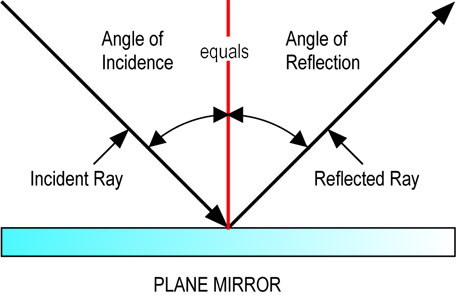
The angle of incidence is the angle that the light reflects back at.

To clarify - light in at 90 goes out at 90 ie straight back at itself
Light in at 45 goes out at 45... ands so on...

To give a picture...

Mirror348.jpg


For 'refraction', that is light passing from 'air', to 'water' for example, the following diagram is useful. The 'index of refraction' is an indication of how much of a change of angle there is at the surface boundary.

critical1.gif


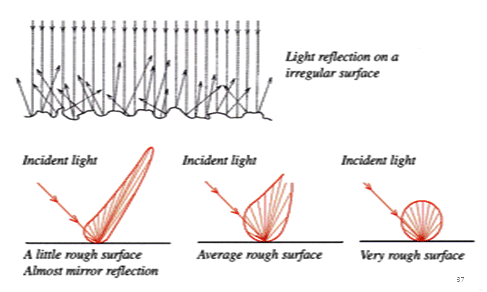
In the case of a 'matte' surface, there are a number of profiles of the 'reflected' light here's a sample of a few:

belwywubuk.png
 
Back
Top