
Navigation
Install the app
How to install the app on iOS
Follow along with the video below to see how to install our site as a web app on your home screen.
Note: This feature may not be available in some browsers.
More options
You are using an out of date browser. It may not display this or other websites correctly.
You should upgrade or use an alternative browser.
You should upgrade or use an alternative browser.

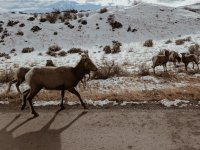


Run&Gun
Veteran
Good times. I dealt with all of those horrible formats. To this day, my nightmares are riddled with Hi-8 tape dropouts. S-VHS was better but still crap.
And you haven’t lived until you’ve edited tape-to-tape with two consumer VHS VCR’s with nothing but a running clock counter(not tied to anything, just free running whenever a tape was popped in and played/re-wound) and front panel controls. I think by the late 80’s/early 90’s was when flying erase heads were introduced, so you could actually make a clean edit. Even though this stuff was never intended to be used like that. And some camcorders had an audio dub function so you could lay down new audio without disturbing the video. I think it was RCA that had a line of camcorders called “ProEdit” that had built-in functions like this. Some Zenith’s had built-in character generators/titler’s that you could use to superimpose over live recorded images.
The innocence of the time was kind of cool, but just look what can be done today with just a cellphone and what’s built into it.
Last edited:
G
Guest
Guest
I feel physical pain with how bad these are. Can't imagine how difficult it must be to realize your mistake in using something like that ever. Your eye and aesthetic almost make me forget I am looking at images captured with photosites smaller than 8microns. In sharing these, it would almost communicate that life is beautiful, but no-no, can't fool us, eventually the metadata comes out.I shot these disgusting excuses for images on my OG Pixel cellphone. I'm sorry y'all have to see these. It came out in like 2016! Get with the times Google.
View attachment 139963
G
Guest
Guest
...just threw up in my mouth a little.Forgive me, father, for I have pixel-binned:
combatentropy
Veteran
And you haven’t lived until you’ve edited tape-to-tape with two consumer VHS VCR’s with nothing but a running clock counter(not tied to anything, just free running whenever a tape was popped in and played/re-wound) and front panel controls. I think by the late 80’s/early 90’s was when flying erase heads were introduced, so you could actually make a clean edit. Even though this stuff was never intended to be used like that. And some camcorders had an audio dub function so you could lay down new audio without disturbing the video. I think it was RCA that had a line of camcorders called “ProEdit” that had built-in functions like this.
Yeah, in the 1990s I made movies with a JVC S-VHS-C camcorder and S-VHS VCR. It had some kind of prosumer way of setting an in and out point, then automatically rewinding, starting playback with a 5-second preroll, and through a LANC cable controlling the VCR to begin recording. It was not quite frame accurate though. I wished for the pro decks with their real timecode. Even film editors with their scissors and tape at least had frame accuracy.
Nonlinear computer editing is wonderful.

puredrifting
Major Contributor
And you haven’t lived until you’ve edited tape-to-tape with two consumer VHS VCR’s with nothing but a running clock counter(not tied to anything, just free running whenever a tape was popped in and played/re-wound) and front panel controls. I think by the late 80’s/early 90’s was when flying erase heads were introduced, so you could actually make a clean edit. Even though this stuff was never intended to be used like that. And some camcorders had an audio dub function so you could lay down new audio without disturbing the video. I think it was RCA that had a line of camcorders called “ProEdit” that had built-in functions like this. Some Zenith’s had built-in character generators/titler’s that you could use to superimpose over live recorded images.
The innocence of the time was kind of cool, but just look what can be done today with just a cellphone and what’s built into it.
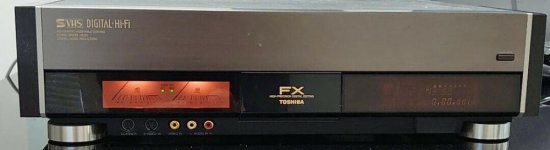
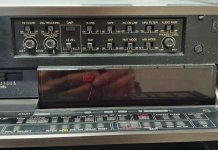
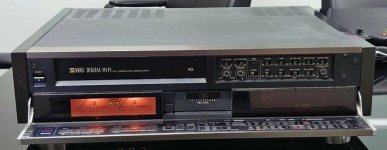
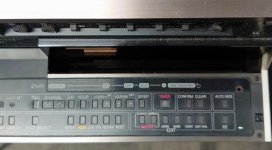
Early 90s, I had two Toshiba SVF990s. Check out those high tech editing controls on the flip down control panels. This deck weighed a ton and was built really well for a consumer device, all metal, real ballistic VU meters, I thought I was a bad ass editing with a pair of these!
You can still pick up one new in the box on Ebay for $3,500.00! https://www.ebay.com/itm/313095782012
Run&Gun
Veteran
Yeah, in the 1990s I made movies with a JVC S-VHS-C camcorder and S-VHS VCR. It had some kind of prosumer way of setting an in and out point, then automatically rewinding, starting playback with a 5-second preroll, and through a LANC cable controlling the VCR to begin recording. It was not quite frame accurate though. I wished for the pro decks with their real timecode. Even film editors with their scissors and tape at least had frame accuracy.
Nonlinear computer editing is wonderful.
LANC control would have been amazing then. I think I was barely a teenager, at the time, IF I even was. I used to read Videography magazine, so I knew some of the tools that were available on the professional side, but way back then that was so far out of reach, that stuff might as well have been a billion dollars and sitting on Mars. Now, some of the stuff that still tens of $K's even just 10 years ago, you can find on eBay for a few hundred bucks.
Early 90s, I had two Toshiba SVF990s. Check out those high tech editing controls on the flip down control panels. This deck weighed a ton and was built really well for a consumer device, all metal, real ballistic VU meters, I thought I was a bad ass editing with a pair of these!
You can still pick up one new in the box on Ebay for $3,500.00! https://www.ebay.com/itm/313095782012
View attachment 139974
View attachment 139975
View attachment 139976
View attachment 139977
I wish I could remember the Zenith model numbers(most of their VCR's and Camcorders were re-badged JVC's, at least then). I can see the front panels in my head as clear as day, but it's been so long, I can't remember the model #'s.
combatentropy
Veteran
Love those VUs
puredrifting
Major Contributor
Love those VUs
Probably the coolest piece of cosnumer gear I ever owned. It was the last VHS machine actually made by Toshiba, every machine after was a re-badged Samsung. The SVF990 was really mechanically solid and those VUs were super cool.
I think I might have paid $2k for them too, they weren't cheap. But at the time, a 3/4 SP Deck was $8k or $10k. So these actually looked better and were a lot cheaper, but no time code and only LANC control.
I shot a ton of U-matic 3/4 for corporate video. Ugly format. Shot training and marketing videos for GE power systems, Michelin, Liberty Insurance. If the shoot was scripted we marked shots as A or B roll and alternated tapes during the shoot so we didn't lose a generation in post. Did work print cuts on 3/4" to get an EDL for online, then onlined from the A&B roll originals to 1" or 2" quad masters in a $350/hour post suite. 2nd gen 3/4" was not acceptable. 3rd gen was definitely worse than VHS, lots of noise and edge ringing. But first gen resolved 350 lines quite cleanly instead of 240 for VHS. I still have a Sony U-matic player I got from GE for free when they wrote them off inventory. Have a last generation JVC top of the line consumer VHS deck with two-line time base stabilizer built in. Don't remember what it cost exactly but it was somewhere in $1k+ range.
Run&Gun
Veteran
I shot a ton of U-matic 3/4 for corporate video. Ugly format. Shot training and marketing videos for GE power systems, Michelin, Liberty Insurance. If the shoot was scripted we marked shots as A or B roll and alternated tapes during the shoot so we didn't lose a generation in post. Did work print cuts on 3/4" to get an EDL for online, then onlined from the A&B roll originals to 1" or 2" quad masters in a $350/hour post suite. 2nd gen 3/4" was not acceptable. 3rd gen was definitely worse than VHS, lots of noise and edge ringing. But first gen resolved 350 lines quite cleanly instead of 240 for VHS. I still have a Sony U-matic player I got from GE for free when they wrote them off inventory. Have a last generation JVC top of the line consumer VHS deck with two-line time base stabilizer built in. Don't remember what it cost exactly but it was somewhere in $1k+ range.
In 1996, the TV station where I did my internship and also freelanced for when I started out, was shooting on Beta and editing to 3/4” for air. When I started my internship, they were also just getting Avid NewsCutters and it became even more convoluted as they started changing their tape bays to non-linear. They shot Beta, ingested(real time) into Avid to edit, THEN dumped back out to 3/4” for airplay. And that went on for several years, before they finally switched to Beta for their airplay format. Which may or may not have been after they switched to BetaSX for acquisition. Eventually, YEARS after starting the Avid endeavor, I think they finally were able to actually play to air off of servers.
puredrifting
Major Contributor
I think you guys are missing the spirit of this thread. We want to see more beautiful images shot with “bad” spec cameras, phones, whatever. Show your poison. We aren’t gagging enough. :cheesy:
I've got some great stuff of Elk and the Grand Canyon waterfall in Yellowstone I shot on Hi-8 but at the moment, I don't have a functioning Hi-8 camera or deck to digitize them and post up.
G
Guest
Guest
https://www.youtube.com/watch?v=ww28AiUAnXE
(listen to this while you read if you are bored)
Might seem like ancient history now, but not long ago there were cameras that were good but typically needed to be rented, and then there were A7 and 5D variants everywhere.
A good friend of mine wanted to start branching into the director's role, and given my conversations with him over the years, I felt he would be pretty great at it. Turns out another friend wanted to try out a script and so we all decided to shoot it over one summer weekend.
We started the conversation about things we hoped to accomplish. To be honest, so many of these weekend projects never get finished, and it can be overly ambitious do shoot them in a weekend. So, I guess in the back of our minds we just thinking if we can get this thing done. But right away, we run into a logistical issue.
The scene is a 7minute dialogue between two people in a front yard. Time of day is supposed to be late afternoon. We talked about the basic staging of the scene, and there was the issue: the sun was only going to give a consistent enough window of light for 1hr+. I told my friend that it will be pretty difficult to do it without a lighting crew, but if he wants to do it, we can try to figure it out. He's done a fair bit of lighting in his career, but he was going to be directing this, but the good was that he really understood the need to block the actors with the movement of the sun.
So, essentially the house was situated, so that the sun rose behind it, and set in front of it. And the staging of the main part of the scene had the actors with their backs to the sun in the morning, and front lit in the afternoon:
Sun direction:

There were also trees in the back yard, so the sun didn't peak over and back light until fairly late in the morning, and then it went straight up in a blazing ball of Summer heat and overhead. So we had about and hour thirty to shoot the wide and some coverage before the sun was really out of sync.
Now, obviously, there are other ways to do this, but I was really wanting to do the best we could to stick to my friend's original idea, and at the same time, I was really curious to see if we could even pull it off. That's a lot of sun movement for a lot of dialogue.
We met up a weekend before the shoot or something, and spent the whole day at the location walking through the script, and making our blocking adjustments to the sun and jotted down the times. Realizing there still might not be enough time in the day, we worked in a 180 degree line flip into the shots and that gave us another 2hrs of back light almost. I actually think the 180 jump felt good, just the lighting was difficult to match in post.
Now I don't know why I thought we should make things more difficult by using a Sony A7II (might have been the S, I don't remember). And knowing we would be editing on a MacBook Pro that would be able to handle the 4K footage, we shot in 1080p. Yes, 50mbps and 8bits. And if that wasn't a challenge enough, we shot in slog2 to further break the footage apart. This was when I didn't own a camera, and we weren't going to shoot on an iPhone. But as we all know, using an 8bit camera is the end of life.
Frames:

We got through the weekend, and even had time for the extra stuff. I learned a lot about working with and against the sun with nothing much more than a 6x silk, and how to make that work for someone else's vision. And we really worked hard in prep so that the actors would have as much time as possible with their lines and that they would be comfortable. Actually, the diffusion played a roll in softening the light for the weak camera, but it also helped keep the actors out of direct heat for some parts of the day got sweaty hot in the direct sun. In hindsight, I might have gone with a lighter diffusion, as it took the levels down and went more soft than needed, but making that work was just all part of it.
It was really fun, doing a project with friends, and completing it. Sure, we finish work stuff all the time, but with friends, projects can easily just run out of steam.
but yeah, I know what we're all thinking. we're all more distracted by the fact that the camera wasn't raw or 8K. Never mind having fun with friends, or getting to flex and experiment.
(listen to this while you read if you are bored)
Might seem like ancient history now, but not long ago there were cameras that were good but typically needed to be rented, and then there were A7 and 5D variants everywhere.
A good friend of mine wanted to start branching into the director's role, and given my conversations with him over the years, I felt he would be pretty great at it. Turns out another friend wanted to try out a script and so we all decided to shoot it over one summer weekend.
We started the conversation about things we hoped to accomplish. To be honest, so many of these weekend projects never get finished, and it can be overly ambitious do shoot them in a weekend. So, I guess in the back of our minds we just thinking if we can get this thing done. But right away, we run into a logistical issue.
The scene is a 7minute dialogue between two people in a front yard. Time of day is supposed to be late afternoon. We talked about the basic staging of the scene, and there was the issue: the sun was only going to give a consistent enough window of light for 1hr+. I told my friend that it will be pretty difficult to do it without a lighting crew, but if he wants to do it, we can try to figure it out. He's done a fair bit of lighting in his career, but he was going to be directing this, but the good was that he really understood the need to block the actors with the movement of the sun.
So, essentially the house was situated, so that the sun rose behind it, and set in front of it. And the staging of the main part of the scene had the actors with their backs to the sun in the morning, and front lit in the afternoon:
Sun direction:
There were also trees in the back yard, so the sun didn't peak over and back light until fairly late in the morning, and then it went straight up in a blazing ball of Summer heat and overhead. So we had about and hour thirty to shoot the wide and some coverage before the sun was really out of sync.
Now, obviously, there are other ways to do this, but I was really wanting to do the best we could to stick to my friend's original idea, and at the same time, I was really curious to see if we could even pull it off. That's a lot of sun movement for a lot of dialogue.
We met up a weekend before the shoot or something, and spent the whole day at the location walking through the script, and making our blocking adjustments to the sun and jotted down the times. Realizing there still might not be enough time in the day, we worked in a 180 degree line flip into the shots and that gave us another 2hrs of back light almost. I actually think the 180 jump felt good, just the lighting was difficult to match in post.
Now I don't know why I thought we should make things more difficult by using a Sony A7II (might have been the S, I don't remember). And knowing we would be editing on a MacBook Pro that would be able to handle the 4K footage, we shot in 1080p. Yes, 50mbps and 8bits. And if that wasn't a challenge enough, we shot in slog2 to further break the footage apart. This was when I didn't own a camera, and we weren't going to shoot on an iPhone. But as we all know, using an 8bit camera is the end of life.
Frames:
We got through the weekend, and even had time for the extra stuff. I learned a lot about working with and against the sun with nothing much more than a 6x silk, and how to make that work for someone else's vision. And we really worked hard in prep so that the actors would have as much time as possible with their lines and that they would be comfortable. Actually, the diffusion played a roll in softening the light for the weak camera, but it also helped keep the actors out of direct heat for some parts of the day got sweaty hot in the direct sun. In hindsight, I might have gone with a lighter diffusion, as it took the levels down and went more soft than needed, but making that work was just all part of it.
It was really fun, doing a project with friends, and completing it. Sure, we finish work stuff all the time, but with friends, projects can easily just run out of steam.
but yeah, I know what we're all thinking. we're all more distracted by the fact that the camera wasn't raw or 8K. Never mind having fun with friends, or getting to flex and experiment.
Last edited:
puredrifting
Major Contributor
Anybody ever use Filmlook circa 1993. I got in some extensive discussions with a producer/cameraman about using it on a no budget feature. Basically they take your footage (Probably betacam) and turn it “filmlook”. Don’t remember being amazed at the time.
I used to have a friend who worked there and I drove past their building in Burbank every day. Being a film shooter, the look always looked
gimmicky but it was a thing back then. Anyone good with AE and plug-ins or even Magic Bullet or one of the like would laugh at the results
today but back then, we didn't have nearly the amount of AE users or plug-ins we have available today so if you wanted the "film look" and couldn't
shoot film, your choices were pretty limited. They really pitched that their workflow was a "secret sauce", which it probably was as it was
largely hardware based.
Run&Gun
Veteran
Anybody ever use Filmlook circa 1993. I got in some extensive discussions with a producer/cameraman about using it on a no budget feature. Basically they take your footage (Probably betacam) and turn it “filmlook”. Don’t remember being amazed at the time.
The early days were HORRIBLE. I remember a show (network sitcom) that was one of, if not the first, to use it, at least on broadcast TV. This was years before I got into TV and even being a kid, I remember thinking “this looks odd”. I then worked on a long running doc series in the late 90’s/early 00’s that used it, and yes, we were shooting on regular ‘ole Betacam. But by then, the process had gotten much better. And shortly after that, we had video cameras that could shoot “24P” and migrated to that(F900’s) when they took the show HD. But, the biggest thing that lent itself to making the look convincing, whether doing it in post or in-camera, was the lighting.