Talk to me about ND filters: Is variable ND a problem in real world use?

NonFiction

Active member
So, I thought I'd like to get an ND filter pack instead of a polarizing variable ND, to avoid some of the pola-weirdness. Got this well reviewed set: http://www.bhphotovideo.com/bnh/controller/home?O=NavBar&A=getItemDetail&Q=&sku=729105&is=REG&si=rev#costumerReview


and here what I got:
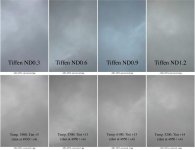
TiffenBlows8up.jpg

These images are straight conversions from the raw files of a 5D classic, shot a few seconds apart. No added contrast or saturation (I zeroed out all the defaults in CS5). This is a mess, clearly, and it's not exactly what I'm asking about.

NEW--Methodology!: +++++ Here's what I did. I shot the four pictures, just seconds apart, on my 5d, looking up a white overcast Seattle sky, through a plastic skylight. I used daylight WB on the camera, and aperture priority auto with +1 stop of compensation. Then I took the pictures into CS5 ACR, and processed them out with all the settings zeroed--no contrast curve, no blackpoint, no saturation, etc. That's the top row.

Second row, I clicked the WB dropper on the whitest part of each picture, and recorded the WB needed to get a neutral balance. The differences between the corrected amount--it seems to me--should reflect the differences in the color of the respective filters. +++++


My question is what dire nastiness is a Vari-ND (I'm thinking a quality one, Heliopan probably) going to introduce in my shots? It's certainly more convenient than a pack of four, even four color matched ones.

Your thoughts are appreciated.
 
Last edited:
I have a tiffen VND.

Its kind of hobsons choice, matte box clap trap or simple shoot but post problems

-ive been using 'click' WB (off a grey card) recently with better results on the VND

i guess deep ND is a problem with a VND but shallow less so.

In practice, shooting slow and considered the set is better, but on a fast moving job you may find that 'needs must' and you will go with a VND

Also if your camera is raw/fat codec you can do more corrections in post, the thinner the camera codec the more perfect your image in camera must be..

S
 
Black text on a dark grey background in the smallest available font. You're not the only one, I can't fathom what thought process leads someone to choose that over the perfectly readable default settings...

I usually ignore such threads but on a positive note, thanks for posting the corrected images and the settings. I found them of interest.
 
I really love to work with VNDs, cause I think of aperture as a creative tool to set my DOF not my exposure. Since shutter is no option for exposure. when shooting video, you are left with ND anyway. Never liked in camera NDs or 4x4, cause the steps of ND are rather coarse, while a VND lets me set my exposure very precise where in want it, to get the most out of the sensor.

You want a good VND though and also need a near IR filter.
I recommend the Heliopan or the new Genus Eclipse.

I did a little comparison here: http://frankglencairn.wordpress.com/2012/12/08/nd-fader-shootout-heliopan-vs-the-new-genus-eclipse/

Frank
 
I really love to work with VNDs, cause I think of aperture as a creative tool to set my DOF not my exposure. Since shutter is no option for exposure. when shooting video, you are left with ND anyway. Never liked in camera NDs or 4x4, cause the steps of ND are rather coarse, while a VND lets me set my exposure very precise where in want it, to get the most out of the sensor.

I saw your post a long time back about your preference to use a VND with a foldable rubber lens hood on top, and copied that technique. I have to say I never looked back, its brilliantly simple for running and gunning. Everyone that has subsequently seen that set up on my camera has since followed suit.

Although I am using a LCW Variable ND, and though I have read a number of negative reports about it, I really like the warm (and slightly soft) image it produces.
 
Black text on a dark grey background in the smallest available font. You're not the only one, I can't fathom what thought process leads someone to choose that over the perfectly readable default settings...

I usually ignore such threads but on a positive note, thanks for posting the corrected images and the settings. I found them of interest.

--Indeed, that certainly wouldn't have been my choice. I think what happened was I copied the text in from another editor, and it came in smaller and blacker than the forum defaults. I agree it's pretty ugly. Sorry about that.
 
Heh. Turns out you can change it, even a few hours down the road. Nice.

So, sounds like nobody's really having problems with the fact that variable ND is introducing polarization funniness? Crazy too-dark skies and super-matte skin and... what else is it supposed to do? Oh yeah, polarization 'vignetting' on wide angle frames... Yeah, I'll probably just go Vari then.
 
Not sure why you are getting such inconsistent results with your tiffens, mine don't do that even when they are stacked.

I guess it depends what you shoot, but I wouldn't recommend Vari ND. Too many whacky colours and too much defraction for my taste. It can get me out of jam, but I've learnt not to get in those any more.
 
The weird results are because the glass in each of these filters is of different colors. I suspect it's a bastard pack that B&H sent me. Not to impugn them, but I just cannot imagine this is how Tiffen sent it out. I MIGHT try again--gonna call B&H today and let them know what I got. It's really as bad as it looks. I took them out of the wrapping and was like, what? Because each filter looked that much differen than the last.
 
Frank, super useful, thank you. I will be looking up that new Genus ND.
Cheers,
Scott

I really love to work with VNDs, cause I think of aperture as a creative tool to set my DOF not my exposure. Since shutter is no option for exposure. when shooting video, you are left with ND anyway. Never liked in camera NDs or 4x4, cause the steps of ND are rather coarse, while a VND lets me set my exposure very precise where in want it, to get the most out of the sensor.

You want a good VND though and also need a near IR filter.
I recommend the Heliopan or the new Genus Eclipse.

I did a little comparison here: http://frankglencairn.wordpress.com/2012/12/08/nd-fader-shootout-heliopan-vs-the-new-genus-eclipse/

Frank
 
You got a bad ND9 there, send it back. Other than that, those Tiffens all match (incorrect WB notwithstanding) and that's what I would stick with - you'll have far fewer issues with those than you would with a variable ND.
 
Don't know what you mean by 'incorrect WB notwithstanding'--the differences between the shots are all accounted for by variation in the filters. One is way off the others, but there's a pretty pronounced difference between them all. I mean, this is the first time I'm testing a stack of neutral density filters, but these are far less neutral and far less consistent that I would expect. Innit?
 
Don't know what you mean by 'incorrect WB notwithstanding'--the differences between the shots are all accounted for by variation in the filters. One is way off the others, but there's a pretty pronounced difference between them all. I mean, this is the first time I'm testing a stack of neutral density filters, but these are far less neutral and far less consistent that I would expect. Innit?

The differences there can all be caused by varying light conditions, since you are relying on uncontrolled natural light. To do such a test properly, you need controlled nonchanging light, as well as a control shot without filter to compare to (which I bet would match the filtered shots pretty well color-wise, other than the ND9).

The fact that you had to color correct all the shots to make them neutral means your camera WB was incorrectly set - ideally at least one shot would have been set correctly, then you could more accurately analyze any differences between the remaining shots. Not a show stopper, but it makes the analysis more difficult when there is no control shot that is "correct".

The differences between these filters, other than the ND9, seem minimal to me.
 
Well, I wasn't looking to test my WB setting proficiency. Nor was I testing for the neutrality of the filters; I was testing for variation among them.

"The fact that you had to color correct all the shots to make them neutral means your camera WB was incorrectly set"

No. You're assuming a neutral sky is "correct". I do not expect the sky at any point to be perfectly neutral. I set the WB going in as daylight, which is how I shoot 90% of the time. I 'corrected' from the daylight WB setting just to see how far each test shot varied from a known baseline (my 5D's Daylight WB setting)--not because the neutral picture was the desired outcome.

Nor do I think the color of my sky is going to change enough in the 5 seconds or so between the shots in this series to affect anything like the difference I'm observing here. I am quite certain that a color temperature meter would have recorded very little, if any variation in the real color balance of the sky I shot during the duration of this series.
 
Last edited:
Each filter has it's place. I use a variable-ND with rubber hood for some of my smaller cameras like the GH2 in certain scenarios like R-N-G, while I use high quality ND & ND grads in a matte box on some of my larger cameras for tripod or dolly work.
 
Yes.

You can use them if you want to get away with it, but professional's in my realm would never use them. I've worked on over 160+ productions, and I've never... ever seen anyone use a variable ND. They are polarizing your light, because that is what they are, two pola filters. They do strange things to natural shine/sheen/reflections on skin, if you use them at variable settings they shift color and consistency of image. I've seen a plethora of very small, yet serious issues, that would not be found acceptable in my line of work, but could certainly pass for those who don't have as high of standards.

I've heard multiple ASC cinematographers swear by never using normal pola's in CU's, for some of the reasons above. It can make the skin shine funny, take reflections out of eyes, or make a strange skintone. Aces wild with VND's.

I honestly think variable ND's are lazy. I don't say that to pick a fight or to call anyone out specifically, but many decent run-and-gun cameras have drop in ND's. If shooting in conditions where you may need them, use a C300, Af100, Fs100, Fs700, HVX200!, all ENG cameras, etc, etc. Of course not all cameras have them... funny enough many cinema cameras and then the photography cameras.

So there you have it! Many people use them and find acceptable success... but if you were to ask me specifically, (I'm a cinematographer and camera assistant in Los Angeles) I'd tell you I've never seen anyone I've worked with on set use a VND, and we have no problem using ND filters in 1/stop increments. We drop filters in and out all day, on narrative work, commercial work, mVideo, etc. So I can speak for that part of the industry. It's small issues are big issues for bigger DP's.

This might work for 7D corporate videos and such, but it typically wouldn't fly in my circle. Again, not trying to make judgements, but saying the way it is in my world... it can very well be different in yours.
 
I think you will find they dont choose it. seems to happen when pasting text working on phone etc..

S

Yup. This happened to a post I made once from my tablet, but I happened to notice it and went in to correct the problem. Strange how it only happened that one time though. (For example, I'm posting this on my tablet and no problems - well, I hope!)
 
Back
Top