Student needs advice on lighting setup

cwminor

Member
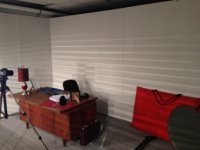
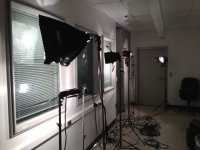
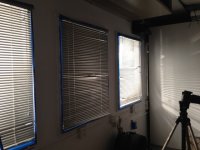
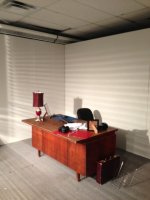
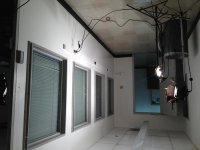
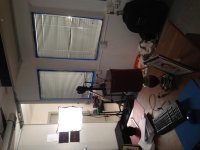
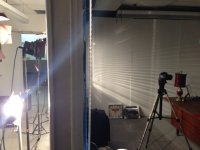
Hey there! I am currently a Junior film student, about to shoot a short narrative film. I have a quick but important question. The majority of my film takes place inside a motel office/lobby that loses power and I want all the "sunlight" to come from outside the lobby and stream in through the window blinds to add drama. Since the room is indoors I am faking it by blasting 2 omni kits, rifa kit, 2 omni DP's and 3 Tota lights. As you can see in the pictures, I have tried this setup and I'm OK with the results but I am looking for advice on a way I could improve the realism of lights. The main problems i'm asking about relate to the diffusion of the windows which causes the image to become flat and the reflector i'm using in the room to bounce on my actors aren't very effective so they are pretty dark even though the room is actually pretty bright. Should I move a light inside the room (the reason I'm not already is because the room is very small)?. Use different gels to make it look like sunlight? Or setup differently all together? Any help would be much appreciated, as I don't have much experience with lighting. Please excuse the set, it is definitely not finished yet. Much thanks!
 

Attachments
  • photo copy 2.JPG
    photo copy 2.JPG
    75.6 KB · Views: 0
  • photo copy 3.JPG
    photo copy 3.JPG
    61.5 KB · Views: 0
  • photo copy 4.JPG
    photo copy 4.JPG
    85.9 KB · Views: 0
  • photo copy.JPG
    photo copy.JPG
    89.3 KB · Views: 0
  • photo.JPG
    photo.JPG
    67.6 KB · Views: 0
Last edited:
im no lighting expert but here goes------ if the room is small, it means you cant fit in many lights, but it also means you don't NEED many lights (or tons of wattage) to light the room. the more you BLAST this (small) room with light the less chance youre gonna be able to get drama/shadows/modeling. if it wuz me id START by thinking about putting the rifa in the corner as the key (where the clocks are sitting--but see FUDGING, next) this'll give you good 45 degree light on anyone at the desk and I guess farside/rim light on everyone else...(then again it depends on what angles you plan to shoot from, but try to set up the key 45 degrees from the camera when you can, or get some backlight/farside light going on---- of course you know you can also FUDGE the position of the key for your different shots in order to get your modeling/shadows- don't be a motivation nazi) I wouldn't worry about gels-- white balance as normal -- in post, tint the highlights warm (yellow, orange, or yellow-orange), if you so chose, and itll go some way in saying "sunlight" - you wont need much (use color curves- its in your nle) also the yellow tint will literally help color the boring white walls. use perhaps the tota light to bounce some fill off the ceiling for fill, or perhaps don't use any fill at all. if you really want that venetian blind effect try using a hard light (through the window?) to cast a ventian pattern on the far wall- ie do it with a ---background---- light but STOP trying to use the light coming through the blinds as a key, it aint happening..i dont have the brains to explain why but its clear they just aint punching through and im not sure thats how its done anyway..i dunno. thats my two cents perhaps someone smarter than me here can correct me there. anyways.... key----fill----background light ...whew....
 
Last edited:
I would do a different setup all together. I'm seeing something pretty typical of student films here; lots of small lights that are too close. Think BIG sources far away. Remember, light depreciates in intensity very rapidly, when you double the distance you're down two F stops. The distance you can get away from the action with a more powerful light acts as a buffer, lighting things more evenly. This is particularly important in this case, because what you have going on there doesn't look like sunlight, venetian blind shadows from real sunlight are parallel. For that effect, you need a very bright, hard source far away from the windows, ideally one covering all of them.

Those windows aren't diffusing the light at all either. The reason you're not getting a stronger blind effect is not only because the lights are so close to the windows, but also because they're all open face units. The reflectors become a source in and of themselves, filling in the hard shadows created by light directly from the filament. Fresnels (possibly with the lens removed) are the best lights to use for something like this. As long as the lamp socket is positioned correctly, they will give you the hardest possible light.

However, if you do go in this direction, you have to be careful. This effect can look great on walls, but not so great on your talent. I can't say much without seeing the blocking of the scene, but I would avoid using the hard window light as a key light in the traditional sense, particularly for close-ups. It could work as a reverse key, with some bounce filling in their faces so that they're not completely black, but hard light doesn't look so good when it's frontal as soon as your actors start to move (nose shadows, eye socket shadows). If that's what you need, I would push it through some light diffusion for close-ups, like cheese cloth or 1/4 tough spun, and make sure you have adequate fill. This will reduce the contrast a bit while still keeping the venetian blind shadows.
 
Thank you both for your responses. I'm used to interview lighting but I have never done anything like this before. So, the brightest lights I have are the omni DPs and Totas. I know you suggested not putting the lights too close to the window, so I tried moving them as far back as I could, and tried to make a single light source. Not sure if this is what you meant. In a perfect world what i imagine is my characters looking out these windows and streaks of light come through the scene but otherwise it's a cool dark blue in the room. I also tried adding the Rifa soft box light in the room. Maybe I will dim them?


- not sure why it makes my photos upside down...
 

Attachments

  • image.jpg
    image.jpg
    68.5 KB · Views: 0
  • image.jpg
    image.jpg
    74.3 KB · Views: 0
wonder if he has the gear and space to do all that. kid may have naught but some open faces a softbox and a tiny room and youre trying to turn him into john alton. keep in mind kid, the window blinds ain't the only way to add drama. try the above , but if you cant, you can get drama by making sure your (softer) key models people's faces. I would guess that's first order of business if you find your venetian blind idea too ambitious for your resources.
 
just as I guessed; thats too advanced for this guy and what he has (and me). keep it freeking simple kid. first picture: move the hard light as far from the window as you can as our friend above noted, youll get more parrellel lines), and just futz with it to try to create venetian blind effect on that back wall. add a warm gel if u like??? second picture: im guessing youre going to be shooting from that doorway? if that's the case get that softbox AWAY from where th camera will be, , put it in the other corner or even directly facing the desk. about 45 degrees to the camera--ish. yes this all super basic lighting 101 I aint no genius. in order of importance..... key---45 degrees from the camera or just NOT FRONTAL to the camera yoll get NO shadows/drama if its pointing the same direction as the camera- try to -make shadows on ppl faces....------then a lil bit of fill maybe......then a background light to create a shape/shadow/mood/blind if you can..... also if you dim the key light you'll lower the color temperature so...use an ND gel in the rifa to get it less bright if the soft box is blasting the room too much?
 
Last edited:
I have a very hard time conceptualizing a lighting design without seeing the actual framing that I would need to light. Remember, BLOCK, LIGHT, SHOOT! My suggestion would be to first, open up those blinds. You have them closed. Try that and see what your light looks like. My next suggestion would be to pull the blinds off of the windows and set them up on stands. Take you hardest light, and a blind on a stand, and position it to give the venetian blind slash across the back wall. Take the Rifa light, and a blind on a stand, position and adjust them to give the base portraiture lighting. I would also take one of your other lights and set up a bounce source that you can use for fill. I would put all of the lights on dimmers to adjust the intensity. You are still going to need some basic gripology, flags and nets/scrims to shape the light, gels to get the color you want and probably some diffusion to adjust the quality of the light. Other than that, you should be all set.
 
Back
Top