

JPNola
Veteran
I have the unique opportunity to be on the sets of major motion pictures and witness the lighting setups of numerous Hollywood DP's. I thought I would share some of the techniques and tricks used by the big-time DP's, techniques and tricks that are simple and low cost.
The "STOLEN" in my title is me being cheeky. I considered the ethics of publicly sharing any "secrets" of DP's but the techniques I discuss are techniques that are widely used in the industry and widely known in the industry. Every Juicer in the biz knows of these techniques. Any member of the public watching a feature film production at work can see the techniques being employed.
____________________________
Boxing 1 x 1 LED panels. Or "boxing-in" LED panels.
This technique is used to reduce the spill from a 1 x 1 LED panel. Coroplast is used to create a shallow box on the front of the LED panel. ( "coroplast", or corrugated plastic, is that plastic sheeting used for political signs, reality signs, and advertising signs you see on the side of the road. Only in this case the plastic is black and not white ). Gaffer tape is used to construct the box-
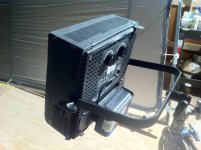
This boxing-in of the light reduces the amount of spill from the light. It turns the light into a more narrow source. This limiting of spill light and narrowing of the light from the LED panel is further accomplished with a piece of plastic grid affixed at the front of the box-
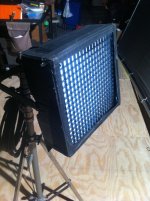
In the example pictured, diffusion has been placed behind the plastic grid. If you omit the piece of diffusion the setup will produce a light beam that is even more narrow. But DP's generally avoid using naked LED's. The narrowing effect of the grid can be seen here-
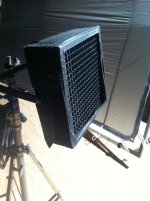
From a side angle you no longer see the diffusion. The grid is "cutting" the diffusion. From this angle your view of the diffusion is "cut" off by the grid and light from the diffusion is likewise "cut off" from hitting your viewing position.
In short, it's a method to prevent LED panels from spilling all over the GD place. I've also seen this coroplast box constructed so that it is more like a snoot. The coreplast box being a foot or so deep instead of only a few inches deep as in this example. This boxing method is really good at defining the light and limiting the light. You can have someone a couple of feet in front of a white wall and if you light them laterally with a setup like the one above there will be very little light on the back wall. Most of what light there is on the back wall is reflecting off the subject or reflecting off the floor.
With an LED panel boxed-in like this you could use the light as an up-light to light a back wall in a scene and the source is so hidden by the boxing it could all be in frame without the lighting source drawing much attention to itself.
Also note in the photos how the yoke on the LED panel is mounted. That is a simple technique people often forget about, one that can be used to position a light at a lower position on a stand that is already as low as it can go.
As far as materials for constructing this setup- the coroplast can usually be obtained locally. Just call a local company that makes signs. The plastic grid in the photo is from a Kino-Flo light bank but this same sort of plastic grid can be found at Home Depot or Lowes as it's commonly used in fluorescent ceiling lights. The black colored grid is not always easy to find. Either paint the silver grid the stores carry or look online for the black grid.
Now you are in possession of STOLEN property. Put it to good use but just don't tell anyone where you got it from.
Snitches get stitches.
The "STOLEN" in my title is me being cheeky. I considered the ethics of publicly sharing any "secrets" of DP's but the techniques I discuss are techniques that are widely used in the industry and widely known in the industry. Every Juicer in the biz knows of these techniques. Any member of the public watching a feature film production at work can see the techniques being employed.
____________________________
Boxing 1 x 1 LED panels. Or "boxing-in" LED panels.
This technique is used to reduce the spill from a 1 x 1 LED panel. Coroplast is used to create a shallow box on the front of the LED panel. ( "coroplast", or corrugated plastic, is that plastic sheeting used for political signs, reality signs, and advertising signs you see on the side of the road. Only in this case the plastic is black and not white ). Gaffer tape is used to construct the box-
This boxing-in of the light reduces the amount of spill from the light. It turns the light into a more narrow source. This limiting of spill light and narrowing of the light from the LED panel is further accomplished with a piece of plastic grid affixed at the front of the box-
In the example pictured, diffusion has been placed behind the plastic grid. If you omit the piece of diffusion the setup will produce a light beam that is even more narrow. But DP's generally avoid using naked LED's. The narrowing effect of the grid can be seen here-
From a side angle you no longer see the diffusion. The grid is "cutting" the diffusion. From this angle your view of the diffusion is "cut" off by the grid and light from the diffusion is likewise "cut off" from hitting your viewing position.
In short, it's a method to prevent LED panels from spilling all over the GD place. I've also seen this coroplast box constructed so that it is more like a snoot. The coreplast box being a foot or so deep instead of only a few inches deep as in this example. This boxing method is really good at defining the light and limiting the light. You can have someone a couple of feet in front of a white wall and if you light them laterally with a setup like the one above there will be very little light on the back wall. Most of what light there is on the back wall is reflecting off the subject or reflecting off the floor.
With an LED panel boxed-in like this you could use the light as an up-light to light a back wall in a scene and the source is so hidden by the boxing it could all be in frame without the lighting source drawing much attention to itself.
Also note in the photos how the yoke on the LED panel is mounted. That is a simple technique people often forget about, one that can be used to position a light at a lower position on a stand that is already as low as it can go.
As far as materials for constructing this setup- the coroplast can usually be obtained locally. Just call a local company that makes signs. The plastic grid in the photo is from a Kino-Flo light bank but this same sort of plastic grid can be found at Home Depot or Lowes as it's commonly used in fluorescent ceiling lights. The black colored grid is not always easy to find. Either paint the silver grid the stores carry or look online for the black grid.
Now you are in possession of STOLEN property. Put it to good use but just don't tell anyone where you got it from.
Snitches get stitches.
Last edited:

