Spike Lee's "Da 5 Bloods" shot Viet Nam flashbacks on vintage 70's 16mm fim stock

Sigel wanted to shoot the flashback sequences on period 16mm cameras and film like the ones used by military doc shooters. Most likely Kodak 7247 neg like I mostly shot during that period. Apparently the vintage stock was quite expensive.

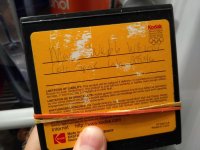
I still have a can or two of 5247 in a freezer somewhere, maybe I should see if there's a market for it... speaking of that, I've got an undeveloped roll of 16mm from Director Mark Webb (500 Days of Summer, Spider Man, etc.) in the back of my fridge... I think his film professor at Colorado College had borrowed my Bolex to give the kids a taste of film shooting and this came back to me after the semester in a box of stock. Of course at the time, "Mark Webb" meant nothing to me or anyone and I just chucked it all in the icebox and forgot about it until very recent. I figure I'll get it back to the professor, or let it continue to chill for another twenty years or so... :)

Mark_Webb_16mm.jpg
 
7247 wasn't introduced until 1974 when Vietnam was already starting to wind down. It's far more likely that a film crew in that era would have been shooting its predecessor, 7254. (The first feature I can remember being shot on 5247, the 35mm version, was "Jaws" in 1975.)

But TV news crews primarily shot reversal films that could be processed and on the air more quickly. 7242 (EI 125, tungsten, used with an 85B filter in daylight) was the most common stock throughout the war years, and really, right up until ENG overtook news film cameras in the later 1970s. It would be tricky to retain quality while incorporating that into a modern workflow, so I'm not sure Lee would have gone that direction even though it would have been more "authentic." It always had a bluish cast and grain like golf balls.

Most (sound) news cameras up until the early '70s were converted Bach Auricons, with a few CP-16s sneaking in toward the end of the war years. Silent footage may have been shot with a B&H Filmo or, more rarely, a Canon Scoopic. The Bolexes and Arris beloved of stateside film students (which I was at the time) were (probably correctly) considered too fragile for war duty.

- Greg
 
I had an old unconverted AC Auricon that I used for interior shoots at one point. Nice quiet blimped sound on film camera. Didn't shoot much mag stripe, mostly double system color neg. Loudest sound from that camera was the clicking of the footage counter. The Bolex was significantly noisier.
Heavy brick of a camera though. Have to hand it to the news guys running around with those on their shoulders.
 
Last edited:
Heavy brick of a camera though. Have to hand it to the news guys running around with those on their shoulders.

Speaking of news time filming, I still have a 35mm Wall camera; a US Signal Corps camera from WW2 and a monster of weight and size compared to any 16mm. Got it my second year in college in 1985 from Martin Hill sight unseen from an ad in American Cinematographer mag. I wanted a Mitchell Standard but couldn't afford one. Thank God it was actually intact and worked... used it through 2002 shooting time-lapse stock footage, multi-pass motion graphics, live action and VFX plates, virtually everything. It was my primary money maker for about 15 years and the best return on investment of ANY gear I've ever owned. A rack over camera by design, I replaced the original lens turret with a single Nikon lens mount and removed all the optical sound recording bits and pieces.

Fully half the original manual was about tweaking the optical sound lamp, and I remember the bit about how to destroy the camera if the enemy is approaching... "Remove the gate/shuttle, insert a grenade and run away."

It was dead solid and had dual pin registration, an interesting moving pin design you can see an example of in this ebay ad for one...

https://www.ebay.com/itm/Vintage-J-...264782?hash=item3b0040000e:g:TsEAAOSwRLZadxMK

Oh, and who was Martin Hill? Here's a video...

https://www.youtube.com/watch?v=k-dfm5k358E
 
Speaking of news time filming, I still have a 35mm Wall camera; a US Signal Corps camera from WW2 and a monster of weight and size compared to any 16mm. Got it my second year in college in 1985 from Martin Hill sight unseen from an ad in American Cinematographer mag. I wanted a Mitchell Standard but couldn't afford one. Thank God it was actually intact and worked... used it through 2002 shooting time-lapse stock footage, multi-pass motion graphics, live action and VFX plates, virtually everything. It was my primary money maker for about 15 years and the best return on investment of ANY gear I've ever owned. A rack over camera by design, I replaced the original lens turret with a single Nikon lens mount and removed all the optical sound recording bits and pieces.

Fully half the original manual was about tweaking the optical sound lamp, and I remember the bit about how to destroy the camera if the enemy is approaching... "Remove the gate/shuttle, insert a grenade and run away."

It was dead solid and had dual pin registration, an interesting moving pin design you can see an example of in this ebay ad for one...

https://www.ebay.com/itm/Vintage-J-...264782?hash=item3b0040000e:g:TsEAAOSwRLZadxMK

Oh, and who was Martin Hill? Here's a video...

https://www.youtube.com/watch?v=k-dfm5k358E

I went to Martins place once or twice with one of my buddies/sound guys who knew him. Interesting fellow. He had a lot of cinematic and movie history there. You really gain an appreciation and almost wonder and awe for movie making back then when you see and are that close and can touch the equipment they used. It’s amazing that they were able to do some of the shots that they did, but also shows you why they didn’t do a lot of the things that are done today.

Too bad that they don’t show you the other stuff, like the lights and tripods and pedestals, in that piece. The giant Moles were kind of crazy to see in-person. My buddy always wanted to get one and make a coffee table.

Unfortunately, I believe everything was sold off after his passing.
 
Speaking of news time filming, I still have a 35mm Wall camera; a US Signal Corps camera from WW2 and a monster of weight and size compared to any 16mm. Got it my second year in college in 1985 from Martin Hill sight unseen from an ad in American Cinematographer mag. I wanted a Mitchell Standard but couldn't afford one. Thank God it was actually intact and worked... used it through 2002 shooting time-lapse stock footage, multi-pass motion graphics, live action and VFX plates, virtually everything. It was my primary money maker for about 15 years and the best return on investment of ANY gear I've ever owned. A rack over camera by design, I replaced the original lens turret with a single Nikon lens mount and removed all the optical sound recording bits and pieces.

Fully half the original manual was about tweaking the optical sound lamp, and I remember the bit about how to destroy the camera if the enemy is approaching... "Remove the gate/shuttle, insert a grenade and run away."

It was dead solid and had dual pin registration, an interesting moving pin design you can see an example of in this ebay ad for one...

https://www.ebay.com/itm/Vintage-J-...264782?hash=item3b0040000e:g:TsEAAOSwRLZadxMK

Oh, and who was Martin Hill? Here's a video...

https://www.youtube.com/watch?v=k-dfm5k358E

Bought my Auricon kit from Martin along with a Tandberg pilot tone sync field recorder to use with the Bolex H16EL's and a Moviola for editing work prints around 1974. Small world!

s-l1000.jpg
 
I bought a Xenon projector from Martin for a theater in NYC.

I believe Martin's estate was purchased outright by the company that now sends me an emaill every few weeks offering up Cinema Antiques as decorative art pieces.
 
Back
Top