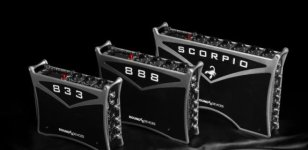
Sound Devices 888

I'd guess they're done with new mixer/recorder releases for a while. Next up will be another control surface (they've talked about that publicly, IIRC). Me, I'm still mainly interested in the 833. But the 888 fits what some people say they want.

8-SERIES.jpg
 
Last edited:
I sent the link to one of my audio guys and he thinks they're just phasing out the 6-series. I haven't done a deep dive into the 888, but giving it a quick once over, earlier, I don't like that it doesn't have at least one 10-pin out. Having had multiple mixers for at least the last 15 years that have them, to feed cameras, it kind of makes you scratch your head and wonder why they wouldn't have at least one, if not two on a mixer in this class(I do understand there's only so much real estate on the body for connections). My 664 has two 10-pin's, plus XLR's and TA3's for AUX/routable out's, as does the 688. You can feed and get return from three cameras at the same time. But maybe that's not as important as it once was to some... Or they want you to buy the Scorpio if you need those capabilities.

They are trying to keep the prices in-range with the existing 6's, though. The 833 is $4K(+$600 vs. 633) and the 888 is $7K(+$1K vs. 688). Although at least one of my dealers has the 633 marked down to $2400(!), which is a great price on a great mixer. We actually use my 633 way more than my 664, which mostly just comes out on multi-cam situations, now.
 
Well the 6-series is pretty old in these high-tech audio-recorders-that-are-largely-specialized-computers days. The 664 was introduced seven years ago. The last unit in that line, the 633, was released about five years ago. (I'm partly and audio guy so I track this stuff).

A couple people who may be in touch with some dealers, or just my be guessing/SSing, said the 688 has been end of lifed. Wouldn't be that suprising. But I could see the 664 and 633 sticking around a bit longer. As you say, no 10-pin out on the 833 and 888 (only on Scorpio). Check out this comparison chart:
https://www.sounddevices.com/8-series-comparison-chart/
 
You can feed and get return from three cameras at the same time. But maybe that's not as important as it once was to some... Or they want you to buy the Scorpio if you need those capabilities.

It may also be a side effect of SD's push toward wireless audio, an area where it's behind Zaxcom AFAIK.

I suspect that it's mainly for market segmentation, maybe SD figures that if you need the 10-pin connectors, you probably also need the higher number of channels.
 
My guess would be that SD figures if you need 10-pin out, you either already have the devices you need, will spring for a Scorpio, or would be satisfied with a 552 (which remains on their product list). https://www.sounddevices.com/product/552/

Or there just aren't enough of you to justify the effort and space to add 10-pin to their mainline products.

Well, the 664 and 688 are both still current, available products, as well. I can't understand why the 552 was never phased out(kinda surprising the 302 is still there, too). I haven't seen one in, well, I honestly don't know. I don't know anyone that even considered buying one new after the 6-series came out. But hey, my 442 is still rigged in its bag in the office on the shelf next to my 664 and 633 bags. Just in-case... One thing I really do miss about the 442, that none of the 6-series have, is the dampened fader dials. Those felt lovely. Just like a properly dampened aperture or focus ring on a lens.

I was so glad that I waited until the 664 came out. My primary mixer was originally the 442. I remember when transcription was becoming more and more in-demand(we were running zooms and the like for transcription then and before that portable cassette recorders. I even had friends that would hook-up home CD burners during sit-downs). And then back-up/iso recordings started to become a thing when you were running more than two channels. I was debating adding and pairing a 7-series with my 442 and then the 552 came out, but it didn't really wow me and I thought it was very limited, even then. I think Zaxcom had already introduced theirs (can't remember if they called it the Nomad originally), as well, but it was more of a recorder that could mix and not a full-on mixer that could also record, like the forthcoming 664. When the 664 was announced, it was exactly what I had been waiting on. A full-on, high-end field mixer with all of the In's & Out's that those of us doing network, broadcast and high-end productions needed, wanted and were used to and that could record quality iso tracks with TC in both mp3 for transcription and WAV for use in post, simultaneously. I pre-ordered it within hours. And I think it still took me until late December or early January to get mine.
 
I still have a 442 (and a 302 and an original MixPre), too. Just in case...work well...still used sometimes. I rented a 644 last year when I needed lots of preamps in a recorder... Wish it had had Dugan Automixing; then it'd have been perfect. But for me, a 633 is fine for most stuff.

But mainly I'm thinking 10-pin is important to fewer and fewer people.
 
Pricing for the 888 is $6995 which as you might expect fits between the $3995 for the 833 and the $8995 for the Scorpio.


There are a few ways to look at the 888:
1) a much more expensive 833, with an extra fader (and an extra XLR input), plus also DANTE
2) a cut priced bargain Scorpio!


My personal take is that I am VERY surprised that Sound Devices announced a recorder in between the 833 and Scorpio! Do I feel bad about making the "wrong" choice? Nope!

Just look at these specs of the 888 vs 833:

1.83kg vs 1.25kg! :-o

That is a 50% difference, I'll take the lighter bag please.
 
The 888 is beyond my requirement. I bought a Mixpre 10T and suddenly I find that within a few months it is upgraded. I don't like changes so fast. However, my 10T will continue to work for the documentaries and corporate projects that I am doing at the moment. Earlier the sound equipment used to work for a long time and there were less updates. These days every now and then there is a new update. It has become difficult to cope up.

I would prefer to buy more top quality microphones which will retain their value for longer duration. A 1000 USD MKH 416 means my corporate clients are happy. It has given way more returns. In comparison the lavalier mics are not so durable as they get pulled and destroyed.
 
The 888 is beyond my requirement. I bought a Mixpre 10T and suddenly I find that within a few months it is upgraded. I don't like changes so fast. However, my 10T will continue to work for the documentaries and corporate projects that I am doing at the moment. Earlier the sound equipment used to work for a long time and there were less updates. These days every now and then there is a new update. It has become difficult to cope up.

Your MixPre10T is just as capable today as it was a couple of months ago.

And what should we do instead? Write to Sound Devices and ask them to stop improving their equipment, and ask them to INCREASE THEIR PRICES??? That's silly.

Plus we've got it much much MUCH better than the camera departmental has it, where clients/directors/producers/competition apply much greater pressure to have the latest and greatest new hot product every year or two.

While there are plenty of full time working pros still rocking an old 664 (which you can pick up for a song today!) or even older 788T recorders without any fuss whatsoever.


I would prefer to buy more top quality microphones which will retain their value for longer duration. A 1000 USD MKH 416 means my corporate clients are happy. It has given way more returns. In comparison the lavalier mics are not so durable as they get pulled and destroyed.

The 416 is a terrible terrible example to give for the line or arguing you're trying to make. The "current" 416 is an ancient design (based on a mic from the 1960's??), and would almost never be a mic I'd recommend buying new today. (and buying secondhand is a big gamble if unknown!)

The 416 is both an example of how many more mics have come after it since then which are an improvement upon it. (but I thought you didn't like updates?)

And also the 416 serves as an example of sound gear can last people a long long time, as if you purchased a 416 back in the 1980's at the start of your career then there is nothing at all wrong with keeping on using it! (demonstrating the other side how updates come out, but our gear can still keep on trucking along)
 
My 416 is there with me for a long time. Don't need to buy it again. I have got the returns many times over. My 702T is still there and will wake up if it is every required. All I was pointing out was that unlike cameras, the audio gear used to have less updates and hence it was easy to recoup the investment and then enjoy the profits for many years. Frequent updates destablise that. Even though I am in filming for passion, people should understand that this is a business as well. I don't buy anything in EMI. If my business can afford it then I will buy it with upfront payment.

Client budgets remain tight. Give them what they deserve based on what they are willing to spend. In many corporate shoots, these days the clients squeeze the audio budget. One needs to be mindful of that.
 
What's an "audio budget"? I have to get tough with clients these days to budget for a sound mixer, much less any kind of sound mix and problem solving or EQ/mastering in post.
Frankly for single camera, single talent interviews, I usually dont need a sound mixer, although it's better to have one. For anything above that, I always tell them they HAVE to
budget for a sound mixer, period. But at times, they want to cheap out and ask me if I can do it. While being the DP. Hate that. And I don't do it, but it's obnoxious that they
always want to cheap out when it makes their end product worse. Have lost a few shoots when they found someone who would OMB it with 2-3 cameras and multiple talent.
Oh well.

That's the problem, there will ALWAYS be someone that will do it, now. And all they see is getting the job NOW, not how much harder they're making it on themselves and the rest of us in the FUTURE(which is actually now).
 
That's the problem, there will ALWAYS be someone that will do it, now. And all they see is getting the job NOW, not how much harder they're making it on themselves and the rest of us in the FUTURE(which is actually now).

You just described the entire LA market, unfortunately. That's a large reason why I am trying to move out of day playing. The best is producing a nice longer term project for a flat fee and building in enough to pay your crew and post a decent wage and to actually end up with some money left over at the end.
Day playing is just a commodity game unfortunately, little to no creativity, finesse, quality and you are almost always at the mercy of someone who doesn't know very much about the finer points of production. We all do these all of the time where everything about the day
is a compromise (always rush, rush, needed it yesterday, under crewed, under budgeted).

I'd like to move away from freelancing and produce more like I used to. Day playing can be fun because it's usually work your ass off, then you are done. Next. As you know, dealing with clients, client teams,
scripts, travel, etc. can be great or a nightmare but if you are smart, you can do fewer of these projects and make more money and have some semblance of creativity and innovation. Seems like the way to go.
I did a couple this year but the goal is to do at least double or triple that in 2020.
 
I'm one of those operators that will take two camera shoots plus audio for single talent interviews. For me, it is more about set-up time than actual work load. Besides cam op/DP, I will also work solely as a location sound mixer so I have a full sound package available. When I am doing OMB, though, I just stick a Mix-Pre d on an articulating arm on my tripod, run a single boom mic on a stand to it, and send the output to both cameras. Nice big level LED's and a fantastic limiter. It is just an extra five minutes and pretty much a set it and forget it job. What is odd to me is that Sound Devices has EOL'd their two output mixers. I wouldn't want to handle audio without the mixpre available.
 
Back
Top