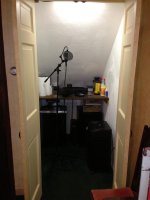
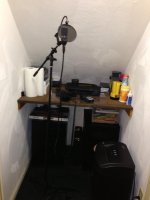
sound booth question...

Looks cozy :)

Before I spent any money, I would probably make a quick experiment where I looked through the home for absorbing material (like matresses, duvets, pillows, moving blankets etc), put it on the walls and just see what that does for you - if nothing else it'll be a good reference point.

Although I have very little actual experience of acoustical treatment of spaces, I have used a vocal booth briefly and was quite impressed (the portability is nice too). I would venture a guess and say that a vocal booth and maybe some experimenting with different common materials on the walls and maybe floor should get you the level of dryness that your looking for.

Hopefully someone will respond that have actually tried both of these and can give more info. Good luck!
 
I would think you would want the door closed during recording and that small space may heat up quickly!
 
Yes, it should be fine but "foam it up," cut those corners with something, maybe get a reflection filter, because otherwise those hard surfaces and parallel walls will be giving you trouble...

GJ
 
Foam panels will do wonders, in conjunction with the first item you mention. it wil get hot in there quick.

good luck
 
You can use egg crate foam for this kind of thing, it's readily available and pretty cheap. But foam doesn't absorb sound it disperses it. A better solution for a vocal booth for VO work is to pt up some packing blankets first. They will actually absorb sound and cut down on the bounce. When we built the Foley stage we lind the walls with packing blankets and put egg crate foam over that. Don't cover all the walls, or be able to peal up some of it, unless you want an extremely dead space.

I would probably do one side wall, the door and put a rug down and see how that works. If you want it deader I would do the other side wall. I don't think your going to want to do the ceiling.
 
AUralex is not typical egg crate foam and will actually absorb it is what is known as 'open cell' foam as opposed to packing foam or mattress foam which is 'closed cell' and will not absorb. Auralex is the best fix for your solution, you can also learn a lot from their web site which explains some acoustical principles and simplifies them some what.
 
The egg crate foam is also open cell. Sound passes through open cell foam and will bounce off what is behind it and back out. Because of the convoluted route it is dispersed and it may be diminished a bit but nothing like an actual sound absorber. This is why treated rooms have a mix of materials applied to them depending on what you are trying to achieve. Some are absorbers and some are dispersers. In a listening environment you are mostly trying to disperse and eliminate reflections and standing waves. In a vocal booth/ Foley stage you are generally trying to create very dead spaces that have no reflections.

In a listening environment you don't want it too dead, you want it with lots of dispersant and you want to tune the room so it doesn't emphasize parts of the spectrum. If you are creating a really dead space this isn't much of an issue since you are going to get very little reflecting off the surfaces so dispersment is less and less an issue the deader you go. For totally dead VO booths it's not unusual to have cloth covered "parallel" walls, except the "walls" are actually a number of inches of fiberglass insulation. It doesn't matter that they are "parallel" because they are almost totally non-reflective.
 
Back
Top