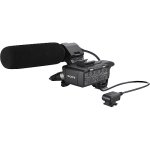
Sony's FDR-AX100 4K Handycam ships in March for $2,000 (hands-on)

This is off topic but Panasonic must be in some financial trouble compared to Sony as it seems Sony is just pumping out the cameras while we have hardly anything from Panasonic.

Anyway, back to the 4k...
 
Just completely out of curiousity, how would this camera compare to the Sony F900?

I understand they are two completely different classes of cameras. One being HD and the other 4K. But I've been watching some older content shot on the F900 (Stargate Atlantis seasons 1-3) and I have to admit the picture is great. I'm just curious if a modern much less expensive camera like this one stacks up in terms of image quality when downsampled to 1080p.
 
While the AX1 could shoot in UHD resolution at 60p, the smaller AX100 is limited to 30p and 24p. In part, that's likely due to the tight thermal envelope of the diminutive AX100 body. A big camcorder like the AX1 can afford to run a little hot since it has the surface area for a larger active cooling system. But you wouldn't want prominent vents or fans on a user-friendly, compact camcorder like the AX100.[Ed. note: The pros out there will want to know about the AX100's chroma subsampling capabilities, but unfortunately Sony hasn't made that information public quite yet.]
Sony has worked on making sure that even if you capture footage in 4K, you can share it on your current-generation equipment. The AX100 downscales in-camera to make your 4K footage playable on a standard full-HD television over HDMI.

If you're an early adopter, this is the 4K camcorder to buy. Not only is it the only game in town, it's also reasonably priced and fully featured.
If you're in the content creation business, or even if you're just a hobbyist who wants the latest and greatest, the AX100 is an extremely enticing package. The combination of a 1-inch sensor with an accommodating aperture, native 4K UHD in 30 and 24p, and good-enough manual controls will definitely appeal to the amateur filmmaker crowd. If you're not interested in a more complicated solution like a Blackmagic 4K Cinema Camera, the AX100 is a fixed-lens alternative you can tote without rigging, lenses, or any of those accompanying accoutrements.
http://camcorders.reviewed.com/content/sony-handycam-ax100-first-impressions-review

evf.jpg
 
Last edited:
Man... they're really pushing 4k now. If it doesn't take, a lot of plans gone out the window.

Why wouldn't it take? Technology moves forward what ever we do… and if 4K doesn't take it will be because someone invents holographic tv instead or something similar.

Manufacturers will just make the old hardware obsolete with new codecs / way of delivery and so on and so on.
 
Man... they're really pushing 4k now. If it doesn't take, a lot of plans gone out the window.

Yeah because most people have the 48" - 55" LCD's now…..

It is always a constant push in consumer electronics to get you to upgrade, how else will they make money?

I still have clients using 12" 4/3 sets with DVD players to deliver corporate training programs….LOL
I have shown them the wonders of the new fangled internet with 1080p delivery and
the managers say bah humbug!
 
Why wouldn't it take? Technology moves forward what ever we do… and if 4K doesn't take it will be because someone invents holographic tv instead or something similar.

Manufacturers will just make the old hardware obsolete with new codecs / way of delivery and so on and so on.

Yes, holographic TV is something I have dreamed of since i was 8 years old….
Real 3D TV.
 
Why wouldn't it take? Technology moves forward what ever we do… and if 4K doesn't take it will be because someone invents holographic tv instead or something similar.

Manufacturers will just make the old hardware obsolete with new codecs / way of delivery and so on and so on.

It'll take, but my point is that they want it to take faster than it will. If you go up to the average person and say 4K, they will look at you cross eyed. I know, because I've done it 10 times.To people who just don't follow these things, and are just now getting decent HD channels 4K is not an easy sell. You have to step outside the world we inhabit to get in the mind of the average consumer.
 
It'll take, but my point is that they want it to take faster than it will. If you go up to the average person and say 4K, they will look at you cross eyed. I know, because I've done it 10 times.To people who just don't follow these things, and are just now getting decent HD channels 4K is not an easy sell. You have to step outside the world we inhabit to get in the mind of the average consumer.

I have.

I went to the HH Gregg store last week and looked at the 4k displays. They are stunning.

The sales guy said they are selling at a good clip.

4k will be adopted en masse when the content is there.

But a bunch of consumers aren't waiting, and the content providers will see the sales of these sets as an incentive to push the 4k content out there.
 
Why wouldn't it take? Technology moves forward what ever we do… and if 4K doesn't take it will be because someone invents holographic tv instead or something similar.

Manufacturers will just make the old hardware obsolete with new codecs / way of delivery and so on and so on.

But the question to me is how fast will 4k take? Of course, TV manufacturers can just make all tvs
4k and not sell any HD anymore. They can drop prices to former HD screen prices. So, if a TV set
is bought, it will be 4k. The big question in my mind is, will this happen fast enough for manufacturers?
When my current TV stops working, if there is a 4k set out there in my price range, I'll probably buy it.
On the other hand, as long as my current 1080p HD set works, I will not be buying any 4k TV set.
What 4k manufacturers want to do, is convince people that their current HD set is no longer 'good enough'
and so they need to buy a 4k TV. In the current economy, that remains a tough sell. Those with
disposable incomes, or those replacing a TV set will probably jump on board early. But what will the
majority of consumers who still have a working 1080p HD set do? That is the $20,000 question.
Can manufacturers convince them to jump over to 4k?

Exactly, great points.
 
I have.

I went to the HH Gregg store last week and looked at the 4k displays. They are stunning.

The sales guy said they are selling at a good clip.

4k will be adopted en masse when the content is there.

But a bunch of consumers aren't waiting, and the content providers will see the sales of these sets as an incentive to push the 4k content out there.

Guess as with most things, it depends on your market/area. I talked to the only 2 stores which
offer 4k tv sets in my area. To say 4k sets are not doing well here would be a understatement
according to them. And this is one of the more 'well off' towns in my state.
 
But the question to me is how fast will 4k take? Of course, TV manufacturers can just make all tvs
4k and not sell any HD anymore. They can drop prices to former HD screen prices. So, if a TV set
is bought, it will be 4k. The big question in my mind is, will this happen fast enough for manufacturers?
When my current TV stops working, if there is a 4k set out there in my price range, I'll probably buy it.
On the other hand, as long as my current 1080p HD set works, I will not be buying any 4k TV set.
What 4k manufacturers want to do, is convince people that their current HD set is no longer 'good enough'
and so they need to buy a 4k TV. In the current economy, that remains a tough sell. Those with
disposable incomes, or those replacing a TV set will probably jump on board early. But what will the
majority of consumers who still have a working 1080p HD set do? That is the $20,000 question.
Can manufacturers convince them to jump over to 4k?

I think it will take 4-7 years for 4k to have the right combination of mindshare, content availability and price point to transition into the mainstream. It also won't hurt that manufacturers still phase out HD cameras and TV sets the same way they phased out SD.


-Andrew
 
But the question to me is how fast will 4k take? Of course, TV manufacturers can just make all tvs 4k and not sell any HD anymore. They can drop prices to former HD screen prices. So, if a TV set is bought, it will be 4k. The big question in my mind is, will this happen fast enough for manufacturers? When my current TV stops working, if there is a 4k set out there in my price range, I'll probably buy it.

............But what will the majority of consumers who still have a working 1080p HD set do? That is the $20,000 question. Can manufacturers convince them to jump over to 4k?
I agree with the general points you're making, but look at it this way.

For any manufacturer, steep peaks and troughs in demand are bad news. Production facilities work best with steady throughput. They rely on a certain percentage buying a new TV every week, would no doubt like to increase the figure a bit, but to avoid a boom then the last thing they want is for too many people to decide "I'm getting that now!"

So whilst they want to up sales (their sales) it's in their interests for it to happen in a steady manner - not for everybody to turn up at the store tomorrow demanding the latest and greatest. That's not least because even if they could service it, it's likely to be followed by a sales slump as everybody has now just bought a TV!

And before any technology becomes mainstream, it's an opportunity for manufacturers to charge a decent premium, which early adopters will pay even if Joe Public won't.

The interesting thing is that 4K is taking off at the ends of the spectrum first, with the mainstream (such as broadcasters) likely to be following well behind. That's similar to what happened with HD. By that I mean it's the high budget productions on the one hand, the low end consumer on the other. That shouldn't be a surprise. For high budget productions, it's likely to mean a small cost increase percentage wise, but give an element of future proofing, for personal use then once you've bought a camera and TV, that's it. Plug in and go.

But for the likes of mainstream broadcasters it's far more difficult, both in terms of a complete technology upgrade and transmission infrastructure, let alone the question of 4K transmission standards. But for the broadcasters, once people get used to their own Handycam footage being 4K, aren't they likely to ask why broadcast transmissions aren't such? I don't think it's any accident that for 4K we're seeing equipment to match - Red and the F5/55 at the one end, and now this camera at the other - whilst cameras between those price brackets remain in basic HD formats.
 
Last edited:
I still have clients who are perfectly fine with SD delivery for corporate training, etc. Anything internal is typically looked at as something that will not generate income, hence, keep costs as absolutely low as possible. However, once you start looking at external projects then we are talking about something that is designed to generate revenue. At that point it becomes more important to look and sound more professional.

It will be interesting to see how long it takes for 4K to become an "expected" delivery format. My guess is that, in the corporate world anyway, it will be some time before they understand the benefits of "Ultra" HD.
 
I wish for once sound would not be sony and take that little extra step with the bitrate.

4 times the pixels, with just 2 times the bitrate. really what is there to protect in their higher lines? everything above it is entirely different, from sensor to lens to body, etc...

come on sony, 96mbps, it's not even asking for more, it's asking to par the course.
 
Back
Top