Sony Wireless Lav - Pilot Tone??

xtianseel

New member
Hi all. I have a post-sound possible issue. I'm not a sound person, but a DP who gets stuck doing audio on low-budget projects.

I recently got a sony wireless lav UWP-D11 and a countryman B3 mic. After a few weeks, I started noticing a very high frequency tone coming through the on the spectral graph (image below). I looked up the product manual and it said the transmitter emits a pilot tone at exactly the frequency I'm seeing - approx. 32KHz. Just now, I tested it again and I'm now seeing 2 high frequency tones, 32KHz and around 40KHz.

My question is, is this a hardware malfunction or is it normal? Either way, why was there no tone at all, then 1 tone and now 2 tones? The frequencies are much above the range of the human ear, so there's no practical issue with the resulting tracks. I can manually take it out in post. Still, I can't help but think these tones should not be showing up in the recorded .wav files.

Sony UWP-D11 Wireless pack
Countryman B3 Lav (also happens with the included sony lav)
Zoom H5 recorder, 96KHz, 24-bit
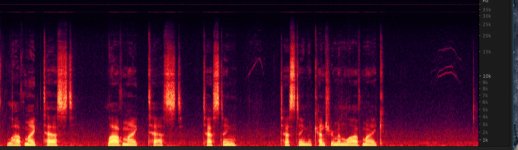
pilot tone q-1.jpg
 
I presume you are recording at 96k ?

Why ??? as video tends to be standardised on 24 bit 48k and that will give a useable audio frequency bandwidth up to around 24khz so anything above that will be filtered out.

The human ear only goes to around 16khz so anything at 32khz or 40khz will only be a problem for your pet Dog or Bats! :love4:
 
I'm with Gary on this. Women and young kids can sometimes hear close to 20kHz, but most adults don't go over 16kHz and many adult men drop off closer to 10kHz.

If you send me 96k dialog the first thing I'm going to do is downsample it to 48k and charge you for the time.

So while you could filter it in post if you just use the sample rate you should be using and the recorder will do it for you.

It's all the rage now to record SFX at 96k, and that is often a waste but dialog is just silly unless you are planing to pitch it all down by 50%. And BTW that is the reason for FX at 96k. Pitching down FX is actually fairly common so it makes some sense.

As to it being a design flaw. I doubt that they would agree.
The transmitters frequency response is listed as 40 Hz to 18 kHz and the lav is listed as 20Hz - 20kHz. Given that why would they care about a sound that is over double what they are spec'd to deliver and about twice what your mic can "hear". Or the better question is why anybody would be recording up there? And this is the counter argument for 96k in FX. Basically all you are recording up there is electronic noise since the devices feeding the recorder are generally not reproducing and "real" sound up there since it is way past their spec.
 
Yeah, I gotta pile-on. There is ZERO practical benefit from recording dialog at 96K, and you have revealed a very good reason to NOT do that.

Many of these questions remind me of the old vaudeville exchange:
Patient: "Doctor, it hurts when I do this!"
Doctor: "Well, then don't do that!"

https://youtu.be/ri3aL8At44I?t=1m24s
 
I suppose it's like recording 4k video on your i-fone and then wondering why the 3mm sized lens is not up to the job when you view it on a cinema screen.
 
Now we probably should give the guy a bit of a break. He asked the question and said he is not a sound guy and hasn't argued for 96k.

OP, the take away is that 96k is not a good choice. In this case more is not more. If someone told you it was a good choice be skeptical of other things they told you, if you just figured more would be better then suprise ;~).

It makes post peoples lives difficult and there has been a wave of "we can so we should" by new filmmakers, So you got a fairly strong reaction.

BTW the human voice doesn't make sounds that high either so there is just no practical advantage to recording dialog at 96k.

As a short primer, the major benefit of higher sample rates is the ability to record higher sounds. For technical reasons the highest frequency you can accurately record is about 1/2 the sample rate, so 96k can record up to about 48K. There is a lot of argument wether the high harmonics of some very bright sounds that would live up there (think the shimmer of a cymbal) actually contribute in some way by the ear. So some music folks have been pushing for 96k and FX recordists who are recording things that may be slowed down have been moving to 96k because the slow down sounds smoother if you start with higher sample rates. The later is the only practical reason to record at 96k IMHO.

For you the other practical benefit of 48k is not recording junk you may want to later clean out.
 
How many microphones can really record above 24khz? I'm not aware of any in the industry, but I may not be looking in all the right places. Most high end stuff tops out at 20khz and that is normally already after a pretty good slope.
 
Well the "standard" is that the range is defined by the point where there is a 3dB drop, so if it says 20K as the high end you should only be down 3dB at 20k. But a lot of mics don't list 20K as the top and there is really not a lot of point to getting there for most applications.
 
Back
Top