Sony A7-II: XAVC-S, slog-2, and now... IBIS

No, you don't expose as if it was ISO 100, but the camera treats its electronics as if it was ISO 100*.

Say you are going to take a RAW still in a very demanding scenario in terms of latitude, say something like this but with somewhat darker shadows in the top right corner. You will take it at ISO 100 because that's the best option for the camera, and you will use a standard picture profile (say, Neutral).
You put your light meter by the guy's face and expose according to that, and take a still. The highlights are be badly clipped, and you don't want that. You have to underexpose. You add 3 stops of ND and take another still; now your highlights are nice and clean, but the guy is underexposed and the top-right corner is basically black.
Now you go to your computer with the RAW file, and start to play with it. You expand the range by bringing up the mids and the shadows, and now everything looks fine. Save those settings as a picture profile and load them into the camera, call that "MySlog2". But when you use it, you have to remember that you have to underexpose by 3 stops.
You took that still at ISO 100 but you exposed for ISO 800. You can "rename" that ISO 100 into ISO 800, so the camera still shoots with all the electronics set at ISO 100, but it reminds you that you have to expose for ISO 800 (i.e. you have to underexpose by 3 stops).

* As you see, the argument doesn't go all the way to ISO 3200, but it gets you more than halfway there. Maybe it sets the electronics to ISO 400, but no higher than that.
 
No, you don't expose as if it was ISO 100, but the camera treats its electronics as if it was ISO 100*.
See, that is kind of my issue with that description of Log. If it is giving a different exposure at the end of the day, then why call it by something less predictable and not fully explained?

Of course, my assumptions are best guesses, but this is how I see it...

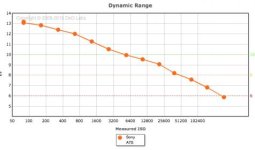
Most people are claiming that iso3200 in slog2 is still insanely bright, and needs to stopped down. So, I am fairly certain it is not anywhere near the base iso of the raw (iso80?) which puts it closer to what the raw would be at iso 1600. However, but iso1600, the dynamic range is reduced to less than 11stops DR, which would be a more manageable range for 8bit slog2.

Screen Shot 2014-12-03 at 1.57.50 AM.jpg
http://www.dxomark.com/Cameras/Sony/A7S---Measurements
 
Two reasons to think it's setting the electronics to ISO 400 or less:
* slog2 on the a7s gives you nearly 3 stops more headroom in the highlights than "Neutral dialed down" in the 5D3
* I measured 11.7 stops of usable DR, so ISO 1600 or 3200 it definitely isn't (in terms of that dxomark RAW stills test)

In any case, what matters here is the amount of DR that you actually get (nearly as much as with a pocket shooting RAW), and how much light you actually need (I usually expose it as if it was ISO 1600, which means I had to buy a new set of ND filters).
Ok, I would be very curious to know where the s-log exposure ends up after grading. Although, I saw you wrote in another post that you do not like using S-log.
 
Since I overexpose by one stop (i.e. I set ISO 3200 but expose for ISO 1600), mid grey falls at 48% IRE. Then, after grading... well, wherever you want to put it, that's the point of grading!

I always use slog2.
Sgamut is the one I don't like: it looks awful, and it has color instability issues (nonlinearities: skin tone changes when you change exposure, goes from green to magenta) (this is not an issue if you use the correct LUT-based workflow, but I don't like standard LUTs).
 
Then, after grading... well, wherever you want to put it, that's the point of grading!
I do not agree with that. Yes, there is a certain amount of latitude, but since there is a defined shadow detail threshold and a defined highlights detail threshold, there is a basic exposure equivalent. How that range at iso3200 compares to other picture styles is important.

I always use slog2.
Sgamut is the one I don't like:
My apologies. That must have been what I read.

...but I don't like standard LUTs).
Agreed, for the most part.

But at the end of the day, we are dealing with 8bits of compressed HD, and there is still an optimal exposure range for log. So, if I am metering and lighting, I would hope that my iso setting doesn't need to be translated too much.
 
Last edited:
I just set my lightmeter to ISO 1600 instead of 3200 and follow what it tells me. Then in the PC I push and pull whatever needs to be pushed and pulled, and it usually works fine. I only need to apply NR in situations where other cameras would have required a lot of NR too (or just wouldn't have worked).
 
I just set my lightmeter to ISO 1600 instead of 3200 and follow what it tells me. Then in the PC I push and pull whatever needs to be pushed and pulled, and it usually works fine. I only need to apply NR in situations where other cameras would have required a lot of NR too (or just wouldn't have worked).
Thanks. That helps.
 
Ah, but you can - at least in theory. The way forward would be for a sensor to have EXACTLY 4x the dimensions of the 1080 frame on each axis.

In other words, 4x1920 horizontally, and 4x1080 vertically. Do the maths, and you get 33,177,600 photosites. Allow for photosites around the edges and you're close to 36Mpix. I'd also expect a still/video sensor to have an aspect ratio of 3:2 (for stills) which gets cropped to 16:9 for video, which would mean a corresponding increase over the 33.2Mp to allow for that.

Reasoning is that you read in blocks of 4x4 - which gives 1920x1080 blocks. And with 4 red, 4 blue, and 8 green photosites per block, the reading process simply bins all the charges of corresponding colours together to give three values per block for R,G,B. So you get a 1080 frame directly with no need for "downconversion" as generally understood. It's comparable to the way the C300 gets it's output, but in that case we're talking about 2x2 blocks, here it's 4x4 - but the same principle. And with such a chip, do exactly as the C300 does (use 2x2 blocks) and you get 4k directly.

As far as lowlight performance goes, then the binning process should mean it's at no disadvantage here. Binning the electric charge from 4 small photosites should give the same results as from a single photosite of 4x the area.

Things are not so simple in digital world. The process you described is a rectangular filter followed by x4 decimation - it has very poor properties, in particular poor stopband rejection and ripple. You would get quite significant residual aliasing (assuming the optical LPF is tuned for original sensor resolution, which surely would be the case here) and other more subtle artifacts. The proper way of doing it is to either use much stronger OLPF tuned for video resolution or to get all the photobins data (unbinned) and apply proper digital antialiasing filter prior to decimation, which needs much longer kernel (meaning it needs to be performed over much wider sensor area - more photobins - than just 4x4) and needs to be properly windowed (the weight applied to the photobins located further from the output pixel need to be smaller and follow certain formula, such as Hann, Hamming or other typical window functions).
 
Things are not so simple in digital world. ........... The proper way of doing it is to either use much stronger OLPF tuned for video resolution or to get all the photobins data (unbinned) and apply proper digital antialiasing filter prior to decimation, which needs ......
I don't disagree with that, but it becomes a question of practicalities - physically reading the sensor fast enough if all photosites have to be read, and the huge amount of processing needed for a proper deBayer.

What I referred to may have some drawbacks - but OVERALL I'd suggest the result will still be pretty good, and with the necessity for relatively simple processing if such a binning technique is used. And assuming the dimensions have the geometric relationship to the output resolution required. (4x) It's worth just thinking of the C300, which is effectively taking just that approach but with a 2x relationship to 1920x1080 - and the measured 1080 results are pretty good.

In terms of a "universal" sensor (little compromise for stills or video) it's main drawback may be that the photosite count (at around 8-9Mpx) is low for high quality stills. Increase it by (say) 2-3x, and the designer is faced with either line-skipping (typical of 12-16 Mpx designs until recently), or a far more complex read/process task. And in a camera where stills may be the primary task, having such for video may add unacceptably to the cost.

In terms of aliasing, then yes - an OLPF tuned for 1080 resolution may be beneficial for video - but obviously not for normal stills. But if each output pixel is derived from 16 photosites, then for finer detail there will be an element of self cancellation within each block. In principle, a fine line structure may mean half the green photosites giving full output within a 4x4 block, (white lines), the other half giving none (black lines). Result - a mid grey from each block - as it should be.
 
That new IBIS firmware... does it work fine for video now?

I haven't done a lot of testing yet, but there are YouTube videos that purport to show the "before & after" difference with the firmware for video. Yes, improvement has apparently been made across the board.

They also fixed the bug that was occasionally turning off IBIS for 3rd party lenses. IBIS now seems to be working as expected at all times.
 
Back
Top