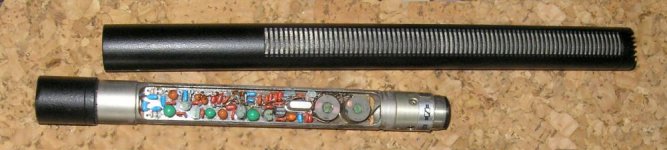
So, where is the capsule in a shotgun mic, anyway?

davefisk

DVXuser Sponsor
A while back there was a discussion (I can't seem to find it) about where the mic capsule is actually located inside a Sennheiser 416. Some people seemed to think the capsule was actually located halfway up the interference tube. I asked one of my friends at Sennheiser, and he said this:

"The capsule is just behind the interference tube slots. towards the bottom of the mic. "

I just wanted to post a follow up to clear away any confusion.


Yep, most shottie's have the capsule located in the forward tube, but behind the slotting. I have seen a couple that had the capsule on the "guts" section of the mike.

But if anyone is considering on looking where it is located, be warned: Capsules are extremely delicate things. Unless you have experience handling them, don't. Same with tearing apart a decent shottie. Otherwise, guys like me will offer you 20 bucks for a "broken mic" and fix it.
 
A while back there was a discussion (I can't seem to find it) about where the mic capsule is actually located inside a Sennheiser 416. Some people seemed to think the capsule was actually located halfway up the interference tube. I asked one of my friends at Sennheiser, and he said this:

"The capsule is just behind the interference tube slots. towards the bottom of the mic. "

I just wanted to post a follow up to clear away any confusion.


Sorry, this is just wrong - whoever you spoke to at Sennheiser is making an assumption and clearly does not know the MKH 416 very well. Was he a salesman?

If he said this, it is obvious he has never been into service department and seen one taken apart.

In the 416 the capsule is about half way along the slots - the ones at the back are just cosmetic.

It is very clear if you hold it up to the light and as you can also see from the picture below where the internals have been removed from the tube and laid beside it.

You can see, very clearly, that the capsule is half way along the slots.

MKH 416 insides.jpg

(Clicking on the picture brings up a larger version)

The mic. would have looked funny with shorter slots and a long back end, so Sennheiser just extended the slots to make it look better.

THIS is the correct answer - so please ignore all other uninformed answers.


I think you should talk to your friend at Sennheiser and give him the correct information - he should have spoken to Uwe Sattler first, before giving you duff information. Oh, and I have let Uwe know someone at Sennheiser USA is giving out duff info. so it should not happen again.
 
Last edited:
I talked with a product specialist at Sennheiser. I would hope he knows what he is talking about.

I'm sorry, he doesn't know what he is talking about if he really told you that the capsule is at the bottom of the interference tube slots.

It is, very clearly, in the middle.

Yes, the capsules of the MKH 60 and MKH 8060 are down near the bottom of the slots - there is one slot missing near the bottom of these microphones where the capsule is - but on the 416 it is definitely in the middle of the slots as the picture I posted clearly shows.

Uwe Sattler is the Technical Director of Sennheiser USA and I have let him know that someone there has been giving out duff info.

If you look at my profile you will see that I do know what I am talking about.

I'm sorry that your friend has embarrassed you by giving you clearly incorrect information.
 
Last edited:
Ahem, maybe the capsule IS at the last slot, as the other half of those are not slots but just decorational dents/depressions (for better grip, maybe?)?

So everybody is right, yes?
 
Ahem, maybe the capsule IS at the last slot, as the other half of those are not slots but just decorational dents/depressions (for better grip, maybe?)?

So everybody is right, yes?

Sorry - no - everybody is not correct. Your post is just confusing things.

The picture clearly shows that the slots go all the way down and the lower ones are not "decorational dents/depressions". They are real slots, just not part of the interference tube.

It's just a shame that someone at Sennheiser USA, who should know better, has given David incorrect information.

OK. I just called two different very knowledgeable people on this. One is the service tech at Coffey Sound, and the other is one of the top service tech guys at Sennheiser USA. Both of them confirmed what John has posted. I apologize for the confusion, and quite honestly, feel a little embarrassed.
 
The OP however asked about shotguns in general. The answer is it varies though most, I have read are about 1/2 way down the interference tube. That lead me, quite possible incorrectly, to assume the rear slots had some functionality. The Sanken shotgun on the other hand has the main capsule at the front of the mic and has other capsules farther back in the mic body. It uses some mix of the signals to generate the pattern. This is supposedly why it doesn't have much of the "indoor problem" other shotguns do.

I think my old ME80 had the capsule near the bottom of the slots. It's in a box someplace or I would check.
 
I pulled up the pic on the 416 too, and yes, John is right (on the 416). Other shotgun mics, though, have many different capsule locations. I still stand by what I said, the ME-80 is just forward of the end of the slotting (have it in my hands right now), and I have another Senn, that the capsule is just behind the interference slots.

So, by saying everyone is wrong, is not right. Maybe on the 416......but not on every shottie out there. A little tact would have went a long way here.

Noiz2, you are not incorrect, the openings to the rear of the capsule assist in patterning of the capsule and off-axis rejection. To accurately describe the action of how this works is a pain.
 
Last edited:
OK. I just called two different very knowledgeable people on this. One is the service tech at Coffey Sound, and the other is one of the top service tech guys at Sennheiser USA. Both of them confirmed what John has posted. I apologize for the confusion, and quite honestly, feel a little embarrassed.

Thank you David.

I'm just sorry that the person you first spoke to did not have the knowledge to answer your question properly and just guessed the answer, rather than finding out the truth.
 
The OP however asked about shotguns in general.


Well, Kinda. I started the thread with a vague title, and specifically mentioned the 416 in my first post, which John has since corrected me on.

If nothing else, I hope we maybe all learned something here.
 
The OP however asked about shotguns in general. The answer is it varies though most, I have read are about 1/2 way down the interference tube. That lead me, quite possible incorrectly, to assume the rear slots had some functionality. The Sanken shotgun on the other hand has the main capsule at the front of the mic and has other capsules farther back in the mic body. It uses some mix of the signals to generate the pattern. This is supposedly why it doesn't have much of the "indoor problem" other shotguns do.

I think my old ME80 had the capsule near the bottom of the slots. It's in a box someplace or I would check.

The OP actually specifically mentioned the 416 - which has the capsule as I said.

For others - it depends on the mic. where the capsule actually is. Many are down near the bottom - but as the raw capsule is normally a super-cardioid there will be some rear entry slots.

The NTG-3 will be positioned the same as the 416.

The Sanken is a special case.

The old ME 80 is also a special case as the raw capsule in that is actually omni-directional and there are no rear entry slots at all so all the slots are in front of the capsule.


I pulled up the pic on the 416 too, and yes, John is right (on the 416). Other shotgun mics, though, have many different capsule locations. I still stand by what I said, the ME-80 is just forward of the end of the slotting (have it in my hands right now), and I have another Senn, that the capsule is just behind the interference slots.

Yes, as I said above. But the ME 80 does have all the slots in front of the diaphragm as it's an omni mic. with all the directivity being done by the interference tube.


So, by saying everyone is wrong, is not right. Maybe on the 416......but not on every shottie out there. A little tact would have went a long way here.

That comment was totally about the MKH 416, which is what this thread was all about - it did not apply to other gun mics.. The text in the original post was only talking about the 416 and not about other microphones at all. I am sorry for Dave, who was really dropped in it by incorrect information he was given by someone at Sennheiser USA, so it wasn't personal.


Noiz2, you are not incorrect, the openings to the rear of the capsule assist in patterning of the capsule and off-axis rejection. To accurately describe the action of how this works is a pain.

Correct.
 
Well, Kinda. I started the thread with a vague title, and specifically mentioned the 416 in my first post, which John has since corrected me on.

If nothing else, I hope we maybe all learned something here.

Ah you are correct I read the posts but then responded to the title. sorry
 
If we're going to get ultra pedantic about it, could I propose we just settle the argument very simply. John's photograph (ignoring his Sennheiser pedigree) shows where the microphone element is in the housing. What everyone is getting very hot over is the description of half way down the interference tube.

The interference tube - the description of which refers in the definition to side slots in front of the microphone - is in the photograph, about 1/2 of the slotted section of the tube. The slots behind the element are slots. The physics prevents these as being part of the interference tube.

We're arguing about description. There's no need to contact further people or any such activity. Evidence wise, John's picture is primary evidence of the facts - everything else includes reference to other evidence, and therefore pointless.

It's cosmetics, that's all. In fact, if you consider the small microphones on the side of cameras since the 70's - the design is very similar, tube wise, just a bit shorter. Mics with separate pre-amp and elements have very little in the attachable section, and although I've not seen any documentation, this also explains the difference in pick-up pattern between the 416 and the popular 66 - which has an effective interference tube a bit longer.

John and I have disagreed on audio issues over the years, but I'd have to say I've never ever been able to shake his technical expertise - especially on things Sennheiser. Behind his back, over here he still is Mr Sennheiser. While many of us have experience of a range of their kit, John has probably used every single product they produced at some point - and that is something none of us can say we have done.
 
Back
Top