Silhouette Technique

nycineaste

Well-known member
Ive noticed a technique used alot in Steven Soderberg's work (especially the stuff he DPs himself), where the camera is exposed to lights in the background, and the foreground is allowed to underexpose/and go into silhouette. It's clearly a naturalistic technique evolved from using available light. If one were to try to replicate this with a camera like the DVX100A, what would be the snags? I was imagining putting low wattage lights into the lamps so they don't blow out, then filling from the front, but that would probably not use the full DR of the camera right?

Just thinking out loud I do plan to test it out...
 

Attachments

  • magic mike.jpg
    magic mike.jpg
    39.9 KB · Views: 0
Part of lighting is about balancing light levels around the exposure.

The exposure is set on the lens and then its a matter of adjusting the light levels to achieve the balance so that the tones display as you wish to see them and at what point on the scale. (the grey scale)

The image can represent the full range of a grey scale (Black to White) or can be compressed into the gamma (open shadows / under exposed highlights) or can favour either end of the scale. Lots of scope within all of these.

Many ways to establish an exposure but you start with one value read from part of your scene and you nominate where you wish to place that in the grey scale.

Reading that initial value depends on what it is. ( Spot , incident or reflected, wfm)

Initial value could come from reading:

the key light on the actors face.
the highlights of a practical lamp
the mid tone from a wall
the white from a wall
the shadows or a black object
....

A silhouette will be an image "balanced" with a considerably brighter BG than the FG.

True silhouette probably has very minimal information in the gammas to shadow levels

Exposure is a like a "sliding window" on the levels in a scene

or vice versa...

Levels is a like a "sliding window" on the exposure of a scene

Exposure is the lens setting / Levels is the lighting
 
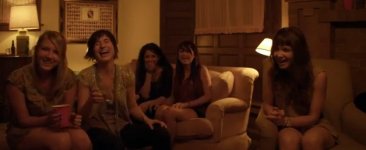
Shooter puts it excellently... in your particular shot I would say it's generally flat lit, but still utilizes a wide dynamic range as it does have localized areas of contrast; the almost burned out lamp, dark pants, dark hair etc. But the general feel is flat and maybe 1/2 - 3/4 stop under exposed? (someone correct me here... I guess it would have been pulled down in post)

Wouldn't space lights give this sort of evenly lit feel? Then again.. if you look at the laughing girl and the way light falls on her you can see there is a single light somewhere up and to her right (from our pov).
It also looks like he chose to use a more powerful lamp in the light to the right, perhaps to give a little more shape to the couch which otherwise would have been a fairly large creamy blob, and the light also adds a little edge to the girl nearest it, seperating her slightly from the background.

The panel lighting in the background.... is that really from a practical? The angle of the camera tells me that it would have to be situated more or less behind that laughing girl and there is a small white thingy going on there, but could a practical really give off this much shine in a scene lit like this?
 
Back
Top