Shoulder mount walking height

So in movies and such there are often shoulder mounted walking shots tracking the subject(s). Commonly, the cameraman's height is around the height of the subject, say a male lead actor.

My question is, what is the typical procedure for achieving the shoulder mounted walking look but with subjects that are different heights than the cameraman, yet, maintaining an eye level eyeline?

A common case would be a six foot cameraman tracking a five foot subject, but I'm also wondering about more extreme differences such as a six foot cameraman tracking a three foot child.

Sure there are things like the Easy Rig which can make working at different heights easier, but I always hear walking during a shot with an Easy Rig is rather wobbly, and something like a Flowcine smooths it out in a way that still doesn't mimic shoulder mount.
 
Ergorig.

Try it out. They have a group buy that just started. I don’t think their low mode is good for long walking shots, as the camera weight is off center. I am also over 6ft tall, and the ergorig helps me when shooting peope 5’2 or shorter.

The Tilta Armor man is fantastic for longer walk n talks where the subjects are short or even the same height as the operator. Operator can lean against the camera weight, and it is actually quite comfortable.

Easyrig is industry standard. But expensive.

Readyrig is nice, from what some say, i haven’t used it.


And then, i believe you already are a steadicam op.

Then there is just using mirrorless or shoulder buttstocks on short body cameras. Not sure what would be worse, a long handheld walk n talk, or watching a long handheld walk n talk.
 
So in movies and such there are often shoulder mounted walking shots tracking the subject(s). Commonly, the cameraman's height is around the height of the subject, say a male lead actor.

My question is, what is the typical procedure for achieving the shoulder mounted walking look but with subjects that are different heights than the cameraman, yet, maintaining an eye level eyeline?

A common case would be a six foot cameraman tracking a five foot subject, but I'm also wondering about more extreme differences such as a six foot cameraman tracking a three foot child.

Sure there are things like the Easy Rig which can make working at different heights easier, but I always hear walking during a shot with an Easy Rig is rather wobbly, and something like a Flowcine smooths it out in a way that still doesn't mimic shoulder mount.


You asked about "shoulder mount", which is most often simply referred to as "hand held", but for a traveling shot where the camera follows a child or any actor of a short height the production is most likely to do that with Steadicam. As far as an Easy Rig or Ergorig, I've been on the sets of roughly 20 features over the past 3 years and have yet to see an Easy Rig or Ergorig on any feature film set. I see Easy Rigs being employed on reality tv prods, not on features. Don't know why that is but I guess it has to do with feature film ops not having to shoulder a camera for long periods of time. Shots are typically under 5 minutes and as soon as cut is called the Op hands off to the Camera Grip.

The physics are such that the closer the camera is to the subject the more it shows when the camera is shooting downward. If the short actor is not close to the camera the disparity in camera height and actor's head-height is not such a big thing. For instance, a camera following a child actor from 5 ft away is going to have more downward tilt than will a camera following a child actor from a distance of 15 ft. The height differential being more noticeable as the distance decreases. And there is also the "thing" where the audience expects the camera to be at adult height when shooting kids and not down at the eye-level of the kid. Maybe this is because in everyday life we adults are looking down at kids and that is "normal". Looking at a kid from eye-level is not normal. Obviously it depends on the frame. If the shot is a closeup of the child's face you likely want the camera at eye-level. If the frame is a big wide you might shoot down from an adult height, especially if there are adults in the scene with the child.

Generally speaking, features don't often do walking shots handheld. The handheld they do is most often stationary. When they want the camera to travel they typically go to Steadicam, dolly, or telescoping crane ( Technocrane ). That said, I have been on sets where they did walking handheld. Deepwater Horizon comes to mind and is memorable to me because the A Cam Op did some amazing, cat-like walking-handheld where he had to back-pedal up steep metal stairs leading the actors who were moving at a brisk pace. For action-flicks like Deepwater you can get away with the roughness ( shake ) of walking handheld because of the forgiveness of the frenetic pace / high action.

Much generalization here, of course. And I'm going largely by what I happened to have experienced.

I didn't provide much of an answer for you here. Maybe the answer is that height differential between Camera and human subject isn't something anyone much concerns themselves with unless the difference is extreme and there they go to Steadi. Consider the inverse where with Steadicam the lens height is typically below the eye-line of the actors yet it doesn't show much. You don't get the feeling that the camera is shooting up. Steadi Ops will of course raise the lens height for closeups, not worry about it much other than for closeups.

Maybe the good ole' wheelchair dolly is a simple, low-budget solution for you for tracking a child actor and getting the lens height down from shoulder-height.
 
In an interview in American Cinematographer about Black Swan, Matthew Libatique says he intentionally hired a camera operator who was close to Natalie Portman's height: "We were looking for somebody who was close to
my height and Natalie’s height, because we knew we wanted to be subjective with the camera without looking down at her."

Of course, he had more than one operator to work with. Not much help if you can have only one.
 
The people that make the Ergorig also created something slightly more elaborate than the Readyrig. I think they used it on ‘Ant Man’. I forget the name of the device. Allows the use of handheld or gimbal, and lets the op go from floor to above head. I tried googling. Didn’t find it.
 
Easy rig / serene / stabil

The ergo rig doesn’t work for tracking. Like a standard easy rig they are good for endurance. But they are terrible at tracking shots. The serene / stabil takes it back to being useable.

Or you get on a rickshaw or some other rig that allows you to sit / change your height but it still feels hand held.

Or steadicam.

Or Gimbal.
 
The people that make the Ergorig also created something slightly more elaborate than the Readyrig. I think they used it on ‘Ant Man’. I forget the name of the device. Allows the use of handheld or gimbal, and lets the op go from floor to above head. I tried googling. Didn’t find it.

This.

I'm working with these folks on a new device that will do what the OP is describing.
 
Walter Klasson has been making these for a long time as well.

https://shop.walterklassen.com/products/slingshot-rig

I find these overly clumbersome to work with.

You often struggle to fit though a door if you’re tallish. Same issue with the Serene.

All of these rigs improve endurance but are less steady when tracking...certainly worse than old fashioned hand held.

I see lots of rigs also not dressed to be hand held. High center of gravity. A zillion baseplates and rigs, all putting the lens center above the eye. And lots of outrighing so the camera not only sits high it wants to roll.

One of the reasons I do not like RED box cameras and the Alexa mini. Though lighter, by the time they’re rigged they’re worse and heavier to hand hold than a regular stripped down Alexa.

Half the issue is convincing American focus pullers to prise the Preston out of their hands so you don’t have to carry a WCU.

JB
 
You asked about "shoulder mount", which is most often simply referred to as "hand held", but for a traveling shot where the camera follows a child or any actor of a short height the production is most likely to do that with Steadicam. As far as an Easy Rig or Ergorig, I've been on the sets of roughly 20 features over the past 3 years and have yet to see an Easy Rig or Ergorig on any feature film set. I see Easy Rigs being employed on reality tv prods, not on features. Don't know why that is but I guess it has to do with feature film ops not having to shoulder a camera for long periods of time. Shots are typically under 5 minutes and as soon as cut is called the Op hands off to the Camera Grip.

The physics are such that the closer the camera is to the subject the more it shows when the camera is shooting downward. If the short actor is not close to the camera the disparity in camera height and actor's head-height is not such a big thing. For instance, a camera following a child actor from 5 ft away is going to have more downward tilt than will a camera following a child actor from a distance of 15 ft. The height differential being more noticeable as the distance decreases. And there is also the "thing" where the audience expects the camera to be at adult height when shooting kids and not down at the eye-level of the kid. Maybe this is because in everyday life we adults are looking down at kids and that is "normal". Looking at a kid from eye-level is not normal. Obviously it depends on the frame. If the shot is a closeup of the child's face you likely want the camera at eye-level. If the frame is a big wide you might shoot down from an adult height, especially if there are adults in the scene with the child.

Generally speaking, features don't often do walking shots handheld. The handheld they do is most often stationary. When they want the camera to travel they typically go to Steadicam, dolly, or telescoping crane ( Technocrane ). That said, I have been on sets where they did walking handheld. Deepwater Horizon comes to mind and is memorable to me because the A Cam Op did some amazing, cat-like walking-handheld where he had to back-pedal up steep metal stairs leading the actors who were moving at a brisk pace. For action-flicks like Deepwater you can get away with the roughness ( shake ) of walking handheld because of the forgiveness of the frenetic pace / high action.

Much generalization here, of course. And I'm going largely by what I happened to have experienced.

I didn't provide much of an answer for you here. Maybe the answer is that height differential between Camera and human subject isn't something anyone much concerns themselves with unless the difference is extreme and there they go to Steadi. Consider the inverse where with Steadicam the lens height is typically below the eye-line of the actors yet it doesn't show much. You don't get the feeling that the camera is shooting up. Steadi Ops will of course raise the lens height for closeups, not worry about it much other than for closeups.

Maybe the good ole' wheelchair dolly is a simple, low-budget solution for you for tracking a child actor and getting the lens height down from shoulder-height.

The shows I've worked align exactly with what JP has experienced. Handheld Alexa or Alexa Minis, if they get into walking/tracking, it's always Steadicam.
The A operator on Prison Break was their Steadicam Op and as you know, you can make Stedicam a bit rougher depending on how you set it up and use it.
The camera ops handheld rarely move more than a step or two.
 
One of the reasons I do not like RED box cameras and the Alexa mini. Though lighter, by the time they’re rigged they’re worse and heavier to hand hold than a regular stripped down Alexa.

Half the issue is convincing American focus pullers to prise the Preston out of their hands so you don’t have to carry a WCU.

JB

I can't speak to RED configurations as I never work with them, but a good AC can build out a Mini that will always be lighter than a comparably equipped Alexa(SXT, XT, Classic etc). Not much point in comparing to a stripped down Alexa, because then the comparison is just a Mini with a cage and battery mount which is obviously going to still be lighter. As far as "worse"--for me the biggest concern with handheld is getting it balanced for and aft so it isn't front heavy, so it always depends on the weight of the lens. At that point it becomes a function of expanding the weights to the back, so possibly outrigging a whale tail (double battery mount) to push the masses back, and always rear-mounting components.

Not quite sure what you were saying about the Preston, I think perhaps you meant if the AC didn't insist on a Preston you could eliminate the Preston MDR and leverage the built in WCU functionality? That is true, but we are talking about 10-16 oz savings depending on which MDR, which is a relatively minor amount of weight. I certainly wouldn't want to go back to the old way of pulling focus on handheld, which was a hard follow focus with a whip! No matter how much the AC would insist that I would never know they were there, there was always some moment when I'd feel that little tug which would translate into the shot, not to mention having an extra human sharing that space which was often at a premium on a small set.
 
Not quite sure what you were saying about the Preston, I think perhaps you meant if the AC didn't insist on a Preston you could eliminate the Preston MDR and leverage the built in WCU functionality? That is true, but we are talking about 10-16 oz savings depending on which MDR, which is a relatively minor amount of weight. I certainly wouldn't want to go back to the old way of pulling focus on handheld, which was a hard follow focus with a whip! No matter how much the AC would insist that I would never know they were there, there was always some moment when I'd feel that little tug which would translate into the shot, not to mention having an extra human sharing that space which was often at a premium on a small set.
I was surprised when watching behind-the-scenes of The Dark Knight to see the AC using a whip to pull focus. Has wireless mostly eliminated whips or do some ACs still prefer using whips? I've heard that some ACs like being with the camera so they can feel the distance rather than using just a monitor to pull off of.
 
I was surprised when watching behind-the-scenes of The Dark Knight to see the AC using a whip to pull focus. Has wireless mostly eliminated whips or do some ACs still prefer using whips? I've heard that some ACs like being with the camera so they can feel the distance rather than using just a monitor to pull off of.

I haven't seen a whip in use in probably 10 years. Even if an AC prefers to pull from next to the camera, they can easily do so with a FIZ without having to be physically attached to the camera, can jump from one side to the other during a shot if required etc.

There are still a few AC's out there who pull without a monitor, but it's getting vary rare. Most sets can't take the time like they used to for the AC to measure and lay marks which was all part of the process. The Light Ranger is one more step towards giving the AC all the information they would have otherwise calculated mentally.
 
I feel like I see walking handheld shots in movies fairly often. Steadicam is a different look, so it would be jarring to have a whole movie be handheld and then switch to Steadicam for waist level tracking shots. If you're shooting say The Bourne Identity which is known for being all handheld shaky cam, and you've got a child to track, you'd have to figure out how to do it. Steadicam cannot fully replicate the shoulder mount or handheld look. Right after Dave reenters the space station in 2001: A Space Odyssey, it cuts to various handheld walking shots as he approaches Hal 9000's computer room to disassemble Hall. Children of Men had long tracking shots that were handheld, same with Birdman (though the majority of takes were Steadicam some where handheld).

Another example is the shot at 0:20 in this fully handheld Key and Peele video.

 
I can't speak to RED configurations as I never work with them, but a good AC can build out a Mini that will always be lighter than a comparably equipped Alexa(SXT, XT, Classic etc). Not much point in comparing to a stripped down Alexa, because then the comparison is just a Mini with a cage and battery mount which is obviously going to still be lighter. As far as "worse"--for me the biggest concern with handheld is getting it balanced for and aft so it isn't front heavy, so it always depends on the weight of the lens. At that point it becomes a function of expanding the weights to the back, so possibly outrigging a whale tail (double battery mount) to push the masses back, and always rear-mounting components.
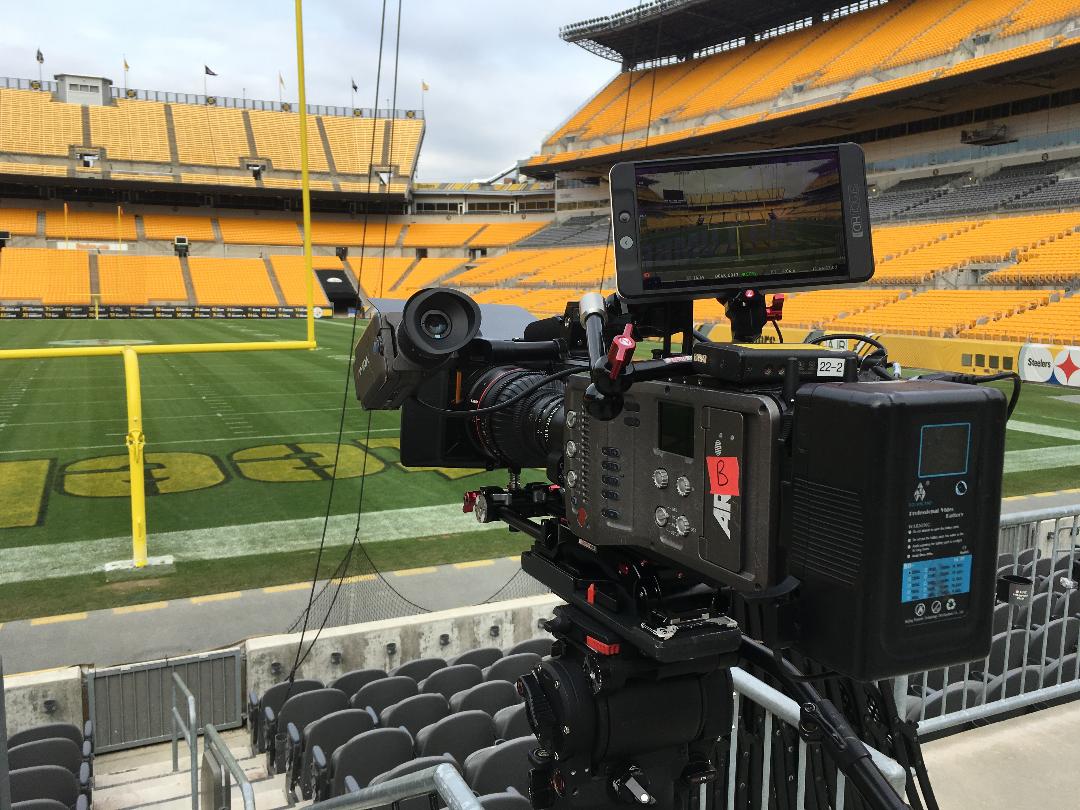
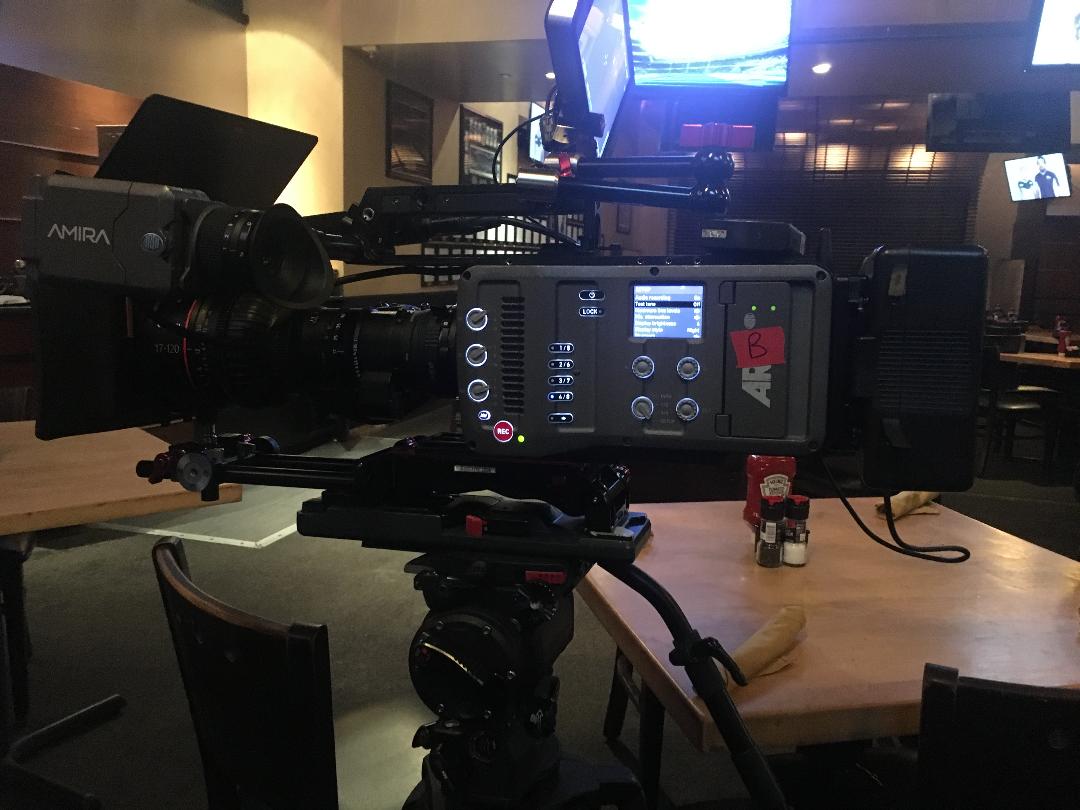
It's interesting that the stock shoulder pad for the Amira (which I dislike for this reason and also lack of padding) does not go forward far enough to give proper balance with the Canon 17-120 (at least, I believe that's the case; I haven't tried it though I have the stock one, but someone I know tried it and said it didn't go forward far enough, which didn't surprise me). I have a flat base adapter I use with the Amira in conjunction with a Zacuto VCT Pro shoulder mount which together can be moved forward far enough to get the shoulder pad to the proper center of gravity.

Of course, with a Mini or C300, you can just push the shoulder pad more forward to get balance without adding counterbalance weight to the rig, but the downside is the camera buttons get pushed back further toward or behind your shoulder and more out of reach.

I would assume the Mini properly balanced for shoulder mount would be lighter than an XT, but I wonder how it compares to the Amira (7 lbs lighter than XT) when balanced out.

thumbnail-3.jpg


thumbnail-2.jpg


There was this whole article comparing the two, and with their configuration the Mini actually came out a tad heavier than the Amira when balanced for shoulder mount, and four inches longer for the Mini.

Given that a lot of features don't use anamorphic or 3.4K RAW but do use handheld which the Amira is better at, it's surprising that the Amira never caught on that much as a feature film camera.

https://vmi.tv/training/useful-stuff/Alexa_Mini_vs_Amira

Amira_essay.jpg


MINI%20proper%20one%20Mk%20II.JPG


Then again, the bias of this article is that it's for an ENG setup, and a lot of cinema is done with shorter and lighter prime lenses which would not need as much counterbalance.
 
Last edited:
I

Another example is the shot at 0:20 in this fully handheld Key and Peele video.


Most of that was indeed handheld, but we also used springy "bobbleheads" wherever we could (camera not tracking) to save the operators.

The real star of that clip is my old CRV which is heavily featured at the beginning. I have no doubt that it will outlast me in the alien apocalypse.
 
It’s always been my experience that an Alexa mini dressed for drama shooting weighs about the same as a regular Amira and almost the same as a regular Alexa.

Often this will be because the camera is so front heavy it needs at least a shark fin on the back (2 x AB batteries) and they often are stuck out a mile to make it sit balanced on the shoulder making the camera in essence, as long and heavy as a regular Alexa.

Don’t forget you have to add a power supply and a cage.

Except.

It doesn’t sit as low, and the lens is higher than your eye. Using a regular Alexa and it’s built in cut out for the shoulder the lens center is below my eye. I want that height from my shoulder to the middle of the lens mount to be as low as possible. I want the center of gravity to be as low as possible.

I also prefer a single wooden handle (great for sweaty hands) mounted underneath and in line with the lens.

A Mini has to have a cage first, then various baseplates to line up all the lenses and rod and motor supports. You CAN of course alter this but in the end you need to have these to balance the camera out anyway.

Like I said, when I’ve gone through this on shows the mini ends up weighing negligiblly less but is usually less comfortable and settled on the shoulder.

JB
(Started on the greatest hand held camera ever made, the Aaton XTR)
 
Back
Top