Should I hire this DP?

Status
Not open for further replies.

ironpony

Carbonite Member
The DP I am collaborating with and might hire for a future project... He keeps on contesting a lot of my decisions making as how I want my movie to look. I am worried that he will become so argumentative that he will do it as I say on set, and cause a problem for the rest of the cast and crew by undermining me. I really like how he is a perfectionist though and is afraid to go outside the book. He takes what he has learned of filmmaking as sacred, and that's good, since he wants to make the most professional motion picture he can. I just want to make sure his rules are the right ones, so no mistakes will be made.

Their are scenes in my script where I want the light to be certain colors. Such as golden yellow sunlight for the day. I though the best way to get golden sunlight is to probably raise the color temperature to 7500 kelvin or something like that. And the best way to get the orange lamps, white, is by adjusting the kelvin as well. However the DP insists on color balancing all the scenes so that the primary source of light is accurate to the human eye. Then put filters over the lens to make the sunlight a different color But would that look right? I also want to use bright halogen lights to light interiors and halogens tend to be on the yellow side, but I want them white. But he says instead of balancing them to be white, it's best to record at the normal color, then gel them. I just want to make sure my DP knows what he is talking about since he is not available to show me most of the time.

He also wants to shoot the whole movie at 60p. He says that 24p is too jittery looking when you move the camera, and that the audience will not be able to look past that. He says instead of shooting 24p, it's best to shoot in 60p, then convert to 24p.

He also has a problem with shooting deep focus, which is what I want. I want to do a lot of wide mastershots, and deep focus is the way to do it, since anyone can be in focus at the same time hopefully, like older movies, and I can cut to the master whenever I want, and the character which the audience will be concentrating on, will be in focus, whoever that character will happen to be. But he is a shallow DOF obsessed guy and keeps constantly pushing for it.

These are just the handful of things he keeps constantly arguing about, saying he is scared it will ruin the movie, but I just don't want any mistakes to be made, that you cannot go back on. But maybe he is right, and I am breaking the rules. Am I?
 
In general, digital cameras have their cleanest signal around daylight. You can say that their native white balance is daylight (the actual native balance CT value may vary from camera to camera). When you start pushing the WB value around you are actually increasing the gain of one of the color channels. Set it to tungsten, and you are pushing the gain on the blue channel (incidentally, this is the weakest and noisiest channel). Set it higher than daylight and your are pushing the gain on the red channel. So, theoretically, you have your cleanest picture with camera WB set around daylight.
But is it worth putting color filters on the lens to manipulate color, while always white balancing the camera for daylight? Almost certainly no. Any color filter you put on the lens will lose you light. Yes, if your light budget is big enough, you can pretend your camera has some daylight balanced "film stock" in it, and proceed from there as if you are shooting film. Best you can do is produce a few quick tests with the camera of your choice under different color temperatures and see if you have problems with the results. If the image is ok (especially in terms of noise), using color filters on the lens is pointless for you and only creates issues.

The frame rate point is entirely up to the look you are after. If you are aiming for a 24p output I presume you are after the film look. Shooting 60p and conforming to 24p will effectively destroy the filmic strobing effect and will slightly alter the quality of the motion blur. And yes, if your audience only watches TV and plays games and has never been to the movies, it might not be able to look past jittering. But this jittering has been around for a hundred years. Here is something on frame rate and film look that I've written.

If you want deep focus and you think it is beneficial to your vision and can do it decently (it is certainly harder to do than shallow focus) I see no reason for your DP to impose his preferences on you.

 
Ironpony, I'll make it real easy for you. NO. That guy doesn't know what he's talking about.
 
Dear Ironpony

Dear Ironpony

Dear Ironpony,

As usual you give no information on anything. No treatment, no names, no reel, no screen shots, no subject, no locations, no styles. You have been accused of tom-trollery. Perhaps that's what your play is, though I can't imagine why. Or you could just be a kid somewhere in the world with no access to books or mentors for whatever reason. Nobody knows, because you never really answer.

I've found this forum helpful beyond words, and feel a sense of pride about how uniquely troll-free and respectful this place is (though I've only been a member for less than 2 years). So when another member presents a well-researched case suggesting time-wasting mischief, I share his/her frustration. Although I equate them to that guy in Washington that the detective in the Usual Suspects equates to the detective in the Incredible Hulk comics. May be right after all, or maybe not, likely we'll never know.

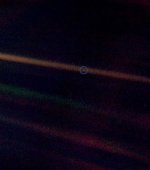
Instead let us revisit Carl Segan's meditation on the last photo series taken by Voyager 1 before they shut down the imagers. It was he who urged NASA to pivot the craft around to take one last sequence of images of our solar system; not for any real scientific reason, but rather for a bit of perspective:

Consider again that dot. That's here. That's home. That's us. On it everyone you love, everyone you know, everyone you ever heard of, every human being who ever was, lived out their lives.

The Earth is a very small stage in a vast cosmic arena. Think of the rivers of blood spilled by all those generals and emperors so that in glory and triumph they could become the momentary masters of a fraction of a dot. Think of the endless cruelties visited by the inhabitants of one corner of this pixel on the scarcely distinguishable inhabitants of some other corner. How frequent their misunderstandings, how eager they are to kill one another, how fervent their hatreds. Our posturings, our imagined self-importance, the delusion that we have some privileged position in the universe, are challenged by this point of pale light.

There is perhaps no better demonstration of the folly of human conceits than this distant image of our tiny world. To me, it underscores our responsibility to deal more kindly with one another and to preserve and cherish the pale blue dot, the only home we've ever known.

—Carl Sagan, Pale Blue Dot: A Vision of the Human Future in Space, 1997 reprint, pp. xv–xvi
PaleBlueDot.jpg
 
Working with a Dp should be a close collaboration. You need someone who understands and shares your vision of the film for critical aesthetic choices like frame rate, composition and depth of field.
The DP should have the freedom to achieve the look you want according to his own experience and skill set. If he would rather white balance to neutral lights and gel for color, trust the judgement if it gets the look you want.
But you both should be on the same page as far as what that look should be and broadly how to achieve it. If there are significant conflicts on that point you probably need to find someone else. If you are wanting deep focus and wide sharp shots then someone shooting a DSLR that doesn't do deep focus without significant potential for moire and who is obsessed with shallow DOF may not be the best choice for collaboration.
 
It's not always easy for DP's to control their own artistic 'needs' so to speak. This particular DP might have seen a wonderful picture shot at 60P and cranked down to 24, and then gotten it in his head that he wants to have a go at this himself - And there you are with your film and it's like putting a tray of meat in front of a lion.
Just have a talk with him and explain that while you do understand his thought process this isn't what you picture for this particular project. Most DP's know that they have <more> technical know-how of how the visuals of films are constructed than the director and combine that with a big ego and -- You're bound to enter the land of Undermining.

Now, as far as the warm light situation goes; You've gotten arguments both as to why changing the white balance is a 'less good idea' and also why putting filters in front of the lens i a 'less good idea'. Discuss this with the DP and see what other options you can come up with.7

The deep focus is not something that will make or break your film, so if you feel that deep focus serves your vision then that's what you should go with.

[EDIT]
Pickthorne, what are you suggesting - That he name the DP, the project, etc?
Keeping it as anonymous and straight forward as possible is by far the best way to go about asking for advice on a topic like this.
 
Pickthorne, what are you suggesting - That he name the DP, the project, etc?
Keeping it as anonymous and straight forward as possible is by far the best way to go about asking for advice on a topic like this.

Yeah you are probably right about names, may have got a bit rant-y there. It's just the OP's established approach to give so little in the way of supporting information.
 
The arguments that you're getting from your DP sound like the rants of someone who has read just enough on the internet to be dangerous, yet has very little real-world experience. I could be completely wrong with that assumption(hard to know without more context and hearing both sides of the equation), but anyone who insists that an audience won't be able to look past something shot at 24p has apparently never seen a narrative film in a theater other than the Hobbit.

As far as gelling the lens instead of the lights goes, what happens when you want that nice golden glow from the sun everywhere except on your talent's face? A big part of lighting is molding and shaping that light, particularly if you want to use more than one color temperature in a scene. Gelling the lens will make everything uniformly shift towards a color, including your skin tones and faces. In terms of the halogen lights, setting your white balance somewhere in the "normalish" range (2700k-6000k) isn't going to dramatically change the quality of image with a modern camera.

And anyone who is averse to shooting at f/4 or f/5.6, particularly for a master, probably has very little real world experience. Again, without knowing more this is conjecture, but if someone wants to shoot their masters close to wide open and has no justification other than liking shallow depth of field, then that tells me they probably haven't been around the block many times.

In short you should hire someone whose technical skills you feel confident in, whose presence you enjoy (or at the very least can tolerate without difficulty), and who can share and help execute a vision. There have been times where I've been firm with a director or producer about doing something a certain way or avoiding particular shots/techniques, but 99% of the time a DP should make their case, explain their reasoning, try to show how they can accomplish the desired feel or intention with a specific technique, and then if the director is still insistent you do what the director wants. A DPs job is to make the director's film, the way they want it made. Period.
 
In general, digital cameras have their cleanest signal around daylight. You can say that their native white balance is daylight (the actual native balance CT value may vary from camera to camera). When you start pushing the WB value around you are actually increasing the gain of one of the color channels. Set it to tungsten, and you are pushing the gain on the blue channel (incidentally, this is the weakest and noisiest channel). Set it higher than daylight and your are pushing the gain on the red channel.

Not trying to challenge you CPC, I have heard the blue channel is the noisiest color channel, but wouldn't daylight color temp use more of the blue channel than say tungston (3,200kelvin), Daylight color temps in the 5,000 kelvin range tend to have more of a blueish cast than say a 3200 kelvin temp which appears more yellowish. Therefore, wouldn't that be using more of the blue channel? My logic may be totally skewd, I just can't seem to wrap my head around why? Maybe you can elaborate a bit more to clarify, thanks
 
Not trying to challenge you CPC, I have heard the blue channel is the noisiest color channel, but wouldn't daylight color temp use more of the blue channel than say tungston (3,200kelvin), Daylight color temps in the 5,000 kelvin range tend to have more of a blueish cast than say a 3200 kelvin temp which appears more yellowish. Therefore, wouldn't that be using more of the blue channel? My logic may be totally skewd, I just can't seem to wrap my head around why? Maybe you can elaborate a bit more to clarify, thanks

Daylight WB doesn't use more of the blue channel. It uses the blue channel "as is": as there is a lot of blue in the daylight spectrum, the blue channel is fat. With tungsten, there is so little short wavelength (blue) in the light spectrum that the blue channel is thin, and needs amplification in order to raise it enough to equalize the strong red channel. You can think about it that way: the more of a particular color you have in the light spectrum, the less you need to amplify the respective channel (to get neutral WB), and vice-versa. And this compensation is centered at a starting (zeroed) spectrum distribution which happens to be approx. daylight.
 
The DP I am collaborating with and might hire for a future project... He keeps on contesting a lot of my decisions making as how I want my movie to look. I am worried that he will become so argumentative that he will do it as I say on set, and cause a problem for the rest of the cast and crew by undermining me. I really like how he is a perfectionist though and is afraid to go outside the book. He takes what he has learned of filmmaking as sacred, and that's good, since he wants to make the most professional motion picture he can. I just want to make sure his rules are the right ones, so no mistakes will be made.

He also wants to shoot the whole movie at 60p. He says that 24p is too jittery looking when you move the camera, and that the audience will not be able to look past that. He says instead of shooting 24p, it's best to shoot in 60p, then convert to 24p. He also has a problem with shooting deep focus, which is what I want. I want to do a lot of wide mastershots, and deep focus is the way to do it, since anyone can be in focus at the same time hopefully, like older movies, and I can cut to the master whenever I want, and the character which the audience will be concentrating on, will be in focus, whoever that character will happen to be. But he is a shallow DOF obsessed guy and keeps constantly pushing for it.

These are just the handful of things he keeps constantly arguing about, saying he is scared it will ruin the movie, but I just don't want any mistakes to be made, that you cannot go back on. But maybe he is right, and I am breaking the rules. Am I?

You definitely got the wrong person lined-up for your project. Go with someone else. And remember, even after production finally rolls, DPs get fired by the director and/or producer all the time, even from major big budget film sets. Vilmos Zsigmond, ASC, HSC got fired once by the producer on orders from Ms. Barbra Streisand, because allegedly his lighting made her nose look too large.
 
And anyone who is averse to shooting at f/4 or f/5.6, particularly for a master, probably has very little real world experience. Again, without knowing more this is conjecture, but if someone wants to shoot their masters close to wide open and has no justification other than liking shallow depth of field, then that tells me they probably haven't been around the block many times.

Is f5.6 what passes for deep focus these days?
 
Is f5.6 what passes for deep focus these days?

It is with a wide lens and a cropped DSLR. If he's shooting masters at 24mm on a 7D then that makes his focus plane a good 15'+ deep depending on where the subject is, which is enough to put everyone in an average-sized room in focus. Obviously things will change depending on the camera and lens, but 5.6 is definitely enough for deep focus in an interior master, or even an exterior where the characters are all within a dozen or so feet of each other.
 
Well I want deep enough focus so that in mastershots, everone is in focus, all simultaneously.

As for the blue channel being the noisiest, I am weary of that. There is one scene I want shot in a location with white street lights, at night. I did a test and changing the white lights to blue, makes it look atmospheric, for the thriller feel I am going for. But it does add more noise. He says that his camera though, which I am yet to see on this color balance setting, has very little noise, even with the gain turned up the highest. If that's true, than that's good. His is a Panasonic, something.

And yes I do just want the traditional 24fps, at 1/48th film look. I told him that lots of movies are shot in 24 and that he probably did not notice that jittery look, but says that they must be doing something to the movie, to cure that. He says the only reason to shoot on 24, if we are using film, and that Hollywood shoots on 24fps film to save money. With digital you can have more frames to work with and their is no excuse to skimp out. Well that's what he's adamant about, but I will tell him, it's 24 or nothing, but he's just worried it will ruin the movie.
 
I thought keylight was going a little overboard earlier, but I think he was spot on. You have to be trolling us, right?

There's no way that your DP is so reverent of what he's learned about filmmaking yet at the same time insists that 24p is just a way to save money. I'm now assuming this guy has never shot anything before.
 
The DP I am collaborating with and might hire for a future project... He keeps on contesting a lot of my decisions making as how I want my movie to look. I am worried that he will become so argumentative that he will do it as I say on set, and cause a problem for the rest of the cast and crew by undermining me. I really like how he is a perfectionist though and is afraid to go outside the book. He takes what he has learned of filmmaking as sacred, and that's good, since he wants to make the most professional motion picture he can. I just want to make sure his rules are the right ones, so no mistakes will be made.

Their are scenes in my script where I want the light to be certain colors. Such as golden yellow sunlight for the day. I though the best way to get golden sunlight is to probably raise the color temperature to 7500 kelvin or something like that. And the best way to get the orange lamps, white, is by adjusting the kelvin as well. However the DP insists on color balancing all the scenes so that the primary source of light is accurate to the human eye. Then put filters over the lens to make the sunlight a different color But would that look right? I also want to use bright halogen lights to light interiors and halogens tend to be on the yellow side, but I want them white. But he says instead of balancing them to be white, it's best to record at the normal color, then gel them. I just want to make sure my DP knows what he is talking about since he is not available to show me most of the time.

He also wants to shoot the whole movie at 60p. He says that 24p is too jittery looking when you move the camera, and that the audience will not be able to look past that. He says instead of shooting 24p, it's best to shoot in 60p, then convert to 24p.

He also has a problem with shooting deep focus, which is what I want. I want to do a lot of wide mastershots, and deep focus is the way to do it, since anyone can be in focus at the same time hopefully, like older movies, and I can cut to the master whenever I want, and the character which the audience will be concentrating on, will be in focus, whoever that character will happen to be. But he is a shallow DOF obsessed guy and keeps constantly pushing for it.

These are just the handful of things he keeps constantly arguing about, saying he is scared it will ruin the movie, but I just don't want any mistakes to be made, that you cannot go back on. But maybe he is right, and I am breaking the rules. Am I?
If this conversation actually took place, which, frankly, there is reason to doubt -- get rid of the guy. He doesn't have the first idea what he's doing, on any level -- technical, artistic, or professional. You don't get to call yourself a "DP" just because you bought a camera.
 
Yeah, I don't mean to come off as trolling or anything, I am just repeating what the guy said. He has shot four short films of his own so far, going on five. I helped him out with three. I am sick of people overselling themselves though. This is not the first guy, and their should be some sort of clarification as to whether not a person is actually selling themselves correctly or not. I mean for example, a heart surgeon will most likely know how to do his job. You don't see any heart surgeons overselling themselves hardly. But in the filmmaking world, the number DPs, PSMs, etc, that are overselling themselves, and saying that they are those professions, is of a much greater ratio. A heart surgeon or a police officer, etc, needs government certified identification to prove what they have learned professionally. The people I have met who call themselves filmmakers, make their own business cards out of their home computers and printers.

Well the reason I wanted this guy is cause he has a jib and steadicam, and has had practice. No DP where I live has those, just a tripod and a dolly. I know DPs are normally not the 'camera operators', but it's nice to have a person who can do both, since good pros are hard to find.
 
Last edited:
Well the reason I wanted this guy is cause he has a jib and steadicam, and has had practice. No DP where I live has those, just a tripod and a dolly. I know DPs are normally not the 'camera operators', but it's nice to have a person who can do both, since good pros are hard to find.

Look, a DP doesn't come with gear (except for a light meter and some duck tape if you're lucky). If it's the gear you wanted and you couldnt rent it yourself be happy with what you get. The kid is obviously an amateur and obviously, so are you.
(And how bad are you at reading people if you work with someone on three productions and can't tell what level they're on craft-wise)
 
I do just want the traditional 24fps, at 1/48th film look. I told him that lots of movies are shot in 24 and that he probably did not notice that jittery look, but says that they must be doing something to the movie, to cure that. He says the only reason to shoot on 24, if we are using film, and that Hollywood shoots on 24fps film to save money. With digital you can have more frames to work with and their is no excuse to skimp out. Well that's what he's adamant about, but I will tell him, it's 24 or nothing, but he's just worried it will ruin the movie.

Shooting on Super 16 film we turn up the frame rate dial from 24 fps only for slow-mo effects, nothing else. Now, whether you shoot on film or on digital at 24 fps camera rate, and even when you have a 24 fps DCI-spec'd deliverable package, the current 2nd generation DCI D-cinema projectors with the latest integrated media blocks will triple flash your stuff, so each frame gets to be shown 3x, i.e. you will see 72 images in total within a second on the screen. Multiply this by 2 if you are showing 3D.

Now, if you shoot at 48 and project out at 48, then the DCI projector will double flash it (assuming a 2D material), so you will see 96 images per second on the cinema screen. Okay, so 72 versus 96, not such a huge difference in the end. 60 fps double flashed is, on the other hand, 120 projected images per second. My brain and eyes do not have to see that many to know that I am watching a movie and not a slide show of still images, but other might disagree.

BTW, the latest generation of home theater PJs will duplicate this redundant flashing technique for you in a home/business environment.

When you shoot at say 60 fps and use an intraframe codec, you may use up to 2.5x the media than if you had originated at 24 fps, but even if not that much, your media use will be significantly higher. Also, you will have to work with faster shutter speeds, which can then result in (A) you needing more light to light the set and/or (B) you having to dial-up the sensor's sensitivity level (higher ISO/grain) on your camera, and thus chance adding noise.

Next to working with actors who are non-professionals, the next hardest thing on the set for a producer or director is dealing with a know-it-all D.P. Audio folks tend to be a whole lot less hustle than camera folks and lighting directors. Usually though, the producer and/or director calls the shots and tells the crew up front how things are going to be on the set. It is always a good idea if your whole crew is 'with you" on these technical things. But I cannot see any reason to hire someone, even if they would work for nothing, just so every decision made by the producer and/or director will be questioned by the cinematographer/videographer. Why bother?
 
Status
Not open for further replies.
Back
Top