
Navigation
Install the app
How to install the app on iOS
Follow along with the video below to see how to install our site as a web app on your home screen.
Note: This feature may not be available in some browsers.
More options
You are using an out of date browser. It may not display this or other websites correctly.
You should upgrade or use an alternative browser.
You should upgrade or use an alternative browser.
Should I get a true white via White balance?
- Thread starter Fellipe
- Start date

Patryk_Rebisz
Veteran
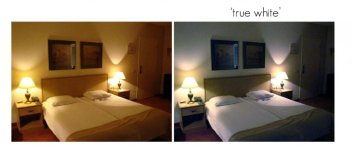
it's all based on the video you are going for - the image on the right might be more "colorful" but the image on the left might be what you are going for (warm & romantic). That said tough the image on the left is a bit monochromatic for my taste so even if i needed "warm and romantic" i still would try to bring it a bit closer to what we see on the right.
j1clark@ucsd.edu
Veteran
Let's say you're indoors with 3200k lighting.
Should I set 3200k (or custom on a gray card) and get a 'true' white? And so on for every shot, so they all have 100% corrected white balance?
Here is a sample image to help you get a better understanding:
View attachment 36737
Thanks
I use to think 'white balance' in all cases for a 'neutral' image... but then, I think it was Postmaster, who posted about problems in 'how white is balanced' in the types of cameras I would use, namely low end DSLRs. The reason for the caution is that rather than dropping the 'red' channel, the 'white balance' operation may boost the 'blue' channel, and thereby have more 'blue' channel noise in the darker areas.
On the other hand, if a scene is really 'red' dominant, such as the tungsten shot above, perhaps there is 'saturation' in the 'red' channel which will disallow correction later on in post... so, one needs to test to see how the channels, and noise, are affected with color temperature adjustments.
However, on a certain level... shooting with a color balance close to what the final image may be, is a 'good thing', so if your shot is to be 'warm', then keep it warm, rather than going for 'neutral' then have to add back warmth later.

William_Robinette
Shallow Member
Agreed, let your eyes tell you what's right. I do think that somewhere in the middle of those two images would be something to look into. People's opinions on this vary but I almost always have my camera set to either 3.2K or 5.6K for white balance instead of doing a custom balance. Depending on lighting (fluorescent, waning daylight) I'll adjust the phase to get skin tones right.
Greg Smith
Veteran
I would probably white balance in the camera, which would yield an image something like the one on the right, and then add filters to either the lights or the lens if I wanted to add a bit of romantic warmth to the scene. Clearly, the image on the left is way too far toward the orange, though.
- Greg
- Greg

Fukurou
Active member
Oh, interesting, I have that problem too.
I shot a lot of scenes indoor, (with a GH1) and got the same orangy results. (I have to admit, at the time, I wasn't doing any white balance, erm...counting on postprocess white balance...which are pretty efficient anyway if you have a "true" white in your image)
And I was wondering about which way to go. I decided lately to go all-neutral for the color correction, and after that during the grading, apply some colors I want for the mood. Not sure if this is a correct way to do things.
But William is probably closer to the truth...I thought about that and going half-way between orange and pure white is probably the way to go.
Thing is, it's harder to do this, since we have to decide were to stop. But I should start trusting my eyes a little more instead of always relying on scopes, I guess...
Because I want the option of setting the finished "look" of any shot in post, I always go for a neutral color balance.
I recently bought a Sekonic C-500 color meter so I can dial in the camera color temperature from the meter reading to record the most accurate neutral balance possible.
I recently bought a Sekonic C-500 color meter so I can dial in the camera color temperature from the meter reading to record the most accurate neutral balance possible.

eiker_ir
Well-known member
the problem with using the example pic you posted is that we're just looking at an room, with no people/actors involved. I think any set can look "good" with many different colors, balance, etc. but throw a person into the scene and it all changes. Someone on the left pic will probably have over saturated skin tones so you have to take that into consideration.
I usually prefer to get the color/contrast as neutral and nail exposure and then do any changes needed in post.
I usually prefer to get the color/contrast as neutral and nail exposure and then do any changes needed in post.
Patryk_Rebisz
Veteran
TheDingo , color meters are only accurate with traditional light sources (sun and tungsten) but are very IN accurate with flos, LED and anything else.
eiker_ir, this approach only work when you work on your stuff when you shoot for someone else - even on med to med-large productions there is no time/money for proper color grading session thus you have to establish the in-camera look on the set.
eiker_ir, this approach only work when you work on your stuff when you shoot for someone else - even on med to med-large productions there is no time/money for proper color grading session thus you have to establish the in-camera look on the set.

TheDingo , color meters are only accurate with traditional light sources (sun and tungsten) but are very IN accurate with flos, LED and anything else.
This meter is fairly new ( it's been on market for 3 years now ) and has a "digital" mode for electronic sensor cameras, so I will have to see for myself how accurate it is.
The few times I've used it so far it was bang on when using it under 2 different fluorescent sources. The only drawback I've noticed so far is that it does not read under dim light.