Shooting "Champions" for NBC

CharlesPapert

Director of Photography
Here's my latest project, which debuts this Thursday on NBC:


I came on after the pilot, which is the first episode airing this week. That was shot mostly on location by "The Big Sick" DP Brian Burgoyne, who did a great job. For the series run, most of the sets were built at Universal, the biggest of which was the gym interior which took up most of Stage 41.

The show is a straight-up comedy and the look is clean and...well...I don't want to say bright, how about "not dark"! I know that most folks here are more interested in more dramatic or stylized looks, but in case anyone has any questions on approaching a project like this, happy to share as always.
 
Nice as always Charles. Looks like the young actor really steals the show.

For a show like this, is it more a case of "this is what the show needs to look like" and therefore tough to leave your own visual stamp?

At your level, if the looks are somewhat straightforward to achieve, you've surely created differences as a DP in other areas i.e. crew management, Steadicam knowledge, rapport with director etc., which all are contributing to speed.

So, did you consciously work on becoming faster over time?
 
Good question, Rob.

I think it's not so much about leaving one's visual stamp as it is working within the parameters of being able to see the faces and eyes enough to "keep the funny", but still give some shape and presence to the proceedings so that it doesn't feel flat, drab or high-key...or that it was shot on stage.

In this instance I came up with a color palette for the lighting that would reflect that the show takes place in Brooklyn which is a different flavor than California. Ambient daylight was tungsten gelled half blue (or more often, LED's dialed to around 4200K, direct sun was played at 3200K for daylight scenes. Exterior scenes were adjusted in color so that the shadows went cool. None of this is new or radical, we've been doing a version of this for a long time but I tended to push the ambient daylight a little cooler than I usually do, and I liked the results.

As far as the looks being straightforward: to be honest, this style of lighting isn't really easier or faster--in many cases it's slower. For drama, I can allow characters to go into darkness or edge light or harsher light, whereas here I have to protect them a bit more, which means more units and more balancing. These days you can get a long way with "available-light" style looks for drama. We moved at what I'd call an average network TV speed.

As far as becoming faster over time--I spend every hour of my working day thinking about efficiency and speed. On a job like this where I had a full crew and a generally reasonable page count, the pressure wasn't on as often as it is on the smaller shows. On those I have to consider every plan of attack based on speed, right down to each and every lighting instrument I call for. I'll often discuss the lighting scheme for a setup or modification for a setup with my gaffer and KG and then ask "how long for that?" or "if that's going to take longer than 10 minutes, let's bail".

And that's just the lighting. Another part of my duties is to work with the director and then with my operators on ways to streamling the shooting plan, from cutting or combining pieces of coverage to subtle re-blocks of the action that can help minimize the number of setups. The classic timesaver is "blocking on a line", where the actors will fall into two directions of coverage so that you can mow them down in a master, then go tighter and clean up coverage without a relight. The trick is to make this elegant enough so that it's not that apparent to the audience, that the actors can fall into that line without it feeling too stagey. If I can offer a cross-shoot, where we are shooting both sides at once with two cameras, even better (definitely for performance and editing, not always faster and rarely better from a lighting standpoint).
 
Looks good Charles. For a 'not dark' approach, there's still a healthy amount of contrast.

I'd love to hear more about the multi-cam aspects of the show. What sort of page count were you dealing with each day? How many cameras were you running? And how was the blocking approached?

Were your directors simply coming to you with the blocking on the day? Or were you plotting it out in advance, to 'block it on a line'?
 
Looks good Charles. For a 'not dark' approach, there's still a healthy amount of contrast.

I'd love to hear more about the multi-cam aspects of the show. What sort of page count were you dealing with each day? How many cameras were you running?

I think we averaged 6-7 pages a day. 2 cameras nearly all the time. Steadicam available fulltime as needed.

Were your directors simply coming to you with the blocking on the day? Or were you plotting it out in advance, to 'block it on a line'?

All the directors would have their overhead diagrams/shot lists built ahead of time, they get a week of prep and would walk the sets with the 1st AD (there are two that alternate episodes) and work that out. My prep time with them was limited to a half hour lunch meeting where we would go over the more complicated stuff, especially anything that required bringing in specialty gear (Technocrane etc). Sometimes we'd steal some time at lunch or after work to talk about upcoming scenes. Most of it was relatively simple so I didn't really need to know ahead of time. The night before they'd email out a set of diagrams for the next day's work.

As the scene was being rehearsed with the actors, I'd be digesting the diagram and thinking of how we could simplify and what the best shooting order would be. Much of the time we wouldn't change very much, every now and again we'd revamp things (hopefully for the better). Sometimes we'd be in a pressure cooker time-wise (as you can see from the preview, we had a minor who could only work so many hours a day) and have to trim out some of the wishlist coverage.

Four of the episodes this season were directed by Michael Spiller, who is the producing director and one of the EP's on the show. Michael and I go back as far as the first two seasons of Scrubs and he is extremely experienced and, as a former DP himself, knows this stuff backwards and forwards, which makes it easy, and of course had complete familiarity with the show. The other directors were great also.
 
I think it's not so much about leaving one's visual stamp as it is working within the parameters of being able to see the faces and eyes enough to "keep the funny", but still give some shape and presence to the proceedings so that it doesn't feel flat, drab or high-key...or that it was shot on stage.

I only meant straightforward as in being well within your ability rather than how difficult it is to execute.

It's interesting because many see a DP's reel then evaluate only the images, without thinking about how it was all achieved. Is it also a matter of communicating your other strengths to the decision makers? Can you show $ figures where you got by with smaller lighting packages or examples where you cut out excess shoot days etc.? I imagine Directors and people in charge of money go a long way in spreading the word too?

Apologies for the side track!

Thanks Charles, your responses are invaluable.
 
Looks like a really fun show to work on. The lighting seems perfect for the content. Thanks for sharing.
 
Bizarre casting choices but this is just a side not.
I feel most, including in film business, don't appreciate how difficult comedies are to light specifically because the need for relatively flat lighting.
I recently shot a comedic pilot that swings between surrealist and slapstick horror (i don't film comedy that often) and was terrified at how much extra stuff i need to bring not to have the shot turn into too dramatic horror. Nowdays i shoot "overlit" commercials that require a ton of "expensive looking" lighting or very dramatic (but expensive) shots and that comedy pilot was a jolt of excitement as despite "average look" it forced me to bring out my A-game.

Congrats on job well done!
 
Interesting story, Patryk!

Rob Norton - on a show like this, it's a little bit less about saving money on the gear side than the smaller shows. I was able to simplify us out of some expensive line items by pitching alternatives to the director. The ultimate goal is usually the same--deliver a good looking show, move efficiently and allow the director and actors to have enough time to do their thing. Back in the day, DP's had more leeway to take time on set (one show I operated on in the late 90's, the DP would regularly re-light the set twice or even three times depending on his whims--I have not had that luxury). One thing we had to observe without fail on this show was that the plug was pulled at the 12 hour mark without fail. We never went over, but there were certainly some wild times in that last hour of work making it happen (and rolling up until the very last minute and even second!)
 
Rob Norton - on a show like this, it's a little bit less about saving money on the gear side than the smaller shows. I was able to simplify us out of some expensive line items by pitching alternatives to the director. The ultimate goal is usually the same--deliver a good looking show, move efficiently and allow the director and actors to have enough time to do their thing. Back in the day, DP's had more leeway to take time on set (one show I operated on in the late 90's, the DP would regularly re-light the set twice or even three times depending on his whims--I have not had that luxury). One thing we had to observe without fail on this show was that the plug was pulled at the 12 hour mark without fail. We never went over, but there were certainly some wild times in that last hour of work making it happen (and rolling up until the very last minute and even second!)

Good to know, thanks.

Back to the shooting, using the gym as an example of an interior with plenty of space, do you have a go to light you use for backgrounds? For backgrounds is it finding the sweet spot between it being a movitavted source and looking good? I know it depends on the type of light you're trying to reproduce but do you have any loose rules you tend to follow?

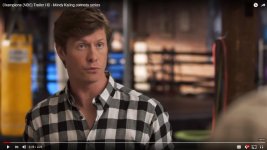
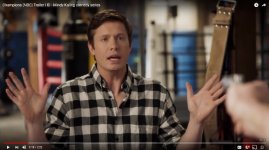
With the backgrounds of the two shots featuring the actor in the checkered shirt, the first looks like a harder source while the second shot looks softer to me - judging from the reflection in the red post of the ring. Is this just how it looks from different angles or did you change it up?

1.jpg
11.jpg
 
One thing we had to observe without fail on this show was that the plug was pulled at the 12 hour mark without fail. We never went over, but there were certainly some wild times in that last hour of work making it happen (and rolling up until the very last minute and even second!)

Was it becaue the talent was young?

I recently shot a large PSA spot for DOT here in NYC and we had 7 year old talent and oh-my-God the whole schedule was planed around whats allowed and not around this 7 year old. It would be more comical to watch if i didn't also have to direct it (not a great combo, to DP and direct, on such a stressful schedule).
 
Back to the shooting, using the gym as an example of an interior with plenty of space, do you have a go to light you use for backgrounds? For backgrounds is it finding the sweet spot between it being a movitavted source and looking good? I know it depends on the type of light you're trying to reproduce but do you have any loose rules you tend to follow?

With the backgrounds of the two shots featuring the actor in the checkered shirt, the first looks like a harder source while the second shot looks softer to me - judging from the reflection in the red post of the ring. Is this just how it looks from different angles or did you change it up?

View attachment 129862
View attachment 129863

OK, I had to watch this a few times to see what's going on and it's actually kind of hilarious. We re-shot this scene from the pilot and it appears that the promo division mixed and matched pieces from both versions of the scene. The first two shots are from the pilot, then after the card "Vince gets around" the footage is from the reshoots. You can obviously tell that Anders' hair is quite different! Beyond that, I opted to key from the camera left side as there are windows immediately adjacent to the actors. What makes this also kind of fun is that the pilot was shot on location at a gym in Hollywood, and the second is from our recreated stage build. I never made any attempt to match the lighting since the scene was a complete re-shoot, so...again funny to see these mixed!

So, I can't speak to what was used in the top still (I would guess sizable HMI guns outside the windows pushing in) but on our set we pushed large softbanks through those windows for ambience (Mactech 960's, which hold 24 4' LED tubes) and a 5K tungsten par for highlight. We also had a series of 4x4 Kinos that would hang down through troughs in the ceiling pushing that direction that were adding in there. You can also see that in the original footage the overhead practicals are off, and I had them on (the china hats had four 1 ft tubes mounted inside with diffusion panel underneath, plus I had practical fluorescent fixtures with four 4' LED tubes sprinkled throughout).
 
Looks amazing as usual, Charles. Definitely up to network standards we probably take for granted.

On a stage show like this I imagine steadicam saw a lot of use but what else did you use to move the camera?
Did you ever use peds?

Also curious about what flavor of diffusion filters you may have used.
Thanks!

Yes, a fair amount of Steadicam. We had Chapman dollies, a Hybrid for A cam and a Peewee for B cam. Occasional handheld, and every now and then a Technocrane.

I used Glimmerglass and Black Diffusion FX for diffusion.
 
Back
Top