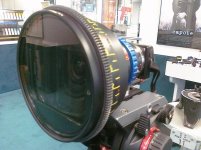
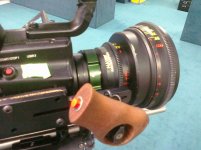
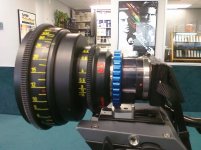
Shooting anamorphic

I am very experienced in all things anamorphic. What are you wanting to know?

If I had to spit knowledge off the top of my head:

1) Anamorphic is an optical process. 'Widescreen' is the aspect ratio associated with anamorphic. Anamorphic widescreen format is widescreen achieved by means of anamorphic capture. You can have widescreen aspect ratio without shooting anamorphic. Aspect ratios can be anything these days, but the offical standard for widescreen is 2.39:1, or commonly called 2.40 for short (although arguably not much shorter, haha.) It is an age-old mistake to call modern widescreen presentation 2.35:1. 2.35:1 WAS correct in/around 1970. It has been a common misnomer for decades. Mostly IMDB and DVD sleeves/other sources calling widescreen 2.35. It's a difference of a handful of pixels in HD resolution, but it's important we at least call it the right thing to start.

2) Anamorphic lenses are typically 2x squeeze, but 1.3x lenses have been made for use with 16:9 sensors. It's important to point out that it's almost never perfect. For instance, shooting 2x lenses on 4:3 sensor OR 1.3x on 16:9 sensor will almost never give you exactly 2.39:1 native. It gets you very close and the image will require small letterboxing or pillarboxing. However, if the camera supports proper desqueeze and guides, you should be able to set your guides.

2.5) I suppose I should mention it's VERY important to have either a camera or a monitor that supports desqueeze function so that you may view your image properly. When shooting anamorphic you will regret operating off of a screen that cannot be desqueezed.

3) There are different types of anamorphic lenses. Professional ones made for cinema use (the best kind) or frankenstien contraptions made with projector lenses or other parts. I don't recommend this unless you work on low-stake jobs.

4) Anamorphic lenses are often designed with a spherical taking lens working in mechanical concert with anamorphic element/groupings. Anamorphic lenses can be designed with the anamorphic element either in front, mid-rear or rear. Anamorphic lenses have flaws. Many of these flaws have come to be desired. To simplify a complicated topic, front anamorphic lenses will provide these 'flaws' while rear anamorphic designs will generally not have much, if any, of these typical characteristics.


Speaking of typical anamorphic characteristics; the list is long.
a) Distortion: Anamorphic lenses intrinsically work because of distortion. Thus the end result, when "desqueezed" often has distortion. The distortion can vary greatly but often, on older lenses, it gets quite interesting.

B) Unique Horizontal Flares. The typical horizontal flare can be gained with special filters but none are as impressive (in my opinion) as the naturally occurring flares in front anamorphic design lenses.

C) Oval Bokeh. Something unique to anamorphic lenses is oval bokeh. Bokeh is typically those spherical out of focus shapes seen when DoF is very shallow / magnification of focal length is high. Because of the way anamorphic works optically, the bokeh will be oval in nature.

D) Typically, although the newer generation of anamorphic lenses are making vast improvements, anamorphic lenses suffer from some design restraints and mechancal shortcomings. Breathing can be a big issue with the older anamorphic lenses. Racking focus can look like a small zoom! Also, in conjunction with the breathing the distortion adjusts creating a compounding wonky effect if the rack focus is a big one.

E) Minimum focus. Minimum focus is generally terrible for anamorphics. There are exceptions out there but most vintage anamorphics have CF no less than 3'. Some even are 5'-6'! It's something to look into before deciding on a lens set, although remedies exist such as diopters, spacers, etc.

F) When wide open, many anamorphic lenses are substantially softer in sharpness and contrast than their spherical counterparts (make and age). Many people today shoot anamorphic near wide open for this soft look, but historically, when anamorphic was used for resolution gain and not because they wanted the aesthetic look for flaws, it was considered necessary to shoot stopped down. This is more necessary with older Lomo/Kowa/etc versus Master Anamorphics.

G) Anamorphic lenses have slightly curved DoF planes. If wide open and very shallow in DoF, one will notice the focal plane is slightly curved.

H) Slower aperture. Even if you don't stop the lenses down for better performance, know that anamorphics don't come as fast as spherical primes can be. Older Kowa/Lomo lenses aren't good performers completely wide open, and wide open on these are more like 2.2. Brand new Arri Master Anamorphics are currently the fastest at T/1.8!!


5) Not all anamorphics are created equal. Now, more than ever, the choices for anamorphic lenses are varied. Some new anamorphic lenses won't look anamorphic. Old anamorphics vary greatly in distortion and flare reproduction. It's important to test, test. test. For a long time, Panavision was supreme leader in anamorphic lensing, so if you have a budget and are looking to rent your gear, you should chat up a rep at Panavision. They've got great glass and can be often overlooked since they don't sell their glass!

6) I should also mention that anamorphic lenses come in all shapes and sizes..... and OFTEN within a set! Lomo's, Older Hawks, and older Panavision anamorphic sets can often be very mismatched. Generally in spherical sets, lenses are made to have a common front diameter, semi-similar weight, size, length, etc. However many sets of anamorphics have very very different specs. It can be a HUGE pain in the ass for camera assistants and camera builds. The Cooke XTals from Panavision are BEAUTIFUL but the 75mm is a pencil thin long lens, while the 25mm and 35mm are GIGANTIC and 2x-3x as heavy. Just get used to changing MB backs, and rebalancing your rig after EVERY lens change. Same with my experience with Lomo's and early Hawks.
 
Last edited:
You know Ryan if you are not going provide an detailed+informed answer, why bother writing in the first place (insert drumroll). Nice Job :)
 
Ryan, so I have to ask... How often do you get to shoot with anamorphics and what type of projects do you use them on?
 
Ryan, so I have to ask... How often do you get to shoot with anamorphics and what type of projects do you use them on?

Oh man! Haha....

Maybe 20% of my jobs? It comes in waves. Sometimes there are months where everything is anamorphic! I split my time as a cinematographer and 1st Assistant cameraman. I was lucky enough recently to do some anamorphic work as a 2nd Unit DP for pickup work. For those jobs, I did some scenes for a short using older Hawk anamorphics and some additional work on a feature film and they used Russian Lomo's.

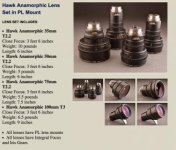
The older Hawks I just used are owned by a great production company I've worked for many times. They have this set. Notice the 35mm is a 10lb lens, and front diameter requires a 6x6 MB. Notice the 75mm is long and skinny while the 50mm is only 5lbs! hahaha. There are other notable oddities but anyone who preps them will notice how these lenses differ from run-of-the-mill Ultra Primes or S4's.

These are beautiful lenses. Depending on the sensor you're using this with, the edges of the frame have some fall off of sharpness and when wide open things are on the softer side. Lovely lenses though. Mechanically ahead of the Lomo's I've used. The Kowa's are definitely smaller and more manageable, so I often suggest Kowa's for those who are doing run-and-gun style shooting.... but these Hawks give a great vintage look.

I should note again, these are older Hawks. Hawks newer sets are vastly different in many ways.

Screen Shot 2016-01-06 at 10.09.11 AM.jpg

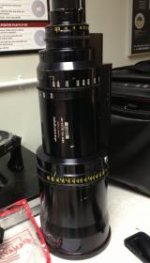
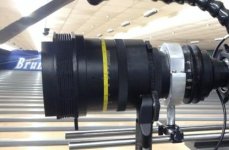
Lomo's: I recently sold a semi-dysfunctional 50mm PL mount square front lomo I had owned for years. I used it to take photographs with and under the right conditions those photographs were fantastic. The feature film I did some pickups with was using a large Lomo they nicknamed 'Natasha'... it's pictured below. I can't remember the focal range or aperture info, sadly, but I believe it was a 40-120 T/3.1. It was quite heavy, maybe around 17lbs. It lacked imperial witnessmarks, telescoped when focused (see the bellows on the front) and the front element was polygonal/semi-squarish, so a clip-on and bellows ring was out of the question. Mostly it was easier to tape a filter to the front and use an articulating eye-brow to control flares. MB's just weren't easy with this. Plus it was so long a large MB would have just further complicated our balancing efforts. The focus ring was a little stiff and as you might not know, Lomo lenses are generally like this. They are very difficult to service and most lens repair shops will turn away lomo lenses. Forewarned. This lens gave a cool image. Felt acceptable closed down but usable open for what we were doing.

Screen Shot 2016-01-06 at 10.30.10 AM.jpg

We also had the 37-140 Foton zoom. Loved the smaller weight and size.... however it was far worse quality. Used it first day or so on the production and retired it hence after. Needed a deeper stop to clean up and we couldn't hit that on our darker night shoots and interiors, unfortunately. It too had many issues, one from memory the extremely square front. Nice it had special made diopters to attach to the front but otherwise almost impossible to get a MB on the front without lots of special pieces. Maybe those pieces are common to own with a foton, but the one we had did not. Wish 'Natasha' zoom quality came in the foton. Would have used Foton the whole time if so. The Foton was slower in speed if I remember as well. The only thing it had going for it was size, weight and range. Rest was substantially worse than the larger zoom.

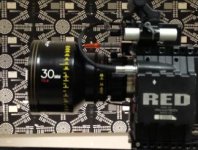
We also had a 30mm Lomo prime lens. We may have used this 2nd most or the most. Yes it's very wide with a 15mm equivalent Horizontal FoV, but it wasn't terribly slow and was VERY small and light in comparison to our zooms. We had steadicam shots in almost every scene, so this lens was our go to for that.

All of these lenses had terrible close focus ability. I think the 30mm was 5.5 feet, while the zooms might have been a little better or worse. Diopters! haha.


It wasn't that long ago I 1st AC'd a music video using Panavision's Cooke Xtal anamorphics. Good DP friend Jeff Bierman shot it, Gia Coppola directed. The video was called "Your Type" for Carley Rae Jepson" of 'Call me Maybe' fame. https://www.youtube.com/watch?v=UlFMVzo9zuE

First of all, at the spherical taking lens heart of the these is Cooke Speed Panchros which are my favorite vintage lenses ever made. So I was super excited to get to use these, as there are not many of the Xtal sets in the world. From memory they had 25mm, 35mm, 40mm, 50mm, 75mm and I think 100mm. The 25mm is an incredibly wide focal length for anamorphic and the DP and I wanted to test it during prep but unfortunately we didn't end up getting to because apparently there are only two in Panavision's world wide inventory and both were out overseas in Africa and Europe :(

The 35mm was deceivingly heavy. It was wide, short and stout, so I reach out to grab it like I would a MP or some other big lens. Nope. Thing is like 3x the weight I expected. I asked our rep if there was any air inside the lens or was it just a solid piece of optical glass. The front was oddly shaped too. Issues much like the afforementioned square front lomo's.

The rest of the set was all sorts of mismatched. The 75mm was lightweight and small diameter in comparison but was very long and thin. Every lens change was a complete change of how I had the wireless follow focus, the mattebox type, where the pistol grips were located and rebalancing the rig for either dolly or handheld balance. Point is, the lenses were beautiful but it felt like having the most motley crew lens set in the world. We shot the whole video almost completely at wide open, so this can be a good example of what they look like. Some neon lighting really showed how the horizontal flare/smear works in that environment.

I also remember I thought it was strange and convenient the Xtals were PL mount and not PV mount. Also, CF wasn't terrible but wasn't amazing. Several times during the Close Ups we would get within minimum focus and I'd try to yell to the operator but the playback was blasting and I didn't want to distract Carly who was just three feet away, so I just let it go sometimes. Directors and editors often like that stuff anyway....


I'll write more stuff in a bit. I'm just worried I'll accidentally press-back space key and lose all of this.
 
Speaking of Panavision, I worked on a commercial where we were testing older and the funkiest of anamorphics from Panavision. This one was custom made for 'Pearl Harbor' when the main character wakes up in the hospital and he's very groggy. It's custom made to get really soft on the edges, etc.

994613_10100440066964467_938830530_n.jpg


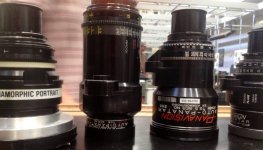
Here are some others. You can see how their sizes vary by design!

1044172_10100440067074247_1998818569_n.jpg


Thinking back, I think we may have taken the strange lens from Pearl Harbor.... I think we might have used it once on the boat in this commercial:


I could be wrong but I do remember we had some lenses which were more funky than others and if I'm not wrong I think we went a bit crazier with the funk on the sailboat. I can't remember it was maybe two years ago. DP was Jeff Bierman, Dir. Andrew Hines.
 
Last edited:
I also did a job for Arcade Fire, working on their experimental documentary "The Reflektor Tapes" as a 1st AC. We shot all over but I was primarily on the crew in Los Angeles and Haiti. We shot on Panavision Anamorphics on Alexa 4:3 but it was the Alexa monochrome, meaning it was stripped of it's bayer filters and we had an IR filter installed. I remember the Alexa monochrome was brand new and it's an understatement to say things were 'complicated' to get Arri to allow their brand new monochrome alexa to be Panavised for our lenses, haha.

The monochrome IR stuff was only in Haiti. I believe the Palladium show was just BnW on our monitors but color meta data was there.

This is one song from the film that shows a lot of the IR monochrome Haiti stuff we did. The DP was Autumn Durald and Dir was Khalil Joseph


I also worked with the team above shooting some Nike FC stuff in Europe. We shot some absolutely amazing stuff, but in the end it was chopped up and put into this throw away ad. Our imagery was beautiful long shots steadicam, through the portrait museum in London, old mansions, Barcelona, etc.... all sliced and diced for the MTV generation. Someday, I hope they do a longer more elegant cut because we did some amazing stuff and to see it go by so quickly in the ad, was sort of a disappointment for me. We did amazing work, but I'm not sure it has been released yet or will be outside of this.

Should mention they sprinkled in some footage (like all the Neymar with photographers/ getting in/out of cars and the Devil stuff) we didn't shoot and cropped our anamorphic frame to 16:9. :(


We did a bunch with a 30mm Panavision G-series anamorphic from memory. Can't remember the others at this time. We had a super long telephoto lens.... did some amazing shots of Neymar playing a match in Barcelona with it. Thank god I was on steadicam unit and not that telephoto lens! Was crazy focus pulling and I dodged the bullet! haha

That super telephoto anamorphic zoom was a 270-840mm T/4.5 anamorphic zoom with CF of 8' 7" !!!! The wink at 0:35 is this lens....
Screen Shot 2016-01-06 at 12.16.24 PM.jpg
 
Last edited:
Screen Shot 2016-01-06 at 12.16.44 PM.jpg
Our beloved 30mm G series from Panavision London.


478365_999528220667_496853738_o.jpg
Random Panavision anamorphic photo I have no info on.


Here is a job I worked on as a camera assistant where we used Clairmont Camera's CCI Anamorphics, which are Clairmont's rehoused/modified Kowas...

414771_902250535927_1621248484_o.jpg
From nearest to farthest: 50mm, 32mm, 40mm.

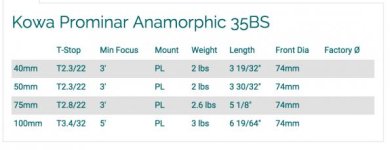
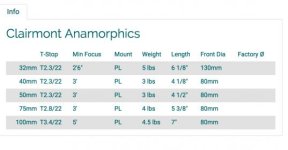
Clairmont CCI's have to be my favorite non-panavision vintage anamorphics when you rate the lenses by image quality AND usability/mechanics. These are much easier to work on from an AC's perspective. Although they do change slightly in shape and weight it's totally within normal tolerances. If these are not available, I will then recommend Kowas for anyone who want's vintage look and small lenses that are about as quick to work with as spherical primes. Cooke Anamorphics and master anamorphics are also nice to work with, but much more expensive and not as vintage looking with the severity of aforementioned flaws and etc, if that is what you want.
Screen Shot 2016-01-06 at 12.30.52 PM.jpgScreen Shot 2016-01-06 at 12.30.40 PM.jpg


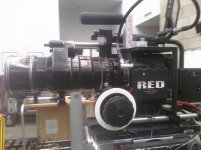
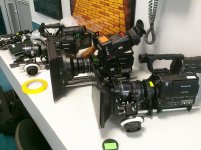
We needed something wider than 32mm so we rented a 25mm Hawk. Here it is, as a joke on my Sony NEX photography camera. It goes on the Panasonic AF100's shown above.

411758_902253395197_2137628963_o.jpg457942_902251498997_287548518_o.jpg414296_902253744497_576523544_o.jpg
 
Last edited:
WOW thanks for the great write up!!! With our lower budget what would be a good to go lens to get that anamorphic look without doing it in post - Thanks
 
I honestly don't know what your budget is, the type of shooter you are or what look you want outside of anamorphic. I'd hesitate to tell you what to get. Lomo's seem to be the bottom shelf of Cinema world anamorphic lenses if budget is first consideration. It only goes up from there, generally.
 
Back
Top