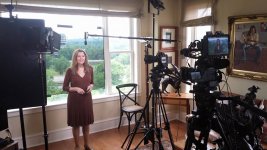
Shooting against window

Good point!

There are certain filters you can buy for your lens which can eliminate reflections. It's been a while since I've used them, but you may want to research their limitations if you do choose to add this to your production kit.

Some I can think of are:
- They cut down on light to the sensor since it is a polarizer
- They work best when the light source is 90 degrees to the reflective surface
 
Consider HMI PARs instead of fresnels. M18, or larger, softened by a 8x8' or 12x12' rag.

Key positioned somewhere between 3/4 to side-light, keeping it's reflection out of frame. Some 4x4' Floppy(s), &/or duvateens, would help.

ND on the glass would be nice, but a pain to apply, & the windows likely already have some built-in.

Push for a proper Gaffer, Grip, & small truck.
 
Are they actually going to be performing live there, or is this a music video where they are lip syncing to a pre-recorded track?

They are going to record a live session there. The'll bring a sound guy as well. So here come mains problems and possible interference. We're gonna gather at 12:00 to set up аnd we'll start, I believe, at 14:00-15:00. We need to record 5-7 tracks. Many takes, of course, so we'll end up late. And definitely, the lighting conditions ouside will change - that's another challenge.

However, these are friends of mine and I've warned them about the difficulties and that they might not get the result that they fantasize, that's ok with them.

The bad news is that we were not allowed to gel the windows since this property is for sale. The good news is that the windows there have reflective coating from outside, so they already block some light.
 
Why does the property being for sale mean you can't gel the windows?

Anyway, consistency in the edit will be a huge challenge - especially going from 2-3 in the afternoon to "late". Does that mean complete dark?

Can you either push for an earlier start or shoot the whole thing at night?

Either way, good luck and post your results if/when you can.
 
I estimate that you need 60,000 LUX of light to compete against the sun (open sky, no overcast at noon time) assuming a nominal 12-stop DR camera and you are shooting using a single exposure (non-HDR, and not using RAW for post processing/compositing).

So where your subject is standing, you need to be able to meter 60,000 LUX. This is an insane amount of light depending on how far your subject is to the camera AND what quality of light you need (harsh or soft).

A harsh 60,000 light will most definitely blind your talent. If you need 60,000 LUX of soft diffused light then your source needs to be at least twice as bright to begin with.

To put it into perspective, an ARRISUN 120 which goes for around $32,000 will do about 80,000 LUX at 6ft using a 7 degree spot (estimated based on their photometric data) and consumes 12,000 WATTS. Note that 80,000 LUX @ 6ft is still configured as a harsh light, so this assumes you need harsh light and your talent is off axis to this light otherwise he/she will get blinded. If you were to diffuse the light then expect a drop to at least 40,000 LUX which now puts you below what you need to compete against the sun.

I'm also assuming the sun is shining somewhat directly into your window and at around noon time, if you have a North/South facing window at magic hour then your LUX requirement will be lower.

Interestingly,Nila's Arina LED light is said to output 100,000 LUX at 10ft with a super narrow beam angle, but diffused would put you at 50,000 LUX (or less) which would put you below what you need.

In short, competing against the sun is very difficult for continuous lighting.
The thought of using a 12k PAR from SIX feet away at full spot is mind numbing. You'd set your talent on fire before you blinded them. I agree that competing against daylight isn't easy but you've needlessly over exaggerated that difficulty. A couple M18's diffused through an 8x grid cloth would be enough to at least prevent the windows from blowing out. Very rarely do backgrounds outside of windows read the same exposure as inside as you seem to indicate is what's necessary, it winds up looking very artificial.
Is renting lights cheaper than buying scrim/gel? What if you need to bring in a bunch of extra power for the lights?
A big office building like that should have a house electrician that can do a tie-in, giving you much more available amps than your regular old wall receptacles will provide. I don't really know anything about what sort of power distribution is used in the motion picture industry overseas though.
 
Gel is cheap and can be applied with sprayed water and a exacto.
@Bern has it right. Use a par through a frame of diff off to the side.
I would also put some distance between talent and window and try to have the window out of focus.
 
I had a client ask for this on-the-spot for a sit-down interview. We shot an 85mm lens and used Kino Flo Diva 401s just outside frame edge on top and bottom in a clamshell. It ended up looking pretty good, as long as talent didn't talk with his hands.
If I had a grip truck, I would have used ND for sure, but the talent didn't complain about being blinded, at least.
 
A roll of LEE ND.9 or 1.2 (cut 3 stops or 4, respectively) can be applied directly to those windows with a silicone squeegee and a spray bottle with a mixture of water and a drop of Dawn. It doesn't take that long to do and will allow you to light with much smaller fixtures, as you'll be chasing a 4.0 - 8 instead of F22.
 
Back
Top