Scriming lights

DDirector

Veteran
So, I wanted to know if I could calculate what equiv. wattage light one is when there are scrims on it.

Lets say I have a 650w with a full scrim. What equivalent light would that be? Or half scrim?

Another example; I want to have a 150w backlight, but I dont have any more 150's. I have to use a 650. Id need to know how many scrims it would need to be a 150w.

*Without calculating on a lightmeter or changing distance/focus.
 
A full single scrim would reduce the light by about 1 stop. A full double would reduce the light by about 2 stops. A half single would only cover half the front of the lighting instrument, so you could reduce the light on part of the subject (by about a stop), while leaving the rest of the subject lit at full intensity. And a half double would reduce the light on part of the subject by about 2 stops. Oh, and I have heard of full triples and half triples, so I imagine that should reduce by 3 stops, covering either all or half of the front of the lighting instrument.

-- Ken

That is what I thought, but couldn't find any photometric specs for scrims. So for Michael's example, putting a full double on a 650 would cut the light by 2 stops, or make it the equivalant light output of about 162.5 watts (Close enough to 150). Gotcha.
 
While this is a whole different conversation, you should stop thinking in terms of watts and start thinking in terms of footcandles. Different 650 watt fixtures will produce a different intensity of light. For example, a Mole Tweenie gives off 78 FC at 10 feet while the LTM Pepper 650 gives off I believe 110 FC at 10 feet, while having an even wider beam than the Mole light. A 150 won't output exactly 3/13 of what a 650 will because of different designs.

But anyways, single scrims reduce light by 0.5 stops and doubles reduce by 1 stop (it's not 1 and 2 stops). So a full double on a 650 would be equivalent to a 325w globe in that same fixture, if such a thing existed. I'm not exactly sure how stacking them works though, I think that two full doubles may not necessarily reduce the light by two stops.
 
Yeah, a double is one stop, single is half a stop.

So, the double with give your half the intensity.

I've heard of gaffers and DP's using their light meters in the foot candle mode, so they get use to how many foot candles certain lights will give at certain distances. Since foot candles always stay the same, and aren't reliant on film speed or anything else, you'll start to remember that a 1k at 10' will give you x amount of light. From there you can make much better calls on what units to use in different situations. Seems like it would be a good habit to get into.
 
I don't mix lights and I do work in fc. But I still wanted to know.But I don't understand how you calculate 650w - 2 stops to be 162.5w?
 
1 F stop is half or double the light. Two F stops is a quarter or quadruple the amount of light.
 
... But anyways, single scrims reduce light by 0.5 stops and doubles reduce by 1 stop (it's not 1 and 2 stops). So a full double on a 650 would be equivalent to a 325w globe in that same fixture, if such a thing existed...
It's possible that different manufacturers use different strengths for singles and doubles. My recollection was 1 and 2 stops. Lowell and LTM seem to be in agreement with me.
http://www.bhphotovideo.com/c/product/125407-REG/LTM_PA_A247_4_1_4_Full_Single_Scrim.html
http://www.bhphotovideo.com/c/product/31936-REG/Lowel_O1_54_Full_Single_Scrim_for.html
http://www.bhphotovideo.com/c/product/125389-REG/LTM_PA_A244_3_Full_Double_Scrim.html
Other manufacturers, like Arri, Matthews, and Mole Richardson, don't have their strengths specified (on the B&H site, anyhow).:huh:

-- Ken
 
0.5 stops and 1 stop is universal. I can say with near certainty that the LTM ones have a mistakes in the description. The Lowel one is called a "full scrim" by Lowel; B&H made a mistake in the product name. Lowel doesn't have single or double, just full, half, or graduated.

Also, as far as triple scrims mentioned earlier, I've only heard of them in the form of a net, never in a circular one meant for a light. A full scrim set should include two full doubles, making such a device unnecessary (although I would much prefer to use a smaller fixture than use two full doubles).
 
Other things can also effect your light output such as bulb age for example. Best way to be sure that light A is putting out equivalent to light B in any given situation is by light meter I realise thats not helpful as you said without calculating on a light meter.

Another way would be to point your cam at a white wall with the light head and use a waveform to read the ire. And then swap lights and do the reading on the second unit / make changes until they match ire level.
 
Full/Double scrim = 1 stop
Half/Single scrim - 1/2 stop

Full/Double scrim (1-stop) [Half the light]
1,000w = 500w

Half/Single scrim (1/2-stop) [Quarter of the light]
1000w = 750wSo, if Im adding a gel to it;
1000w + Full CTB (1-stop) = 500w
1000w + 1/4 CTB (1/4-stop) = 750w

Everything right?
 
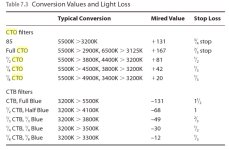
1/4 CTB cuts the light by a little over half a stop too. Quarter, half, and full don't correspond to the F stop reduction, it's solely the color temperature change.
 
Oh. Good you pointed that out. thanks
I know it wasnt related to f-stops, but I thought that it might have been roughly the same.
 
So, CTB is roughly 2x the amount stated:

1/4 CTB = approx 1/2-stop
1/2 CTB = approx 1-stop
1 CTB = approx 2-stops

what about CTO gel?
how much light loose would it be? if its possible to calculate.

1/4CTO =
1/2 CTO =
3/4 CTO =
1 CTO =
 
Back
Top