#screenplays registered each year-- put up or shut up :)

Okay i am so tired of the numbers thrown around in blogs, by gurus, by amateurs, about the number ("50,000", "70,000") of feature spec screenplays written and registered each year. I feel those numbers are grossly overstated, hyperbole, but I may be wrong and if so serve me up two pieces of humble crow pie. :)

Time to put an end to this non-sense, or else document the number with some credible evidence.

I wrote the WGA again today about this, and I did the same for the US Copyright Office. I wrote the WGA in the past, couple of years ago if I recall but I can not find that email response from them. They register about 50,000 works a year i believe, and that is the number I have heard so often from non-WGA bloggers and on forums for the alleged number of feature specs registered each year. Oh really? The WGA had told me in that email that that number represents the number of registrations each year through their online submission system, but that they do not differentiate between the types of works that are registered for that massive number. Thus those 50,000 registrations include: feature length spec screenplays including first drafts, second drafts, final drafts, shooting scripts; poetry; short screenplays; novels including first drafts and second drafts and final drafts; theatre plays; magazine articles; short written literary works (short stories); and more.

So I am seriously interested in discovering the truth-- how many feature length final draft screenplays are registered each year, and not including duplicate registration, at either WGA or the US Lib of Congress Copyright Office? Is there a way to know, or are the numbers tossed around on blogs people pulling numbers out of their you-know-what without really researching and knowing the actual number?
--randall
 
Last edited:
I just heard back from the WGA West. Still awaiting a response from the US Copyright Office.
_
"The WGAW Registry registers over 70,000 pieces of material per year. You are correct, registerable [sic] material includes scripts, treatments, synopses, outlines, and written ideas specifically intended for radio, television and film, video cassettes/discs, or interactive media. The WGAW Registry also accepts stageplays, novels and other books, short stories, poems, commercials, lyrics, drawing, music and other media work. The WGAW Registry does not monitor the different types of material registered annually as the material type or medium is strictly assigned by the author for his or her own reference and has no bearing on the actual registration. The Registry does not have any type of monitoring or census mechanisms in place. --WGAW Registry"

​
I think I will ask the same of WGA East.

I don't think anybody really knows the number of final drafts (really all that matters) of feature length screenplays that are registered with WGA or the Copyright Office. So I just wish bloggers and forums would quite using that number 50,000 or 70,000 or I have even heard higher numbers. Does nobody any good.

Okay IGNORE the following if you just want to stick with facts. The following is just for fun, mind games, think tank mateiral, really: We can have some fun playing voodoo guestimation but it would be speculation-- even with 140,000 WGA literary registrations (WGA West+East), and another 140,000 literary registrations withe the US Copyright Office, one might speculate that maybe ~5% of those are final draft feature screenplays, so maybe 15,000 screenplays (final drafts, read to market or on the market/assigned). I like 15,000 a lot better than 70,000, because many 'experts' cite 10% of screenplays even being properly formatted, so now we are down to a competition of 1500 annually. Of those 1500 only half with proper story structure-- now we are down to 750/year. Of those perhaps 1 in 10 with a decent (high concept compelling) logline-- now we are down to 75/year, getting closer to the small number of specs sold each year for the several hundred movies made each year, but at least it starts to make sense what sells and why and why so few out of the mass of mediocrity flooding WGA and the Copyright Office. Drop that 5% of all registered material being final draft feature length screenplays and the odds improve even more (less competition); all voodoo speculation of course, but interesting to contemplate, and I find it all far less discouraging than the hyperbole running amuck on the internet that only disparages screenwriters with disinformation.
-- randall
 
Last edited:
Id be inclined to agree with much lower numbers. It is anecdotal, but I can't tell you how many people I know who have been writing a screenplay for as long as I've known them. Not screenplays, but A screenplay. Also, spending any time on triggerstreet should give a glimpse into what many consider to be screenplays. Kind of like Ultimate Fighting right now. I see tons of UFC MMA gyms around my town, but how many due-paying members will ever enter the octagon? I agree the actual screenplays that could compete in the market would have to be considerably low. Especially when you hear the tales of woe from script readers.

Good post :)
 
Wouldn't you want to take the Han Solo stance on this: "Never tell me the odds"?

Not at all. Because I actually find the odds rather good once some realistic numbers are used. All assuming a well crafted screenplay, well written, high concept, great logline, great story; and that just means learning the craft, and then writing such a screenplay, and then marketing it. But it is NOT the typical dismal chatter one reads on blogs about competing with 70,000 similar scripts put out there each year. Now writing a great screenplay is no easy task, takes years of apprenticeship, mastering the art form, hard work writing and rewriting, but it is doable, not just a roll of the dice as some would have us believe; at least that is what I believe.
 
Last edited:
...Now writing a great screenplay is no easy task, takes years of apprenticeship, mastering the art form, hard word writing and rewriting, but it is doable, not just a roll of the dice as some would have us believe; at least that is what I believe.
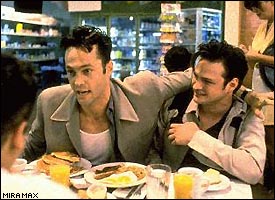
swingers_drunk_diner.jpg

Looks like our Randall's all growns up...
 
Id be inclined to agree with much lower numbers. ...how many due-paying members will ever enter the octagon? ...Good post :)

Funny. I like that (Enter the octagon). :)

Yes I think the numbers are even lower than my initual voodoo witchery number crunching machine, when one factors in all the TV show teleplays that must be part of those registration numbers. I just emailed the WGA East, will be interesting to see what they say. And if I have to, I will call the US Copyright Office tomorrow, if I do not hear back by email by then (figuring my email got chomped by a spam filter).
 
Regardless of what filters get applied in your very reasonable manner, it's still probably a lot like...the New York Marathon; the winner can truthfully say s/he beat ~25,000 people (if, just for the sake of discussion, we assume equal numbers of men and women among the ~50,000 entrants). But in reality, they were only competing against a relatively tiny number of serious competitors. Like maybe a couple dozen or so...

Which, like your guesstimate, is actually good news : )

On the other hand, those very few tend to be *extremely good* at it...
 
Kudos to Randy for doing research. It should give all of us hope and re-determination if you were feeling down on the "odds."

I think when people poo poo anything you have to ask yourself:

1. Do they have an agenda?
2. Is their ego dominating their reason?
3. Are they speaking from experience and are truly looking out for you?
4. Have they had such negative experiences they want to share their misery?
5. Are they so insecure with their work that they spread mis-information to reduce potential threats to their corner?

I don't really dwell on trying to figure these out--in my mind, I am committed to learning the craft and because I had some success with another craft, I feel learning the craft is about smart, hard work, learning from others who know more than you do, figuring out your weaknesses and fixing them, and keeping on the path.

I think if you want to write, you got to write. You can write in a vacuum and you might be the next wonder boy or girl. I prefer to look at what has been done before and what is being done now as I learn this craft and wear blinders to the "odds." I do believe there are very little odds if you learn the craft and keep writing, get feedback, keep writing, re-evaluate, keep writing, rinse and repeat. I'll let you know if this works!
 
Because I actually find the odds rather good once some realistic numbers are used. All assuming a well crafted screenplay, well written, high concept, great logline, great story; and that just means learning the craft, and then writing such a screenplay, and then marketing it. But it is NOT the typical dismal chatter one reads on blogs about competing with 70,000 similar scripts put out there each year.
Well, the odds are long, that's for sure, but here's another way to approach getting to the bottom of it... Michael Hauge, of "Writing Screenplays That Sell" fame, in his seminar states that he used to work in a studio as a reader, and (IIRC) his estimate was that barely 1% of the scripts that came in are even readable, much less "good".

So if you look at it that way, there's not really that many good scripts out there. The sobering fact though is that ALL those people who submitted their scripts to studios for consideration, obviously all thought that they were good -- and 99% of them weren't even readable, they were so awful. So that points to an absolutely massive disconnect between the writer, and reality. People are churning out massive amounts of garbage that they think is good enough for Hollywood, when it in fact isn't good at all.

However, if you want to get some quantitative data, try writing to the best screenplay contests like the Nicholl Fellowship and ask them how many submissions they get. That'll tell you a pretty decent number of how many screenplays are being written and submitted for consideration. You might also want to ask them what percentage of those submissions actually make the first cut, and that'll give you a good clue as to how realistic writers are in assessing their own material. I mean, if you're submitting it to the Nicholl you obviously think it's pretty good, right?

EDIT - so I just looked up the Nicholl FAQs. They got 6,304 scripts entered in their contest in 2010. 6,304. Now, think about this -- these are people who are submitting their scripts to a contest run by the Oscars, fer cryin' out loud. And over six thousand of them flooded the office. And of those, half of them were thrown out on the first read. 2900 went on to get a second reading, upon which 2,000 of those were tossed. 900 scripts got a third reading, where 2/3 of them were tossed. 326 actually made it into the contest, at the quarterfinals round.

So of 6,304 scripts submitted, only 5% of them were good enough to enter the contest. 95% of the writers who submitted their script to the Nicholl were turned down.

So in a way I'm agreeing with the OP -- the numbers of scripts written each year looks overwhelming and daunting, and it makes the odds look like a lottery. In reality, most of those things that are written and registered are either not scripts, or are garbage, so they don't count. But the truth of the matter is that something on the order of 100% of the writers out there think that their stuff is actually good, and 95% of them are very wrong.

If you actually are really good, then you've got a chance. Of course, how much of a chance is a matter of interpretation -- consider that any script actually accepted into the Nicholl and making it to the Quarterfinals is probably a pretty good script. But of the 326 that made it to the QF's, 316 of them were sent home empty-handed before even making it to the finals.
 
Okay i am so tired of the numbers thrown around in blogs, by gurus, by amateurs, about the number ("50,000", "70,000") of feature spec screenplays written and registered each year. I feel those numbers are grossly overstated, hyperbole, but I may be wrong and if so serve me up two pieces of humble crow pie. :)

Time to put an end to this non-sense, or else document the number with some credible evidence.

Obviously someone who's never lived in So. Cal... everyone has a spec script they are trying to sell... whether it's written down on paper or not...
 
Obviously someone who's never lived in So. Cal... everyone has a spec script they are trying to sell... whether it's written down on paper or not...

But see that ('everyone [in So. Cal.] has a spec script') seems very non-quantitative to me, a perception-- how many people have you actually encountered with a feature film spec script written down? Really, be honest. 100? 500? More than that and you must really be talking a lot to strangers. How many of 'everyone' have scripts for TV pilots (not relevant to me)?

If it was not written down it does not count, sorry, because then that is just an idea, dime a dozen, perhaps worth a pitch but likely not, certainly not a gem of a screenplay worth marketing.
 
Last edited:
... So that points to an absolutely massive disconnect between the writer, and reality. People are churning out massive amounts of garbage that they think is good enough for Hollywood, when it in fact isn't good at all.....

I completely agree with that. I have seen this 'phenomenon' with myself (less so of late, I am pretty harsh on myself with story ideas these days, and loglines), with my screenwriting friends (and it is really hard to tell a friend that about that disconnect-- friends just want praise, and of course I too want praise from friends), and with screenwriter wannabees at a local screenwriters group (who unbelievably had each written 7-10 feature screenplays and yet had not even heard of Move Magic or Final Draft or even Celtx and were using MS Word for their scripts, had not heard of a thing called subtext or the hero's journey or turning points, no sheeet, unbelievable, but there you go)./
 
Last edited:
...On the other hand, those very few tend to be *extremely good* at it...

Yes, I am sure those that 'attain' (David Goyer, Stuart Beattie, Terry Rossio et all), end up writing many of the movies we see at the box office. So the rest of us saps end up hoping to sell the dozen or two specs sold each year-- that is a heck of a gauntlet to run, but as is being discussed here, 99%+ of the specs are delusional junk, unreadable and incoherent for the most part, at least to an agent/prodco. So again, a matter or mastering the craft and writing a script with a great story and great logline and that is a fast read, a compelling marketable screenplay; the networking/marketing the heck out of it.
randall
 
...However, if you want to get some quantitative data, try writing to the best screenplay contests like the Nicholl Fellowship and ask them how many submissions they get. That'll tell you a pretty decent number of how many screenplays are being written and submitted for consideration....of the 326 that made it to the QF's, 316 of them were sent home empty-handed before even making it to the finals.

I have heard from a respected source that the Nicholl attracts (and the winners often end up being) a lot of 'artsy' type screenplays, far fewer 'commercially viable' screenplays (our goal-- to sell). But the Nicholl data does provide some insight, especially on the quality of scripts being submitted by writers who all think their scripts are great.
 
Last edited:
...a local screenwriters group (who unbelievably had each written 7-10 feature screenplays and yet had not even heard of Move Magic or Final Draft or even Celtx and were using MS Word for their scripts, had not heard of a thing called subtext or the hero's journey or turning points, no sheeet, unbelievable, but there you go).

Exactly. And more back-handed good news for those of us that do know, and know how, even if only as aspirants, to apply these things...

My experience as an actor and (non-professional) script reader/consultant have shown me the same exact thing you describe - to put it in my own words: rampant incompetence fueled by an incomphrehensible unwillingness to actually study/learn the craft.

And it's not just in screenwriting. I've been involved in music creation/production for most of my career, and am an avid offshore racing sailor. The same situation applies there.*

But again, the good news: it thins the herd competitively for those who *have* trained well and *do* know (at least to a substantial degree) what they're doing. The 99% who don't become the "low hanging fruit" for those guys.

When the skilled and knowledgeable compete with each other *that's* the real ball game... : )

*EDIT: not to denigrate the many very talented, highly trained, hardworking professionals I've worked with over the years, in both music and sailing (not to mention film!). Some of those people have been my teachers and mentors, however formally or informally...and my close friends.
 
Last edited:
More data to add to my original post:

WGA East "registers 10,000 to 15,000 [literary works] a year, varies each year" (email communication today with their registrations department). This is a much smaller number compared to the 70,000/year through WGA West. So really we are looking at ~80,000 literary registrations each year with the WGA. That includes poems, outlines, treatments, short scripts, short stories, novels, TV teleplays including the gazillion episodes that permeate the 100 cable/satellite stations, animation, music, lyrics, concept, art, TV commercial, pilot, play, teleplay, reality, documentary, first drafts, subsequent drafts, final drafts, shooting drafts.

Geesh, realistically we are looking at more like 1-2% of all that being a feature length screenplay title a writer goes on to market, so maybe 1000-2000 specs a year as 'competition' via WGA; that is my voodoo guestimation. Also remember that WGAW requires a renewed registration every five years, WGAE every ten years, so some of those registrations each year are renewals.

2000 a year via WGA. Maybe another 2000 through the US Copyright Office (pure speculation on that number at this point). Maybe 1000 not registered anywhere.

Okay 5000+ serious specs, a number kind of close to Barry's figure of 6000 or so submitted to the Nicholl contest; I feel we are getting in the vicinity of a number with some reality behind it, But again, I could be wrong, keep that slice (or two) of Humble Crow Pie nearby, and I might need a quart of milk to scarf it down.

6000 specs x 1% written well with a great concept = 60, much closer to the number of specs bought each year.

6000 specs but the real ball game (as Ted pointed out) is going on with players that have mastered the craft, maybe a few hundred, most of those 6000 spec writers can't even find their way to the baseball field (count me in, I am still looking at the map, lost, but one day i will find that golden ball field!). I am continually amazed why, with other a few serious screenwriters forums on the web (as judged by daily postings by members, and believe me I have looked for those forums and there ain't many of em, dvxuser is perhaps the best I have found, though there are a couple of other good ones), there are so few regular screenwriters here or on other forums (hmm, maybe they are busy writing though instead of talking about writing? i think there is a healthy balance somewhere there)

Further good news-- even if a spec is not sold, the unsold specs if well done and high concept can serve as calling cards to get writing assignments ($$$$$$).

And ten times as many specs are bought as are made.

And movies at the box office did quite well this summer, set a new $ record, what I heard on the news this morning--
_
"The National Association of Theatre Owners (NATO) today announced the summer 2011 box office domestically reached a new record of $4.4 billion. Summer admissions were up an estimated 1.0% over summer 2010 to 546 million. 2011 also marked the fifth consecutive summer in which box office revenues exceeded $4 billion. (Summer is defined as running from the first full weekend in May through Labor Day of each year.)

NATO president and CEO John Fithian stated, "In the midst of 9% unemployment and a continuing weak economy, it is striking that the movie theater industry can continue to grow revenues and admissions. Along with our distribution partners, movie theaters offer compelling entertainment in state-of-the-art facilities at reasonable prices. In a weak economy or strong, the movie theater remains the first and most affordable choice in out-of-home entertainment.""​
_
let's hope hw is picking up, they might start buying more specs, make more movies, take more chances

--randall
 
Last edited:
I think you're trying to drink your own Kool-aid here a bit... Six thousand scripts were submitted to the Nicholl alone. The Nicholl is one of the premium, best, highest-tier screenwriting contests in existence. I would guess not more than 20% of writers are bold enough to submit their scripts to the Nicholl.

So thirty thousands scripts being written per year. Probably. 27,000 of them utter garbage, probably.

Remember, 2,900 scripts made it past the first round of the Nicholl. Sure, 3500 got thrown out in the first round, but 2900 made it past the first round. 900 made it to a third reading. 900. That many made it past two readings at the screenwriting contest run by the Academy of Motion Picture Arts & Sciences. That's pretty sobering.

Meaning -- there's a massive amount of garbage out there. But there's at least 900 scripts that are good enough to get read not just once, not just twice, but three times by the Nicholl.

Competition? There's a LOT of competition.

Is your script good enough to get through three readers at the Nicholl? Mine aren't. I mean, I've placed as a quarterfinalist, and a finalist, and won 2nd place in three national screenwriting competitions -- but I never got past the first round of the Nicholl...

So, I guess -- if you're trying to find out if your stuff is actually competitive, my answer would be - submit it to the Nicholl and see what happens. If you get bounced in the first round, you know you've got a long way to go. If you get to the quarterfinals, your script is probably pretty good. Good enough to get bought? Probably not. But still pretty good.

You make it to the finals of the Nicholl, and you'll receive some pretty serious consideration from agents. You may still not get bought, but you'll get seriously read.
 
Back
Top