Follow along with the video below to see how to install our site as a web app on your home screen.
Note: This feature may not be available in some browsers.
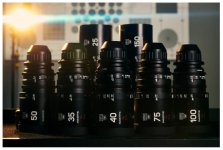
Looking forward to shoot my next feature film on those babies in September
They got the anamorpic ratio, but without the artifacts. Much like shooting spherical but in anamorpic.
What do you mean by that? my guess would have been "anamorphic bokeh and aspect ratio but no crezy flares and no soft sides", but looking at the footage I don't even see the elongated bokeh! (which also means I don't get the point of using them instead of spherical lenses, but I'm pretty sure there must be a reason)
Interesting, thanks for the explanationThey are rear anamorphics which don't have oval bokeh.
Oval bokeh is caused by front anamorphics because the f stop is constant for both the horizontal and vertical planes. If you had a 50mm f2.8 2x front anamorphic, that means it is 50mm f2.8 vertically, but a 25mm f2.8 horizontally. If you can imagine, the depth of field for a 50mm and a 25mm lens is different, so vertically, the depth of field is going to go out of focus quicker than it is horizontally. Thus, you would see ovals, because horizontally it is not turning into "bokeh balls" as quickly as it is vertically.
A rear anamorphic is just a teleconverter in one direction. That means that the f stop is not constant for both planes. If you had a 50mm f2.8 2x rear anamorphic, you would have 50mm f2.8 vertically, but a 25mm f1.4 horizontally. The depth of field is going to be the same in each direction, so the image is going out of focus at the same rate in both directions, which means you'll see normal circular "bokeh balls".
Ursa MiniPro, or maybe the 12K, when I can get my hands on one.
.
I gonna shoot in very tight spaces, having the magnification of a - lets say - 50mm, but the with of a 25mm at the same time, is what I need/want.
I'm confused - wouldn't you get the same vertical magnification by just cropping a spherical lens down to 2.39:1?
Also isn't Grug right that if you want to shoot in tight spaces, you will be unable to shoot wides with a 50mm anamorphic on a S35 sensor?
An anamorphic lens shifts the relationship between the magnification of the vertical and horizontal axes. Cropping a spherical lens is going to give you a fundamentally different result.
Which, I thought, would be the same as shooting with a 25mm lens and cropping out the top and bottom until you see a 50mm vertical FOV.
.
I'm confused. I understand that you can achieve a 25mm horizontal FOV with 50mm DOF - I'm not sure why, but I assume it has to do with the lens having 50mm focal length and a separate optic drawing in the sides of the field of view.
I'm confused about what you're saying about different vertical and horizontal magnification.
Wouldn't there be distortion if the end image looked any different than it does with a spherical lens?
Also, if you crop in on a 25mm image, you get the exact same shot you would get with a 50mm lens. So, in my mind, shooting with a 50mm anamorphic would be like shooting with a 50mm spherical lens and then expanding the sides of the frame until you see the full width that would be seen with a 25mm lens. Which, I thought, would be the same as shooting with a 25mm lens and cropping out the top and bottom until you see a 50mm vertical FOV.
If you have the time, please explain.
So, generally, everything feels more telephoto and you've gained that advantage at the expense of the ability to use an ultra wide-angle perspective (and also anamorphics have a long mininum focus distance without diopters and have a number of optical aberrations) - correct?
Well, 25mm is hardly an ultrawide. You can get the 12.5mm FOV but you'll never get that perspective. But I understand the advantage. Plus, if you ever really needed that look or a fisheye look, you could sneak in a cropped shot of spherical 12mm rectilinear or fisheye
Interesting what you say about modern anamorphics. $50k/each for those arri master anamorphics - those advances have not come cheaply![]()