science fiction: my idea for RGBWK sensors

Samuel H

Major Contributor
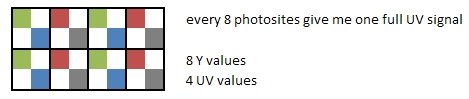
Given how our eyes work, 4:2:2 chroma subsampling seems to be enough for most applications. If we're going to end up subsampling our color information anyway, we might as well do it directly in the sensor, and get better DR out of it. My idea would be to substitute some of the color filters on regular RGB Bayer sensors by white filters (some Kodak patents already do that) and black filters (strong-ish ND, probably somebody has already thought about this too, no idea), arranged in a way to give out the kind of information that 4:2:2 color subsampling is going to keep (this arrangement is what I've recently been thinking about)

This should lead to a few stops of higher DR, as the white photosites see better into the shadows, and the black photosites protect the highlights

similaar.jpg


more details here:
http://www.similaar.com/foto/bayer/rgbwk.html
 

Attachments

  • similaar.jpg
    similaar.jpg
    18.2 KB · Views: 0
The preponderance of green pixels in the Bayer and other traditional sensors is intended to exploit the eye's high sensitivity to green for detecting edges and therefore "sharpness" in the image. Consequently I'd say there is a risk that your filter pattern might produce pictures that don't appear as sharp to the viewer.

It would be relatively straightforward to simulate different encoding schemes by re-sampling an existing full resolution image file and measure viewers' reactions to them, so I'm all for trying this out and seeing how it works. The idea of ND filters incoporated into the sensor makes a lot of sense for improving the dynamic range (but at the probable expense of noise).

- Greg
 
I always wondered, why nobody ever came up with the idea of a 3chip camera, but with 3 bayern CMOS sensors that have 3 different sensitivities.
 
I always wondered, why nobody ever came up with the idea of a 3chip camera, but with 3 bayern CMOS sensors that have 3 different sensitivities.

I was told once by a Canon engineer that the 3-color prism assembly in a 2/3" video camera adds about $4,000 to the price of the camera. And if you take the side off one, it's easy to see how much bulk and weight it contributes to the system. For larger sensors, it would be even worse. Not to say it wouldn't be worth trying -- again, I think this could be simulated in software to see if it's worth the downsides.

- Greg
 
Back
Top