SanDisk’s New Extreme Pro SD UHS-II Cards are World’s Fastest SD Cards with 280 MB/s

joe1946

Veteran
SanDisk has released new UHS-II SD cards with write speeds up to 250MB/s and read speeds up to 280MB/s. This new line gets its major speed boost from the UHS-II bus interface. Most SD-compatible cameras currently on the market support UHS-I, at best; however, we are just starting to see new cameras with UHS-II support (like the Fuji X-T1).
The new UHS-II bus interface offers the ability to build cards with up to 312MB/s transfer speeds, which is a big jump from the maximum theoretical speeds on the UHS-I interface at 104MB/s.

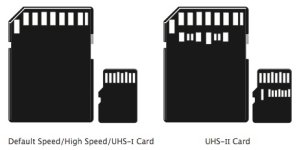
The new UHS-II cards have a second row of pins to support the higher data transfer rates. The first row of pins are identical to the standard SD cards we’ve seen on the market over the past several years and allow UHS-II cards to function normally in older, non-UHS II devices. Of course, if you don’t have a UHS-II compatible device, you will not see the speed benefits from the UHS-II bus interface.


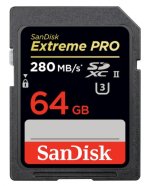
UHS Speed Class symbols, such as U1 and U3, indicate minimum write speeds for real-time video recording. For UHS rated cards, you will find the numeric class rating within the letter “U” on the card’s label. (See the U3 labeling in the top image.)
Compressed 4K video capture data transfer rates will vary among cameras depending on what codec the camera uses. The new U3 Speed Class should be plenty fast enough to handle Sony’s XAVC-S 4K codec (used in the new Sony FDR-AX1), which captures 4K video at a 150Mb/s data rate. The U3 Speed Class at 30MB/s minimum write speed translates to a 240Mb/s data rate. While the 30MB/s minimum write speed may seem low, it’s worth noting that the SD Association has not established a speed class rating higher than U3 at the time of this card’s release.


Photographers need to keep in mind that the U1 and U3 ratings are practically meaningless for still photography. The max data transfer rates can vary widely among cards with the same U1 and U3 ratings.
Additionally, while there are UHS-I cards that offer a U3 speed class rating, it is unclear whether the U3 rating on these new SanDisk cards is valid for non-UHS-II devices. For more about SD card types and ratings, see the resource article Demystifying SD Cards.
The new SanDisk Extreme PRO UHS-II cards should be available in April in 16GB to 64GB capacities for $119.99 to $299.99.
http://www.photographybay.com/2014/...-sd-uhs-ii-cards-are-worlds-fastest-sd-cards/

SanDisk_Extreme_PRO_SDXC_280MBs_NoClass_Front_64GB_HR-404x500.jpg

UHS-II-Cards-with-Second-Row-of-Pins.jpg

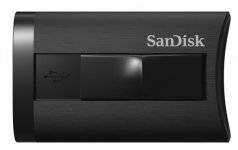
SanDisk-UHS-II-Card-Reader-640x405.jpg
SanDisk UHS-II Card Reader

4K @ 60fps ?

 
Cool.

It's just that the variance in advertised write speed makes planning a little hard: "Up to" 250 MB/sec., but we promise only 30.
 
Cool.

It's just that the variance in advertised write speed makes planning a little hard: "Up to" 250 MB/sec., but we promise only 30.

What do you mean only 30? If you are talking about those new Kingston cards which came out at the same time as the GH4, they are only UHS-I Class 3, not UHS-II.
 
I'm talking about the cards announced here, the SandDisk ones. Read the middle of the copy-and-pasted announcement.

Class 3 means "We guarantee 30 MB/sec," whether UHS-I or UHS-II. UHS-I and -II mean the speed of its bus. UHS-I means 50 or 104 MB/sec. UHS-II means 156 or 312. And so each new card gets a bus speed rating (UHS I or UHS II) which tells the speed of the bus and a speed class rating (1 or 3) which tells its guaranteed "minimum sustained speed" of the overall card, when you account for any other bottlenecks, like the flash memory itself. And this replaces the "x" speed ratings of yore. Go ahead, read for yourself, and see if you can make better sense of it: http://en.wikipedia.org/wiki/Secure_Digital#Speeds

But then every card also has a "maximum speed," and here it is 280 MB/sec. But that's only reading, which is always faster than writing, which for this card is 250 MB/sec. But for how long, and under what conditions?

This is totally insane. "What is wrong with you people?"

ngbbs4ada4a55a49a9.jpg
 
Last edited:
Well, class 3 means it's fast enough for the 200 Mbps video in the GH4 (25 MB/s). Not really impressive, if you've shot 5D3+RAW at 84 MB/s on CF cards, or BMCC RAW at 120 MB/s on SSD drives.

and even if it was actually fast... what is it good for? The only people who might need something faster are Canon RAW video shooters with SD-card cameras, and their bottleneck is the SD controller.
 
Last edited:
I see they also show a UHS-II Micro SDXC version so if the Samsung Note 3 smartphone shoots 4K @30fps with the current 64GB Sandisk UHS-1 Micro SDXC card with support for the new UHS-II Micro SDXC the next Samsung Note 4 might shoot 4K @60fps. The new Sony A6000 has the worlds fastest AF with 24mp @11fps with tracking in stills so I think there will be some interesting 4K cameras coming later on in the year when support for UHS-II comes in them.
 
Last edited:
Back
Top