Roger Corman

bennycord

Well-known member
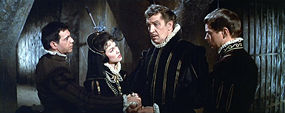
Anyone know how the lighting was done in Roger Corman's old
Edgar Allan Poe movies. The ones with Vincent Price.

I've looked everywhere but haven't been able to find any info.
The atmosphere created by the lighting in those films was
amazing. I want to film my next feature in similar fashion.

Thanks in advance!
 
I'm having flashbacks to cinematography class today, when my instructor talked about "push-button cinematography." Watch those movies over and figure out what they did. Look at the direction the light is falling from, look at how sharp or soft the shadows are, the color palette of the light and production design (if they're in color), look at the composition of the shots, check for "rays" of light--they probably used diffused smoke to define the light like that--learn some cinematography so you know how to figure it out yourself instead of looking for a quick fix from somebody else.
 
HappyGobo,

If you read my post you would have noticed that I have done some research to try and learn. Obviously, a lot of hardlight was used but I want to know
more.

Roger Corman was know for being very resourceful. Maybe there is a grip or DP on DVXuser.com who worked on the set of some of his films. Who knows?

Gee...Happy, you don't even know the answer do you? And you took a cinematography class!

Also, life's too short. If I can get a quick fix that can help. So be it.
 
How would taking a class tell me what kind of lighting was used in films I've never seen? Besides, a class is only good up to a certain point, after that the best way to learn it is to do it, and one can start by just watching and analyzing. Hence my actual advice.
 
anal-ize away...

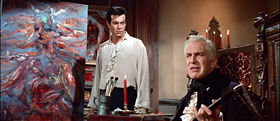
fallusher2.jpg


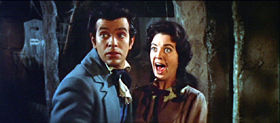
fallusher3.jpg


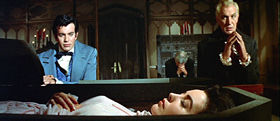
fallusher4.jpg


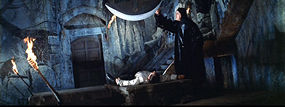
pendulum2.jpg


pendulum4.jpg
 
I appreciate such large stills. Bright spots would tend to indicate a general lighting scheme of a crosskey and fill combination, the lighting palette is mainly variations of blue (with the top one the most "naturalistic"), and some slightly broken throw on the background for a sense of depth and space. Basic stuff.
 
My guess is a lot of fresnels and barndoors... plus whatever they used for flags back then. This stuff was probably done with BIG lights at distance... like 2K and up... and the soft stuff was probably the same light punching through a silk. Some of those shots probably even have an ellipsoidal going.

The nice thing is that you can rule out flos and HMI by a long shot... that only leaves "bread 'n butter" options like fresnels, scoops, and open face. :)

It's funny... inexperienced filmmakers only think about base tools. Look at the audio forum... every new guy thinks he can get some mic and be done with audio... just like in the lighting forum guys think they can get a particular light or lights (or even home depot options) and then do good lighting.

The point so many guys keep missing is that being effective is about control... not just power. If you want to light things well you need to address control issues first... that means black duvetyne, flags, barndoors, scrims or nets, and controlling spread and intensity.

Thanks for posting this thread... isn't it amazing how great of a job the lighting guys did back then? Simply beautiful... :beer:
 
MattinSTL said:
Thanks for posting this thread... isn't it amazing how great of a job the lighting guys did back then? Simply beautiful... :beer:

It's even more impressive when you consider the budgets and tight schedules they were working with on a Corman production.:)
 
MattinSTL said:
My guess is a lot of fresnels and barndoors... plus whatever they used for flags back then. This stuff was probably done with BIG lights at distance... like 2K and up...

This is a really good point. Back then hollywood was all about the huge gigantic lights.
 
Back
Top