Rings of Power - Spoilers

Now it’s over, let’s come out and say it: The Rings of Power was a stinker
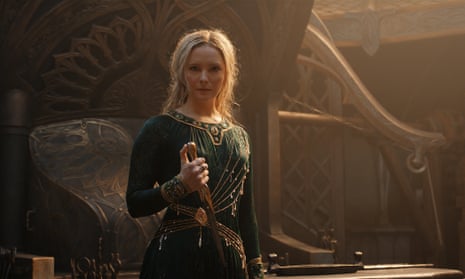
2093.jpg


The world’s most expensive show – which looked like an episode of Hollyoaks, only with woeful acting – was so inept that every episode left you sniggering

You've gotta love merciless British reviews

https://www.theguardian.com/tv-and-...t-and-say-it-the-rings-of-power-was-a-stinker
 
I thought it was a really solid first season. Episodes 6-8 were better and more exciting than anything in the Hobbit movies, with a couple narrative twists I didn't see coming that fills in the lore in a satisfying way. I didn't read that review but it just sounds bitchy and like that reviewer has an axe to grind.
 
I'll admit I'm triggered by this show. Amazon took this opportunity recreate Tolkien's work to fit the current social agenda in Hollywood. In addition to this the show is poorly written so it fails on two fronts. Finally Tolkien fans have the right to voice their displeasure without being blocked or labeled as a racist. They basically want insert woman as lead character and give her masculine qualities to make her powerful to elevate her. When writers have social agendas it feels forced and unnatural and detracts from the story. They basically went into the Tolkein's appendix so they would have free will to do whatever they wanted. If they want to create a high fantasy series without being restricted they should have created their own world from scratch. Instead they said Tolkien is a racist and we are going fix his world and then expected his fan to thank them. They want the views from the fan base but not the criticism. Sorry you can't have your cake and eat it too.
 
I thought it was a really solid first season. Episodes 6-8 were better and more exciting than anything in the Hobbit movies, with a couple narrative twists I didn't see coming that fills in the lore in a satisfying way. I didn't read that review but it just sounds bitchy and like that reviewer has an axe to grind.

I think the reviewer felt like there was a lot of time spent hemming and hawing over who was Sauron, but he felt both that the answer was obvious and that that question alone wasn't enough to sustain his interest in the drama
 
If you are looking for a chill show to watch, Rings of Power is way up there for casual entertainment value.

And if you are looking for more complex entertainment, there is plenty of fan/hater drama on the periphery to grt into.

So, as they say, there’s something for everyone
 
Here's an interesting column on Dragon House vs Power Rings by a conservative commentator for the NYT: https://www.nytimes.com/2022/10/28/opinion/rings-dragon.html

Most of it is a broader analysis of the dramatic successes and shortcomings of the two shows. But later on, he gets into discussing the aspect of diverse casting. Whether or not one agrees with his conclusions, I think it's nice to have a level-headed discussion of the issues and the implications.

In theory, I’m on the side of the diversifiers. It’s true that Tolkien’s legendarium is a self-conscious attempt to invent a mythology for his beloved England, such that stripping away too much Northern European atmosphere is the equivalent of making a “Black Panther” adaptation set in South Korea or Scandinavia. But it’s also absurd to imagine that a narrative so vast and complex, spanning thousands of only partially mapped-out years, is somehow sullied if every adaptation doesn’t recapitulate the final battles in “The Lord of the Rings,” with its proto-European heroes pitted against darker-skinned Easterlings and Southrons.

Especially when you consider that several thousand years pass between the events of the famous trilogy and the antecedents depicted in “The Rings of Power,” it seems easy enough to imagine diversifications that don’t betray anything essential to Tolkien’s world. If the Hobbits of the Shire are supposed to look like plump Englishmen, for instance, that doesn’t mean that their distant Harfoot cousin-ancestors can’t appear to look more African or Asian. If the people of Gondor seem Greco-Roman, that doesn’t mean their distant Numenorean forebears, based on the myths of Atlantis, shouldn’t be presented as looking more Egyptian or Phoenician. If the core property of elves is their unsurpassed beauty, then why not make the Vanyar look Germanic, but the Noldor and Nandor look South Asian or Ethiopian? And then it’s easy enough to imagine Nordic- or Celtic-looking bad guys, the progenitors of the Hill-men who serve Sauron and his Ringwraiths in the backstory behind “The Lord of the Rings.”

But notice what I’ve done in these extremely nerdy speculations: I’ve evoked a racial reimagining of Tolkien’s peoples (human and nonhuman) that still treats them as peoples, with shared histories and phenotypical traits passed down somewhat similarly to the way that they are in our world, whose distant-past Middle-earth is supposed to embody.

This isn’t what “The Rings of Power” ended up doing. Instead, on the Amazon show each tribe and kingdom is internally multiracial, resembling an elite college campus engineered for maximal diversity. The Numenoreans, who hail from a deliberately set-apart island kingdom, look Asian and African and European. Ditto the Harfoots, all in a tiny population of wanderers who presumably mostly marry one another. With the dwarves and elves, the pattern seems basically the same. On the show, every kingdom and clan, however insular, whether human and nonhuman, boasts the diversity of a United Colors of Benetton advertisement.

Now, one could certainly invent a fantasy world where, for some reason, magical or otherwise, skin color and other physical characteristics are assigned randomly at birth and every family, to say nothing of every domain or principality, is home to a perfect cross-section of the human race. But that kind of invention would need to be part of the world-building, part of the fantasy, and “The Rings of Power” isn’t doing that. It’s just asking us to accept its Benetton-world without any attempt at explanation. And since we can guess that the actualexplanation is just that this was the simplest way to do diverse casting, requiring zero world-building effort and minimal risk, it’s a constant reminder that a story set in vanished Numenor or mythical Eregion actually belongs emphatically to America in 2022.

Here, the choices in “House of the Dragon” offer a useful contrast. The main way that the show diversified its source material is by making one of the major noble houses in Martin’s version of medieval Europe, the Velaryon family, dark-complexioned, albeit with the same platinum blond hair as the light-complexioned Targaryen family with whom they share a distant point of origin, the lost realm of Old Valyria.

The show doesn’t address (not so far, at least) Valyria’s internal ethnic diversity or how exactly traits like white hair, the signifier of its ancient bloodlines, get passed down. But the general dynamics of skin color on the show are familiar to our world. The Velaryons don’t look like other families of Westeros, who are mostly light-skinned, because they aren’t from Westeros. When Velaryons marry Targaryens, their children look multiracial. And — again, mild spoiler — when a Velaryon heir marries a Targaryen heiress, but the Targaryen heiress takes her captain of the guard as a lover, the fact that her lighter-complexioned, brunet-haired oldest sons don’t resemble her Velaryon husband creates a climate of suspicion that’s then crucial to the plot.

In other words, “House of the Dragon” uses diverse casting to raise the stakes of its family drama, while “The Rings of Power” just injects diversity haphazardly. And that lack of care is a defining feature of the show.
 
Back
Top