Reversing polarity - does this work?

Paul Walker

Active member
So will be filming in a pretty noisy environment and I don't know what I'm doing with sound. I some basics but want to run an idea by the audiophiles here.

I was thinking of having have two, separate mics. Specifically, one focused on the interviewee (dialogue) and a second pointing away from the interviewee picking up the background noise which is going to be a lot of motorcycles.

I would then flip the polarity of the non-interview mic in post to reduce background noise. Would this potentially work as a noise reduction strategy?
 
No. If that technique worked we would all be using it. The problem is that you must have an EXACT phase-match in order to cause cancellation.
And if your "noise microphone" is even a millimeter away from the main microphone, the phases don't match well enough to use for cancellation.

The most typical ways of dealing with this kind of shooting/recording situation are:
1) Simply select a quieter environment (during location scouting).
2) Artificially quiet everything. Background (people, objects, etc.) just "pretend" they are doing business as usual.
Then add the sounds back in during post-production editing.
3) Replace the dialog after the fact (ADR). Assuming you have the time, budget, and actors who are up to it.
4) Mic the actors very closely (with wireless body mics) to greatly increase the dialog/ambient ratio.
Note this can be expected to work only moderately noisy locations.

^ This, this, this.

This is EVERYTHING in one list.

Seriously, print that list out and keep it with you. It will work. I guarantee it.
 
I agree with the other guys that in this instance you will not get the results you are hoping for.

However we do use such techniques in post and where I used to work we had a TC Electronics 6000 system with some software called backdrop: http://www.tcelectronic.com/backdrop-system-6000/

You could take a sample of a buzz or atmos track taken on location and then use the software to tune the phase cancellation and hopefully improve the signal to noise ratio.

It worked great on one particular soap drama we did that had it's street backlot built next door to a sunlight laundry place on an industrial estate so I went and recorded a buzz track of the laundry machinery and could then use bakdrop to tune some of the noise out in post.

It offers varying degrees of subtraction but if you used it too much you started to get all sorts of weird bleeps and dalek type noises.

I have used the mic only phase cancellation technique but as others have rightly said it relies on the phase difference being very close and it really will only work where the background noise is fairly constant such as aircon etc.

P.S The TC6000 system used to be around $10k so it very specialised.
 
So will be filming in a pretty noisy environment and I don't know what I'm doing with sound. I some basics but want to run an idea by the audiophiles here.

I was thinking of having have two, separate mics. Specifically, one focused on the interviewee (dialogue) and a second pointing away from the interviewee picking up the background noise which is going to be a lot of motorcycles.

I would then flip the polarity of the non-interview mic in post to reduce background noise. Would this potentially work as a noise reduction strategy?

In theory, yes - but Richard has given the practical answer.

What you describe is how ANR headphones work. But, to work fully, the second capsule has to be in *exactly* the same place.

As the microphone will be in a different position it would only work at bass frequencies where the wavelength is a lot longer than the separation distance of the microphones.

There is a lot of other things you have to do to get this sort of thing to work properly - it needs an exact level match as well as inverting the polarity - and you have to remove the high frequencies from the inverted mic. as these shorter wavelengths could actually *add* to the noise as they could now come in in-phase due to the separation distance.

So - it's really best not to do this at all and take Richard's advise - unless you have the time to experiment a lot before using it.
 
I'd have thought that just doing the F1 pit man technique of a long handled mic, foam windshield and lis virtually on the basket would be the best, other than using a proper lip mic, which looks much uglier.
 
Yup RE50 is pretty much the stock mic as being omni you can get it really close without too much popping and proximity effect, if you are doing interviews having one per person can still beat pretty much everything else.

BBC F1 team tend to use radio mic's which can be cardioid or omni with plug in transmitters:
 
Last edited:
The Sennheiser MD42 & MD46 are another option around the same price range as the RE50. However if the mic has to be out of sight, your back to square one.
 
We also sometimes use headset mics for football presentation and the sennheiser HMD25 or 26 tends to be the best bet, the BBC has used the skeltal headsets too but they tend to be more in the studios. The big problem with loud background noise tends to be the presenters actually hearing themselves or the interviewee.

 
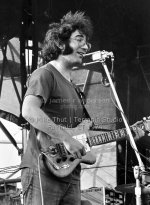
Many years ago, the Gratful Dead had a mike setup where they would do a phase cancel with the crowd noise. I do not know the details, but I know that they could take the crowd noise down a significant amount.
 
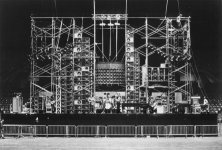
The Grateful Dead was experimenting with their "Wall of Sound" where they all the FOH speakers BEHIND them.
They ended up creating "differential noise-cancelling" microphones by taking a couple of high-end "instrumentation mics" and connecting them out-of phase.
By keeping the mics close together, they could cancel out "most" of the sound coming from the speakers while still picking up the vocalist.
Because it was for a live reinforcement system, they didn't need COMPLETE cancellation, they just needed enough cancellation to avoid massive feedback.
They had to use instrumentation-grade microphones (vs. the traditional rock-music standards like Shure SM-58, etc.) in order to get the microphone response to match reasonably well.
In order to make this work, the performers had to almost "swallow" the mic to maintain the signal differential. Clearly that doesn't work at any distance.

Jerry-Garcia-Dillon-Stadium-1974-B-W-Thut.jpg

97961d1224263681-ozzy-plant-2-mics-taped-together-grateful.jpg
 
it worked well if you took the right amount of acid. Seriously the best way to fight unwanted noise is to use low sensitivity mics, and to mute open mics as often as possible. I don't know about the Dead, but many have used proximity sensors or touch pads on the floor close to the stands that switch mics on when the performer is near. Of course a competent console operator can do that too.

i always get a laugh when I see that PA system photo in an old sound system engineering text book where it is captioned something like " A typical rock sound system ". I do enjoy the concept though. It must have been a hard day assembling that rig.

Many years ago, the Gratful Dead had a mike setup where they would do a phase cancel with the crowd noise. I do not know the details, but I know that they could take the crowd noise down a significant amount.
 
Last edited:
This sort of thing comes under the general category of 'beam forming' arrays. Here's apparently some commercial 'conference call' solution, to allow a 'focus' on quadrants of the area covered by the microphone array.

While this one is probably only good for relatively quite rooms where one wants to focus on a speaker or speakers in a tight group around the conference table.

For cutting 'background noise' one would have to form a 'box', rather than just a 'cone', of reception pattern.

http://www.clearone.com/blog/advanced-beamforming-microphone-array-technology-for-corporate-conferencing-systems/
 
As others have said it is largely a myth. It assumes a few things that really never happen in practice. And if you think about it a good ambience killing microphone would sell like hotcakes, and the manufacturer is really the only one that could get the capsules close enough to have a good chance of really working. The fact that such a mic is not in use by every TV reporter out there kind of sums up how well it works.

Other than not working at all the biggest danger is strange phase issues. Things like sounding like your speaker was talking inside a bottle or big tube, odd sounding background noise that is more distracting than the original sound. Think of the sound of those motorcycles with a phase shifter on it...


As a small world side note, the guy who ended up building the Dead's eventual sound system's sister used to babysit me. His father worked with my father at UCB.
 
Back
Top