Reverse key lighting (key light from behind subject)

Hutchman

Active member
Hey guys,

I'm just starting out studying cinematography and am particularly interested in "reverse key lighting", ie having the key light behind the subject rather than in front. I'm particualrly a fan of Fincher and want to emulate that great low-key style he has.

Does anyone have any advice, stories, etc that could help me learn more about it?

Here's an interesting article on it:

http://evanerichards.com/2012/2463

Thanks!
 
erm., yeah, this is actually my main technique, I would've done it like ten times by now if I wasn't ten times hampered by shooting, like many of us do, in small apartments with no room to place the key light behind the actor.


BUUUTTT..... Ya knoooooowwwww.....

listen carefully:


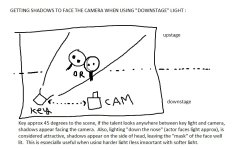
If you place the light 45 degrees IN FRONT of the actor , facing 45 degress or so TOWARDS the scene, (not in back), and have the actor FACE THE LIGHT, and/or face the area ---INBETWEEN THE KEY LIGHT AND THE CAMERA--,

the shadows still FACE THE CAMERA,

In other words, you dont NEED to use this reverse key technique to get the low -key effect of shadows facing the camera.

the old-school way of stating it is that you light "down the nose" meaning, again, if the subject faces the light, you'll get your shadows.

skin that cat
 
Isn't this the same as lighting from the upstage side?
Found that blog post to be pretty vague as to explaining what the concept really was.
 
yes it is, and as i pointed out you dont have to light from upstage to get shadows that face the camera
 
We go into this some on the Lighting DVD, and how key light placement such as this affects mood and character.
 
erm., yeah, this is actually my main technique, I would've done it like ten times by now if I wasn't ten times hampered by shooting, like many of us do, in small apartments with no room to place the key light behind the actor.


BUUUTTT..... Ya knoooooowwwww.....

listen carefully:


If you place the light 45 degrees IN FRONT of the actor , facing 45 degress or so TOWARDS the scene, (not in back), and have the actor FACE THE LIGHT, and/or face the area ---INBETWEEN THE KEY LIGHT AND THE CAMERA--,

the shadows still FACE THE CAMERA,

In other words, you dont NEED to use this reverse key technique to get the low -key effect of shadows facing the camera.

the old-school way of stating it is that you light "down the nose" meaning, again, if the subject faces the light, you'll get your shadows.

skin that cat

Yep. Basically instead of shooting on the same side as the key light on your actor, shoot on the shaded side.

I think the biggest advantage of shooting from the rear however is that you can get a nice rim light and with what's left over bounce back for some fill or key depending on where you place that reflector/bounce board. Thus killing two birds with one stone. It also prevents light from spilling onto the back of your scene when you light from the back so has that advantage too. So now we're up to three birds I guess....
 
erm., yeah, this is actually my main technique, I would've done it like ten times by now if I wasn't ten times hampered by shooting, like many of us do, in small apartments with no room to place the key light behind the actor.


BUUUTTT..... Ya knoooooowwwww.....

listen carefully:


If you place the light 45 degrees IN FRONT of the actor , facing 45 degress or so TOWARDS the scene, (not in back), and have the actor FACE THE LIGHT, and/or face the area ---INBETWEEN THE KEY LIGHT AND THE CAMERA--,

the shadows still FACE THE CAMERA,

In other words, you dont NEED to use this reverse key technique to get the low -key effect of shadows facing the camera.

the old-school way of stating it is that you light "down the nose" meaning, again, if the subject faces the light, you'll get your shadows.

skin that cat

Would you by any chance have a diagram of this?
 
here ya go. i like drawing.

oh yeah also its a little known fact that it may be best to put the fill in between the key and the camera (same dotted area that the talent faces), NOT on the other side of the camera as is often (kind of wrongly) stated in most lighting tutorials/texts.

so essentially the actor faces the key and/or the fill using this approach.

I know alot of this theory cause i collect alot of books, but I struggle to implement it on set, reality likes to fight you when you make movies (reality: oh you want to put the light there? well screw you ill put a wall there)...

right now my theory/approach is as simple as trying to get some nice soft yet dramatic side light going on in my shorts.

get david's lighting dvd!
 

Attachments

  • downstage shadows.jpg
    downstage shadows.jpg
    107 KB · Views: 1
Last edited:
here ya go. i like drawing.

oh yeah also its a little known fact that it may be best to put the fill in between the key and the camera (same dotted area that the talent faces), NOT on the other side of the camera as is often (kind of wrongly) stated in most lighting tutorials/texts.

so essentially the actor faces the key and/or the fill using this approach.

I know alot of this theory cause i collect alot of books, but I struggle to implement it on set, reality likes to fight you when you make movies (reality: oh you want to put the light there? well screw you ill put a wall there)...

right now my theory/approach is as simple as trying to get some nice soft yet dramatic side light going on in my shorts.

get david's lighting dvd!

Thanks sir. I'm a visual person so just looking at text descriptions doesn't help me. Diagram makes it very clear. Thanks for taking the time to do it :)
 
Thanks guys for the responses!

@ nycineaste, thanks a lot for the advice! A few questions if u don't mind.....

What sort of lights are you using? You say u don't have enough room to do the reverse-key technique in apartments, but couldn't u use say, 150/300W Arris or even dedos on a wall mount or something? Also, do you use practicals a lot? eg. having a couple sitting at a table against the wall, and havong a lamp on the table against the wall as the key, and a couple of dedos coming from the other side as backlights one for each actor, etc?

Will this technique you've described give as nice shadow fall-off across the face as reverse keying?

THANKS!
 
@hutchman - generally for the scenario you are describing with the practical on the table against the wall, i will place one light on either side behind the two actors, cris-crossing and hitting the face of the actor on the opposite side - this gives the audience the impression that the light is coming from the practical, when in reality the practical is just being used as a motivated light source. then fill in from the front (or don't) as you see fit. obviously it also depends on the mood of the scene you are trying to go for, but generally speaking that's what I do. usually with something like a 300 or a 650. Just make sure no light is hitting the back of the actor's head, as this wouldn't be a motivated light.
 
Will this technique you've described give as nice shadow fall-off across the face as reverse keying?

well, yes, thats the whole point of my post/this thread. just try it yourself. set up a light, look somewhere between it and the camera, point the camera to your face and youll see the shadows on the side of your head.


as far as what lights I use, how to motivate the light, i have to preface all this by saying that I am far from a lighting expert but:

the ideal situation in cnematography is to keep the actors away from walls, so you get depth in th e frame, and have the space to treat the basckground seperately (either lighting it with a cookie or gel or keeping light --off-- of it, both of which are ways of giving it a treatment seperate from the key light), and so you have room to put a light there for back light or a reverse key or whatever.

I have NNNEEEVVVVEEERRRR been able to do this. Shooting no budget, one-man crew (me), working with I have, I almost always have actors near a wall.

so essentially Im the wrong man to talk to about complex lighting sceanrios, because Ive thrown up my hands and given up. I keep my idea of lighting very very very simple:

stop reading now if you have issues with learning fro m a struggling amatuer:

1. set up a soft source somewhat to the side of the talent/scene. the exact angle depends on you and also the REALITY of what youre dealing with (as stated ive NEVER been able to put a light in the ideal place i would like)

2. set it up close, since that how you get falloff with soft sources.

3. I decided Im not going to be a nazi about motivation with "in scene" practicals. screw that. Im not convinced audiences care or notice. My theory about convincing lighting is thus:

4. i think ive learned from experience that the main technique to a convincing key is that it be IN SCALE with the location in terms of wattage and size. In other words, in a small room, a 200 watt bulb in a scoop with some frost works as a key, because it basically is the closest thing possible in ACTUAL SIZE AND WATTAGE to a lamp with a lamp shade. As amatter of fact, it almost IS LIKE an actual lamp- the frost is like the lampshade, etc. I think phony lighting happens when the light is "out of scale" if that makes any sense- in other words, if you put a too- high wattage movie light right in the actors face in a tiny room, thats exactly what it looks like- theres a too-bright light that would never be in that room (ie a movie light), in that room.

5. So for me what im testing out is to emulate a real source closely as possible, with higher wattage light, but as low as posssible, so youre just "fudging" real life since the camera needs more light than our eyes do.

to my dumb beginner mind ill be using my small softbox or scoop-with-frost to emulate room lamps and my bigger softbox if im imagining that the light is coming from a big window, etc etc

youll see how it works out on my next short, ill post it here.

im sure theyll be mistakes
 
Last edited:
Google Short lighting pattern and Rembrandt lighting pattern, you'll find lots of diagrams on light/camera placement to get near-side shadow.
 
"Low-key" is not a term that defines where the key light is coming from. In a low-key scene
most of the picture is underlit and there will be little or no fill light. You can have a low key scene
(or high key for that matter)with the key light on the camera side or the opposite side.
 
Back
Top