Recreating scenes to improve own cinematography?

Cinesaurus

New member
Hey Guys.

I'm at the starting point of my career choice as a DP/Cinematographer. I know I have many years ahead to even become medicore but I am doing everything I can to improve.
As a challenge and exercise I thought it might be a good idea to pick scenes with good cinematography and lighting to recreate them as best as possible.

I got a good a small crew of people from film school to work with, and the gaffer and productionhouse I am interning at have agreed to lend me some basic lighting gear to pull this off.
I'm not sure how much work this is going to be, but I figured it might be a great bi-weekly/monthly exercise to understand Cinematography and lighting better in my freetime.

So to my question: Do you guys have any advice or input for me? And perhaps some good example scenes to start with? Doesn't matter how hard, I love challenges.
Ofcourse i have already picked some scenes myself, but i'd love to get some diversity and input from others

Thanks for reading, any help is greatly appreciated!

Edwin G.

ps. would it be "kosher" to upload those scenes to youtube or use them in a showreel?
 
Recreating established scenes is a great way to learn. Take special care to figure out why it works -- why does the placement help? Why does diffusion -- or no diffusion -- help? Things like that. Pay attention to the smallest details.
 
The most important thing to discover is WHY everything was setup the way it was. Re-creating a scene is a nice technical exercise, but I think you're missing at least half of the picture if you don't realize the reason the camera was placed where it was, the focal length, the motion, light sources and placement, etc.
 
i did this once for film school and it was one of the best learning experiences i've had.

i will say i think, to start, rather than going in blindly and trying to do it on your own i would get advice from someone knowledgeable (if you know someone in person who can help, or post pics on here) to analyze a scene and tell you where THEY think the light's coming from.
Then you'll have a starting point and you can fiddle with the lights from there. Once you get more advanced you can skip having someone else analyze it first, but the key is learning how to look at a scene and know where the light's coming from (that will help you grow as a cinematographer)... so it'd be best to start off doing it the right way.
 
I think that is a pretty good idea. However, I do suggest that you spend some time and learn the basics of the lighting units that you have available. To me, the basics is learning what the photometrics are of the lights. By that I mean, what is the quantity of light that a unit produces at a given distance in a given configuration. The quantity of light is usually measured in footcandles.

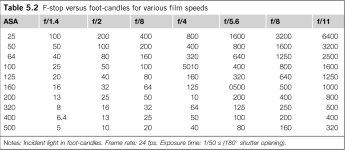
Let me start at the beginning. To me, the basics to pre-planning a lighting set up is understanding this chart. (Note, f8 between f2 and f4 should be f2.8, the footcandle reading at f4 at 100 ASA should be 200 and the footcandle reading at 160 ASA at f5.6 should be 250)

F-stop versus footcandles.jpg

Knowing the amount of light needed to expose at a specific ISO setting (ASA on the chart), knowing the distances you need to light subjects in a scene, and then knowing the light output of the lights that you have available makes designing the lighting much easier and quicker.

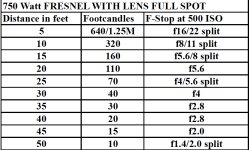
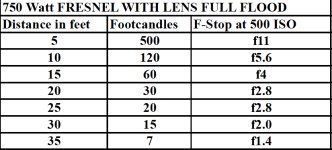
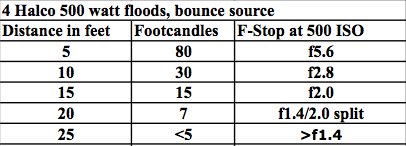
To learn the light output of my lights what I have done is to set up a measured distance in my backyard and putting markers at every five feet from 0 feet out to 50 feet. I then set up each of the lights I own, in different configurations, and took a light meter reading at every 5 foot interval out to 50 feet, or where the light level fell to a point that it was not measurable. I put together charts for each of my lights, in the different configurations that I now have as a basic tool I can pull out when I am setting up a lighting design. Like this:

750 Fresnel w lens full spot photometrics .jpg

750 watt Fresnel w lens full flood photometrics.jpg

4 light bounce photometrics.jpg

If you do not have a light meter, you can still set up a set of reference tables for your lights. What I would do is again set up the measured distance and set up your lights in the dark. Then take a DSLR on still mode, set it to manual at a usable ISO. I would probably use 500 ISO or 1000ISO, but it doesn't really matter. Set your shutter speed to 1/48 a second (Standard for 24fps with a 170 degree shutter) Then get a photographic grey card and using the DSLR, focus on the card at the different intervals and then adjust the iris until the camera shows that it is exposed properly (Usually right at the middle of a scale in the eyepiece). Note the iris f stop setting at each interval and chart that out. Knowing the ISO setting and f stop setting, you can calculate the footcandles by going all algebra on this standard formula, 100 footcandles at 100 ISO = f 2.8.

I like what you are doing, but if you are going to be setting up lights as a learning experience, I really recommend getting familiar with lighting photometrics. Doing the above will give you a very good reference point going forward. good luck.
 
Last edited:
I think this is a wonderful exercise and I've done it in the past for both parody reasons and for film school assignments... however, if copying someone elses work completely, just be careful using it as demo reel footage because that might not be kosher. Otherwise, it's a great way to study other people's techniques and learn some craft.
 
Thanks for the input everybody!

I'll try to see if theres a light meter somewhere in our school's storage and will try to familiarize myself with Photometrics today.
Ryan, do you think it would be a good idea to start of with some of the lighting examples from your Article thread? (thanks for all that info in there btw).

I think I might start out with movie stills from different angles and the right light setups before I actually will do whole scenes and work out camera/framing/movement theory.

I've already done a lot of filming and worked on shorts, but when it comes to serious cinematography I am pretty new, so any info is greatly appreciated, quite exiting to learn all this new stuff :)


~ Cheers
 
Good luck to you. If I could give another piece of advice, I would say to really strive to get good at portraiture lighting, paying particular attention to peoples eyes and making them look good. Making the talent look good is the bread and butter of the craft.
 
Back
Top