Re: Neumann KM 184 MT vs Sennheiser MKH 8040 vs Rode NTG-1

Re: Neumann KM 184 MT vs Sennheiser MKH 8040 vs Rode NTG-1

Assuming I have a proper XLR source with Phantom power, which of these three would perform the best while providing the smallest physical footprint (i.e. not too long and heavy):

Neumann KM 184 MT vs Sennheiser MKH 8040 vs Rode NTG-1

Assume we are filming Live Events/Documentaries and interviews.
 
Easily the best is the Sennheiser MKH 8040.

But the Neumann KM 184 and the Sennheiser MKH 8040 are both cardioid mics and the NTG1 is a gun mic. with a totally different polar pattern (and about one-tenth of the price, so it's not a fair comparison really).

If you want directivity the Sennheiser MKH 8050 (super-cardioid) or MKH 8060 (short gun mic.) would be better.

The Sennheisers are very low noise RF condenser mics and will work well out of doors.

The Neumann KM 184 (or 185 if you want super-cardioid) are good mics, cheaper than the MKH 8000 series and are not so good out of doors - but are very nice mics.

I hope this helps.
 
On that note, between the Sennheiser Me67 and MKH8070, which one would provide the farthest reach such as for weddings as a back-up mic to my wireless lav during the ceremony/vows?
 
Easily the best is the Sennheiser MKH 8040.

But the Neumann KM 184 and the Sennheiser MKH 8040 are both cardioid mics and the NTG1 is a gun mic. with a totally different polar pattern (and about one-tenth of the price, so it's not a fair comparison really).

If you want directivity the Sennheiser MKH 8050 (super-cardioid) or MKH 8060 (short gun mic.) would be better.

The Sennheisers are very low noise RF condenser mics and will work well out of doors.

The Neumann KM 184 (or 185 if you want super-cardioid) are good mics, cheaper than the MKH 8000 series and are not so good out of doors - but are very nice mics.

I hope this helps.

Between the 8050 and 8060, what would be their advantages and disadvantages?
 
On that note, between the Sennheiser Me67 and MKH8070, which one would provide the farthest reach such as for weddings as a back-up mic to my wireless lav during the ceremony/vows?
Both are long shotguns and have about the same "reach." But take note, there is really no such thing as "reach" when you get down to it - the term implies that the mic somehow reaches out and magnifies distant sounds like a telephoto lens magnifies distant images. Microphones simply don't work that way, Long shotguns have a tighter lobe of maximum sensitivity than the more commonplace short shotgun and because they are rejecting more ambient noise because of it you can add a bit more gain when recording with them, their longer working distance is a matter of degree. When you might be able to work the mic at 22 to 24 inches from the source with a short 'gun, with a long gun you might be able to increase that to 36 inches or so. On a really quiet sound stage you might be able to work out to 4 feet or so with a long 'gun. But it definitely will not sound any good from 99.9% of camera positions, any more than the short 'gun will, and I'll bet dollars to donuts that's what you had in mind when you posted "for weddings as a backup mic for my wireless lav." Sure either one will record some sound but it's very unlikely that it will be good enough to be usable. So the correct answer to "which will be the better backup mic" is "neither one."
 
Last edited:
On that note, between the Sennheiser Me67 and MKH8070, which one would provide the farthest reach such as for weddings as a back-up mic to my wireless lav during the ceremony/vows?

Definitely the 8070 - it is a longer shotgun and also has a much lower distortion and self-noise.


Between the 8050 and 8060, what would be their advantages and disadvantages?

The 8050 is a super-cardioid and the 8060 is a short gun.

They have about the same directivity at low frequencies, but the 8060 gets more directive as frequebcy rises.


Both are long shotguns and have about the same "reach."

Not true, the 8070 is a longer gun than the ME67 and also has a much lower self-noise which will enable it to hear further.


But take note, there is really no such thing as "reach" when you get down to it - the term implies that the mic somehow reaches out and magnifies distant sounds like a telephoto lens magnifies distant images. Microphones simply don't work that way, Long shotguns have a tighter lobe of maximum sensitivity than the more commonplace short shotgun and because they are rejecting more ambient noise because of it you can add a bit more gain when recording with them, their longer working distance is a matter of degree. When you might be able to work the mic at 22 to 24 inches from the source with a short 'gun, with a long gun you might be able to increase that to 36 inches or so. On a really quiet sound stage you might be able to work out to 4 feet or so with a long 'gun. But it definitely will not sound any good from 99.9% of camera positions, any more than the short 'gun will, and I'll bet dollars to donuts that's what you had in mind when you posted "for weddings as a backup mic for my wireless lav." Sure either one will record some sound but it's very unlikely that it will be good enough to be usable. So the correct answer to "which will be the better backup mic" is "neither one."

This is correct - it's directivity rather than "reach".

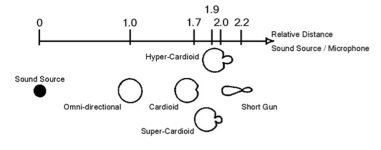
A short gun's "reach" is only about double the length of an omni mic.

This distance chart helps explain things:-

Microphone Distance Chart.jpg
 
Last edited:
Not true, the 8060 is a longer gun than the ME67 and also has a much lower self-noise which will enable it to hear further.

Agreed... should have been clearer that while the two mics are different, in the use envisioned it won't much matter.
 
Agreed... should have been clearer that while the two mics are different, in the use envisioned it won't much matter.

Answered to say that I meant to say 8070 in my post and not 8060.

The 8060 is the same as the 416 and ME66.

The ME67 is about the same as the MKH 70

The 8070 is a long gun and about the same as the old 816, maybe even longer.
 
Beware the handling noise on the 8050. Some will say you can work around it. Rent one and try it yourself, see if it's something you want to deal with. MKH50 all the way.
 
Beware the handling noise on the 8050. Some will say you can work around it. Rent one and try it yourself, see if it's something you want to deal with. MKH50 all the way.

I always use my mics in a Rycote "Lyre" shockmount and with a ConnBox or S-series XLR tail to decouple the mic. from handling noise coming up the cable. That sorts out most things.

I don't have an 8050, but I do have pairs of the 8020 and 8040 as well as pairs of the 20, 30, 40 and 800 - and the 816F.

John
 
Thankfully I don't own an 8050 but have used it quite a bit.

Friend has one is selling it off b/c of the handling issues (opting for an MKH50 and CMC641 instead). It can be tamed to an extent but always a consideration and given we have enough things to worry about in the field, having to be overly delicate on the boom is not something I want to do. Between handling noise and "whoosh" on quick moves, it is way too touchy.

I'd recommend anyone considering an 8050, get your hands on one and compare it to other mics.

I've been really happy with the MKH50 (built in roll off), have had to add a BBG with anticipation of larger swings.

I always use my mics in a Rycote "Lyre" shockmount and with a ConnBox or S-series XLR tail to decouple the mic. from handling noise coming up the cable. That sorts out most things.

I don't have an 8050, but I do have pairs of the 8020 and 8040 as well as pairs of the 20, 30, 40 and 800 - and the 816F.

John
 
Last edited:
Thankfully I don't own an 8050 but have used it quite a bit.

Friend has one is selling it off b/c of the handling issues (opting for an MKH50 and CMC641 instead). It can be tamed to an extent but always a consideration and given we have enough things to worry about in the field, having to be overly delicate on the boom is not something I want to do. Between handling noise and "whoosh" on quick moves, it is way too touchy.

I'd recommend anyone considering an 8050, get your hands on one and compare it to other mics.

I've been really happy with the MKH50 (built in roll off), have had to add a BBG with anticipation of larger swings.


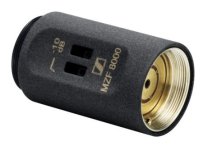
Don't forget that Sennheiser have the MZF 8000 filter that fits the MKH 8050.

The 8050 does not normally need the filter when used in a studio, but would when used on a boom for video use.

4f623e8e21de6mcs077a.jpg
 
Don't forget that Sennheiser have the MZF 8000 filter that fits the MKH 8050.

The 8050 does not normally need the filter when used in a studio, but would when used on a boom for video use.

View attachment 54200

Filter specs aren't appropriate in my opinion (compared to the MKH50), plus extra cost.

8050 Add-on LF Rolloff:
-3dB @ 160Hz (Switchable)
-3dB @ 16Hz (Fixed)

MKH50 Built-in LF Rolloff:
4db at 50Hz

If the 8050 polar pattern is your thing, I'd recommend the MKH50. But in the end, recommend putting one to use in typical scenarios (non-studio). I bet the 8050/8040 are great in the studio but put them out in the field, not so much.

As far as I am aware, the MZF 8000 filter was designed for broadcast use and to minimise wind and handling noise when the MKH 8000 series was used outside on a boom.
 
Back
Top