
Navigation
Install the app
How to install the app on iOS
Follow along with the video below to see how to install our site as a web app on your home screen.
Note: This feature may not be available in some browsers.
More options
You are using an out of date browser. It may not display this or other websites correctly.
You should upgrade or use an alternative browser.
You should upgrade or use an alternative browser.
Quick theory question
- Thread starter Finnegan
- Start date


starcentral
Veteran
Assuming you precalibrated your camera and lenses (combination of them together) to determine your actual working ASA/ISO of your setup - YES.
From these forums I get I can tell you very few people are using light meters to light anything. I on the other hand have written about how I've been using them on all my shoots for even and consistent exposure, so if you're interested in reading it here is the link. The most important part however is making sure you do the precalibration and determine the effective-ASA of your setup.
I will warn you in advance that it typically sparks a debate between reflective and incident light metering, and whether or not you light black people brighter than white people, and lastly many will also feel the need to chime in that the camera already had a light meter built into it and light meters are useless. (people will even complain that meters never match their lens)

From these forums I get I can tell you very few people are using light meters to light anything. I on the other hand have written about how I've been using them on all my shoots for even and consistent exposure, so if you're interested in reading it here is the link. The most important part however is making sure you do the precalibration and determine the effective-ASA of your setup.
I will warn you in advance that it typically sparks a debate between reflective and incident light metering, and whether or not you light black people brighter than white people, and lastly many will also feel the need to chime in that the camera already had a light meter built into it and light meters are useless. (people will even complain that meters never match their lens)
Last edited:
starcentral
Veteran
46, 50... who's counting.
Shooter is correct however, 46.2% or 328mV if you really want to get precise.
Shooter is correct however, 46.2% or 328mV if you really want to get precise.
Last edited:

Shooter
Veteran
I once owned and ran a Neg only film processing lab and I offered a meter check service to my D.P mates when they ran their camera tests.
They shot cards and scales on neg which we processed and compared to our LAD (lab aim density) via the densitometer and our calculations from our control strips.
(Its more complex than one would imagine)
The test neg sometimes went to telecine where we could see it on a WFM.
Thats where I recall the more precise % figure from.
They shot cards and scales on neg which we processed and compared to our LAD (lab aim density) via the densitometer and our calculations from our control strips.
(Its more complex than one would imagine)
The test neg sometimes went to telecine where we could see it on a WFM.
Thats where I recall the more precise % figure from.
starcentral
Veteran
very interesting to know the theory behind it all, great stuff.

Ryan Patrick O'Hara
Veteran
Also remember that F/stop is formulaic, not actual.
This is why T-stops rule. They are much more accurate, thus you'll see much less variation and get a much more accurately consistent result.
I would not throw up a semi-vintage zoom lens rated with a f/stop and expect it to be less than 1/3 of a stop in accuracy. Just saying that could be a big variable in your equation above.
This is why T-stops rule. They are much more accurate, thus you'll see much less variation and get a much more accurately consistent result.
I would not throw up a semi-vintage zoom lens rated with a f/stop and expect it to be less than 1/3 of a stop in accuracy. Just saying that could be a big variable in your equation above.

cpc
Well-known member
First, F-stops mean nothing, as pointed by Ryan. They don't say anything about lens light transmission, although one can expect they are within 3/4 EV (or less, for primes) of the corresponding T-stop.
Second, where a tone falls in terms of IRE or actual values depends entirely on the transfer curve used by the camera range mapping software. On a Rec709 compliant transfer curve midgray will be around 117-119 (in 8 bits, out of 255 values), or around 46 IRE.
BUT. On another curve it can be anywhere, depending on the purpose of the curve. For example, look at the chart in the article on Canon transfer curves: CineStyle's flat curve pushes the midpoint up to almost 50 IRE. And other curves can move this point even more depending on their design, especially on their overexposure or underexposure latitude and the specifics of their tonality distribution.
Second, where a tone falls in terms of IRE or actual values depends entirely on the transfer curve used by the camera range mapping software. On a Rec709 compliant transfer curve midgray will be around 117-119 (in 8 bits, out of 255 values), or around 46 IRE.
BUT. On another curve it can be anywhere, depending on the purpose of the curve. For example, look at the chart in the article on Canon transfer curves: CineStyle's flat curve pushes the midpoint up to almost 50 IRE. And other curves can move this point even more depending on their design, especially on their overexposure or underexposure latitude and the specifics of their tonality distribution.
starcentral
Veteran
Ryan, if you threw your vintage lens on your camera at f2.8 and knew what ASA to dial in your meter that would deliver you 46% grey on your camera, then what will it matter between using Tstops or f-stops? Or are you suggesting accuracy issues once you dial your iris up and down?
Yes - definitely know what gamma mode you are working in for your camera when using grey cards. For example if shooting on the Sony F3 with slog many people use 38% although I haven't done my own tests yet. The best thing to do Sean, is conduct a grey card test for each curve and document it for reference. I put this document together using frame grabs from dear old Andy from Abelcine so I know where the grey points are approximately for each gamma curve on the F3.
Here's what a sample of what's in my reference guide. Shown here is curve for SLOG on the F3:
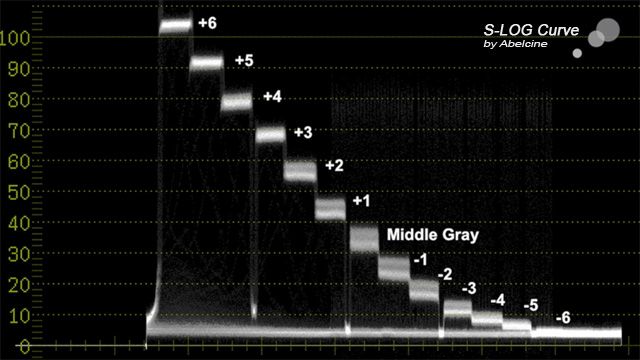
Sean you might also want to watch this video by Andy to see how he determined the ISO of his specific setup. This is how I learned to do it.
http://blog.abelcine.com/2011/03/11/abelcine-tests-the-sony-f3-iso-rating/
Yes - definitely know what gamma mode you are working in for your camera when using grey cards. For example if shooting on the Sony F3 with slog many people use 38% although I haven't done my own tests yet. The best thing to do Sean, is conduct a grey card test for each curve and document it for reference. I put this document together using frame grabs from dear old Andy from Abelcine so I know where the grey points are approximately for each gamma curve on the F3.
Here's what a sample of what's in my reference guide. Shown here is curve for SLOG on the F3:
Sean you might also want to watch this video by Andy to see how he determined the ISO of his specific setup. This is how I learned to do it.
http://blog.abelcine.com/2011/03/11/abelcine-tests-the-sony-f3-iso-rating/
j1clark@ucsd.edu
Veteran
Ryan, if you threw your vintage lens on your camera at f2.8 and knew what ASA to dial in your meter that would deliver you 46% grey on your camera, then what will it matter between using Tstops or f-stops? Or are you suggesting accuracy issues once you dial your iris up and down?
Once you find the ISO/ASA value to dial in to get the desired level... sure... but the T-stop allows you to replace the current lens, set the next lens to the same T-stop, and have the same amount of light...
Now of course you never use anything but your own lens, and have potentially different ISO/ASA 'calibration factors' for each lens you own... all is well... other than remembering that...
But if you 'rent'... or 'borrow'... (well who lends out their own cine lenses anyway...).
But for me it seems that 'middle grey' at 38% seems 'really low'... if there's about 15% change for every stop in the camera's 'linear' response range... that's almost a stop away from 50%...
From the curve picture... 'middle grey' almost seems to be at the end point of the linear range, or just a 'step' up...
In Film Film, the 'grey' card was 2 stops up from Zone III which was considered the first real 'textured' dark grey/black.
Ryan Patrick O'Hara
Veteran
Ryan, if you threw your vintage lens on your camera at f2.8 and knew what ASA to dial in your meter that would deliver you 46% grey on your camera, then what will it matter between using Tstops or f-stops? Or are you suggesting accuracy issues once you dial your iris up and down?
Assuming the manufacturer has built an accurate iris assembly from maximum aperture to minimum aperture, yes you can solve this problem. However I think it would be easier to compensate by re-labeling the lens aperture ring versus altering the working ISO/ASA on the meter. This is mainly because f/stop lenses will differ from it's true transmission value by different discrepancies. Meaning an old zoom could be severly off by a whole stop, while a brand new high quality prime could be a 1/5th of a stop. If using multiple lenses on a shoot that are not T-stop rated, it would be wise to keep a consistent working iso/asa and simply make the compensation at the lens side. I would do this by testing each lens individually and keeping a log of the results.
Example (not indicative of real light loss on these particular lenses)
Nikon 85 f/1.8
F/2=T/2.4
F/2.8=T/3.3
F/4=T/4.8
F/5.6=T/6.7
F/8=T/9.5
Nikon 24mm F/2.8
F/2.8=T/3.5
F/4=T/5
F/5.6=T/7.1
F/8=T/10
Etc. etc.
That is what I would do. Many people just go by f-stops despite their inaccuracies and don't care. If you want precise exposure continuity, you would heed this fact and either use T-stops, or know what your lenses are really giving you.
Once you have logged all lenses, then you can switch between them and give yourself a much more accurate exposure between focal lengths. As mentioned many people, especially in the videography world to not concern themselves with these fractions-of-a-stop discrepancies... But many top narrative DP's do, and since this thread is about getting a gray card at a very specific IRE value, these discrepancies reveal their great importance.
j1clark@ucsd.edu
Veteran
Assuming the manufacturer has built an accurate iris assembly from maximum aperture to minimum aperture, yes you can solve this problem. However I think it would be easier to compensate by re-labeling the lens aperture ring versus altering the working ISO/ASA on the meter. This is mainly because f/stop lenses will differ from it's true transmission value by different discrepancies. Meaning an old zoom could be severly off by a whole stop, while a brand new high quality prime could be a 1/5th of a stop. If using multiple lenses on a shoot that are not T-stop rated, it would be wise to keep a consistent working iso/asa and simply make the compensation at the lens side. I would do this by testing each lens individually and keeping a log of the results.
Back in the olden days when there were about 5 or 6 camera repair stores in town, I would take my shutters in to have the timing determined and I got a list of shutter markings vs. actual speed. I'd then use that for my exposure calculations. For some reason I never seemed to really feel a need for checking the f-stop vs. transmission. But then again, I had only 2 lenses for the 4x5 and 2 for the 2 1/4 x 3 1/4, and perhaps they were 'consistent' amongst themselves such that my practical determination of a working ASA was sufficient.
Then again, again... since I printed my own work, I would probably adjust for any residual differences there.
starcentral
Veteran
It is a little difficult to know what the OP was trying to establish from his original question.
Maybe he could come back and tell us.
I think it is clear, he wants to be able to light something at f2.8 and be able to set his taking lens to f2.8 also. I am already doing this with my setup since I know that I need 42 foot candles, or f4 to expose an 18% grey card at 50% IRE on my camera. (That's how little light I need when your working with a native ISO of 800! hehehe). You can only do this once you determine the working ISO of your camera + lenses.
Im just curious, is there any app that you can use to check specific lenses and convert their f/stop to see what is the t/stop. Have any heard about it?
If you're using your own set of lenses all the time the best thing to do is measure them and re-label as someone had suggested.
Once you find the ISO/ASA value to dial in to get the desired level... sure... but the T-stop allows you to replace the current lens, set the next lens to the same T-stop, and have the same amount of light...
Now of course you never use anything but your own lens, and have potentially different ISO/ASA 'calibration factors' for each lens you own... all is well... other than remembering that...
But if you 'rent'... or 'borrow'... (well who lends out their own cine lenses anyway...).
But for me it seems that 'middle grey' at 38% seems 'really low'... if there's about 15% change for every stop in the camera's 'linear' response range... that's almost a stop away from 50%...
From the curve picture... 'middle grey' almost seems to be at the end point of the linear range, or just a 'step' up...
In Film Film, the 'grey' card was 2 stops up from Zone III which was considered the first real 'textured' dark grey/black.
With Sony S-LOG 18% middle grey is 38%, or 37.7% IRE according to Sony's white paper on their SLOG. It will vary camera to camera, and cine gamma curve to cine gamma curve.
Last edited:
Shooter
Veteran
F-stops..T-stops
Both largely redundant in practical sense these days.
If you want to nail an exposure between various lenses or set ups...use the waveform and a reference eg Gray Card , Gray Scale, color chart.
If you are using a meter for lighting level purposes...F-stops are fine (as are Foot Candle etc.)
Personally...I note the white, black and skintone degrees as per wfm and ensure they remain relative for different setups or lens changes. That usually requires a tweak of the lights..not a tweak on the aperture.
Both largely redundant in practical sense these days.
If you want to nail an exposure between various lenses or set ups...use the waveform and a reference eg Gray Card , Gray Scale, color chart.
If you are using a meter for lighting level purposes...F-stops are fine (as are Foot Candle etc.)
Personally...I note the white, black and skintone degrees as per wfm and ensure they remain relative for different setups or lens changes. That usually requires a tweak of the lights..not a tweak on the aperture.
Ryan Patrick O'Hara
Veteran
How much percentage of exposure difference in lenses does it take before caring? A half stop? A stop? Please let me know how much one is willing to ignore until giving a damn. I'm interested. For me, personally, I care within a fourth of a stop. Within that amount (less than), I'll let some slop slide. I am curious to know what cavalier cinematographers in the DVXuser world are willing to overlook. Of course this is a wide ranging audience so we should remember the context, but it just seems that everyone is fixated on ISO/ASA values of camras as well as exposure values in waveform, but ignore the typical 1/4, 1/3, 1/2, 1 stop of exposure difference in manual f/stop primes to actual T-stop performance. This varies less for modern lenses but holds very true for manual primes that are a bit older.
I found an example at http://forums.dpreview.com/forums/read.asp?forum=1030&message=33785655
You can see the zooms are much more inefficient (for good reason) and you can see the T values this person gives them. I did not conduct these tests so I cannot verify them. It's just an example.
I don't see how anyone can give half a damn about exposure in other ways but fail to overlook these discrepancies.
I found an example at http://forums.dpreview.com/forums/read.asp?forum=1030&message=33785655
Prime Lenses
AF DX 10.5mm f/2.8D: 85%, T/3.08
AF 14mm f/2.8D: 74%, T/3.29
AIS 28mm f/2: 83%, T/2.19
Zeiss ZF 35mm f/2: 85%, T/2.17
AF 35mm f/2D: 92%, T/2.09
PC-E 45mm f/2.8: 90%, T/2.99
AIS 50mm f/1.8: 95%, T/1.83
AF 50mm f/1.4D: 91%, T/1.48
AF-S 50mm f/1.4G: 91%, T/1.48
AF Micro 60mm f/2.8D: 83%, T/3.11
Hartblei 65mm f/3.5 T/S: 96%, T/3.62
AF 85mm f/1.8D: 81%, T/1.97
AF Micro 105mm f/2.8D: 82%, T/3.13
AF 135mm f/2D DC: 86%, T/2.16
AF-S 200mm f/2G VR: 79%, T/2.24
AF-S 400mm f/2.8G VR: 76%, T/3.25
Zoom Lenses
AF-S 14-24mm f/2.8G: 90%, T/2.99 (meas. at 20mm)
AF-S 17-35mm f/2.8D: 88%, T/3.01 (meas. at 24mm)
AF-S 24-70mm f/2.8G: 88%, T/3.02 (meas. at 50mm)
AF-S 24-85mm f/3.5-4.5G: 83%, T/4.39 (meas. at 35mm f/4 nominal)
AF-S 28-70mm f/2.8D: 80%, T/3.16 (meas. at 50mm)
AF 35-135mm f/3.5-4.5D: 72%, T/4.73 (meas. at 66mm f/4 nominal)
AF-S 70-200mm f/2.8G VR 1: 70%, T/3.38 (meas. at 200mm)
AF-S 70-200mm f/2.8G VR 1 plus TC-14: 67%, T/4.90
AF-S 80-200mm f/2.8D: 70%, T/3.39 (meas. at 200mm)
Sigma 120-300mm f/2.8: 72%, T/3.34 (meas. at 200mm)
AF-S 200-400mm f/4G VR: 61%, T/5.11 (meas. at 300mm)
You can see the zooms are much more inefficient (for good reason) and you can see the T values this person gives them. I did not conduct these tests so I cannot verify them. It's just an example.
I don't see how anyone can give half a damn about exposure in other ways but fail to overlook these discrepancies.
Last edited:
Chris Adler
Veteran
I've learned to use my GH2's internal meter and its never steered me wrong, regardless of the lens.
Shooter
Veteran
but it just seems that everyone is fixated on ISO/ASA values of camras as well as exposure values in waveform
What is your argument regarding the exposure as determined in waveform?
Shooter
Veteran
I've learned to use my GH2's internal meter and its never steered me wrong, regardless of the lens.
Internal meter...Are you talking about the Histogram?