Proper use of Profile Shots?

Kholi

Section Moderator
Kind of realizing that I have a very strong affinity for Profile Shots, well, I think I realized it a while ago. My problem is that I'm not exactly sure why, and I'm not sure when, why, how they are appropriate. Is there a specific time, place, or effect for it?

Trying to understand myself, and not sure where to look for literature on this specific topic.
 
You are tired of the "status quo" in either narratives or docs.

Profile shot is the 1st step when trying to get away from 1/3 of the frame rule.

Afterwards you have "disregard for framing" by placing the character in dead center (watch Three Colors: Blue)

Afterwards you got various headroom (too much and too little).

Basically if you want the form being part of your story then go for it, if not then and all you care about is communication then you need to make that choice.
(the caveat here is that most people are visual morons so it doesn't matter if your framing is unique to enhance the story or not - they just pay attention to what's in the frame)
 
Just opinion, but profile shots generally give you the least amount of information about your characters because you cannot make "eye contact" with them and therefore are removed from a more direct form of evaluation.


However, there are certainly times when you want to keep your characters' intentions or emotions cloaked from your audience: interrogation scenes, standoffs, unreliable narrators and confused characters come to mind.


It is pretty common to see characters framed in profile for interrogation scenes or standoffs where you do not want one character to have a perceived advantage over another character. The classic example can be found in spaghetti westerns. In these situations, characters may be seen in very wide establishing shots and the profile framing may even be carried through the building of tension as shots become tighter.


The example that I have always been most interested in is the unreliable narrator (or subject). The recent ESPN 30 for 30 film, 9.79, uses some great profile shots of Ben Johnson during a portion of his interview. Watching the profile shots, you are not sure whether Ben Johnson is being truthful or not during the interview; both with the interviewer and even himself. In fictional work, Shutter Island has some really interesting profile shots and creates a similar tension.


Confusion can also be communicated by a profile shot. If memory serves, there are some nice frames in Paris Texas. In general, Paris Texas is a wonderfully shot film with lots of interesting framing choices throughout.
 
It's interesting because I understand the language and why you would use it, or the appropriate use of it to convey data...

But, I actually just like Profile shots for general coverage and I have a feeling that's just wrong. =T That's why I asked, anyway.

I'd be inclined to shoot a two shot with actor's staggered, profile. Just because I like the way it looks. lol
 
Just opinion, but profile shots generally give you the least amount of information about your characters because you cannot make "eye contact" with them and therefore are removed from a more direct form of evaluation.

Just did a little narrative two character piece and shot it entirely from this perspective apart from the final component for exactly the reason you outlined.
 
There's no inherently 'correct' use for anything, as you know. Traditional visual rules would tell you that a profile shot is more emotionally distant than seeing a character straight on. I don't think that's why you like it though.

Are you shooting with a wide or long lens for the staggered two-shot you describe? If I'm picturing it right, it's a long lens without much depth. I think you might have a preference for 'limited space' visually, which might come from comics and whatnot.

There is a great book, "The Visual Story," that goes over this in more detail. I went to read through it but can't find it on my shelf right now.http://www.amazon.com/Visual-Story-Second-Creating-Structure/dp/0240807790

Another good book on this is "The Filmmaker's Eye." http://www.amazon.com/The-Filmmakers-Eye-Cinematic-Composition/dp/0240812174/ref=pd_sim_b_1
 
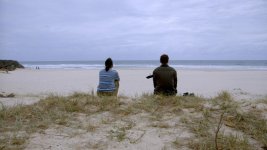
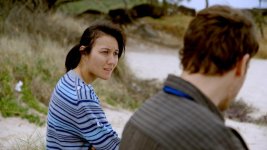
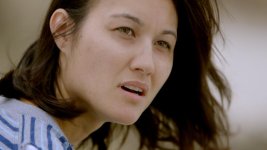
On my note above we started at a rear and sometimes went back to it when I wanted to pull the audience back and as things heated up, pushed in - in a fairly typical fashion - just all profile. From his side it looked like this. (These only have a base grade LUT applied).

SHOT 1 REAR.

PROFILE JENNY 0.jpg

SHOT 2 PROFILE MEDIUM

PROFILE JENNY 1.jpg

SHOT 3 SEMI PROFILE - CU.

PROFILE JENNY 2.jpg
 
Are you shooting with a wide or long lens for the staggered two-shot you describe? If I'm picturing it right, it's a long lens without much depth. I think you might have a preference for 'limited space' visually, which might come from comics and whatnot.

There is a great book, "The Visual Story," that goes over this in more detail. I went to read through it but can't find it on my shelf right now.http://www.amazon.com/Visual-Story-Second-Creating-Structure/dp/0240807790

Another good book on this is "The Filmmaker's Eye." http://www.amazon.com/The-Filmmakers-Eye-Cinematic-Composition/dp/0240812174/ref=pd_sim_b_1

=O You just blew my mind. The idea that I might favor that type of composition because of Comic Books... and better still, video games. lol. Growing up with side scrollers I guess I kind of experienced a certain kind of drama in 2D form.

Something to think about! I'll check those links out.

On my note above we started at a rear and sometimes went back to it when I wanted to pull the audience back and as things heated up, pushed in - in a fairly typical fashion - just all profile. From his side it looked like this. (These only have a base grade LUT applied).

SHOT 1 REAR.

View attachment 65368

SHOT 2 PROFILE MEDIUM

View attachment 65364

SHOT 3 SEMI PROFILE - CU.

View attachment 65363

Noel this is a good example of what I mean. Although the two shot's not as profile extreme as I would go... I'd likely literally stack them with the upstage subject being a foot or two forward. Which is the shot that Drew is picturing in his head. The last shot I definitely would prefer to the stock 1/3 angle.

Frames look good, man.
 
Back
Top