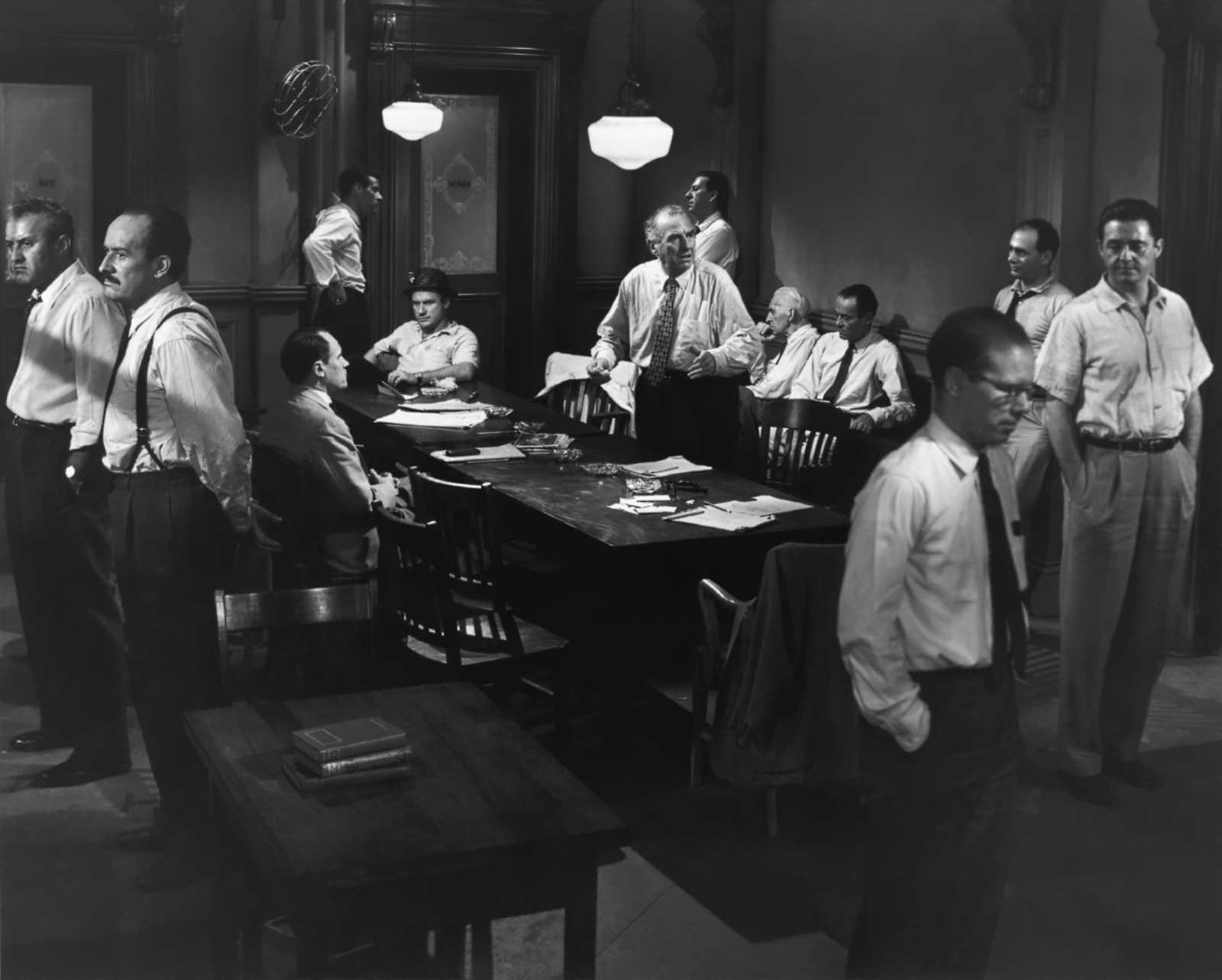
Proper coverage of multiple actors sitting in a circe around a table.?

ryan brown

lOwEr CaSe Member
Is there a procedure to follow when shooting this scenario? I've dealt with it before and the results ended up well, but I felt like I lost a bit of control when on set. I have a feature coming up with 2 similar scenes, and I'd like to have a much more precise game plan to maximize coverage and still keep it time efficient, while not confusing the audience about positioning.

I'm sure it's been covered before, so if anyone can point me in the right direction, I'd appreciate it. And also if anyone can think of a similar scene from a movie, it would help immensely. Or even a scene with multiple actors in a small area, all in one conversation and speaking back and forth between them.

Specifically, one scene has 5 actors all sitting around a circular table in the middle of the room. Camera's on sticks, no dolly.
 
Maybe check out some movies dealing with poker and other gambling.

EDIT: And any shows with people sitting around in a circle doing therapy would help too.
 
Last edited:
What is the scene about? Is it a comedy? Then maybe let more of it play out in wides and groups. If you need to punch in for character, it's usually fine to pull back when you need to cover relationships or action.

Scenes like this can get sort of cutty when you push in. Get a good wide, and a couple of 2 or 3 shot groupings for characters with a lot of dialog. It's cool on these to create different lines for pairs of people talking but if you can have one act as a pivot when changing the line, that is helpful. It depends on who's doing the talking. Hopefully not everyone ;)

A shot I love to see is where you are shooting down the profile of one or more characters and where the action permits see where you can tilt or pan into a take or across characters.
 
If you have to light the scene (not natural light) and if you can't do it from an overhead rack, you're going to have to break the scene down into at least 2 separately lit run-throughs. There's just no other way "around" it.

I have been in a similar situation, and I think what's key is to stick to the game-plan and get what you need from one angle all the way through the scene before switching setups for the reverse(s).
 
Watch "12 Angry Men"(1957) I thought I had seen a shot diagram somewhere, but alas I can't find it but here's some stills...

annex-fonda-henry-12-angry-men_10.jpg


12_angry_men_jury_table.png


12_Angry_Men_large.jpg
 
I do this for live broadcast. Of course, live broadcast is quite different from a film, but the issues of coverage are similar. The setup is typically two hosts and one or two guests. I use the typical 3-camera shoot. The limitation for the live broadcast on sticks (the cameras can dolly a bit for shots, but not much) is that the cameras are planted in one position. So essentially, it would be the same as a film with 3 camera setups. The cameras are set to the eyeline or slightly higher.

I always open with a wide shot to establish the scene. I go back to the wide shot once in a while to break things up and to re-establish the set. I only use one camera for the wide shot. This establishes the 180degree line that will be violated by at least one of the cameras. All cameras can cover one or more talent face-on and can get the others with over-the-shoulder shots. Over-the-shoulder shots can be used to see the talent talking and we can see a rear/side profile of them as they speak, but we are mostly focused on the other person's reaction to what they are saying.

The shots are:
- wide establishing shot -always from the same camera
- close up of any talent
- two-shots of any two adjacent people
- over-the-shoulder of one person's back/side and face of one or two people.

For broadcast, we also make use of zoom to go from any wider shot of two or more people to a single-shot.
 
Thanks gentlemen! Some good info here, and pretty much what I've done in the past. What I did that worked out well last time was pretty much spot on with what Finn Yarbrough recommended.

I lit one side of the room and shot: wide, OTS from the person who had the most dialogue, swinging double shots, swinging CU's, then Cu's focused on one person at a time for reaction shots possibly missed in the swingles. Then I flipped the room and lighting, and did the same from the other angle, minus the wide establishing. It worked out really well in the end to have so much coverage, but it took FOREVER. I think we did 17 takes, and the actors were sitting "indian style" on the ground... they were happy when the scene was over.

j1clark@ucsd.edu, I'll check it out for sure. Thanks.

Paul F., that seems like logical info, and a good reference for me to start making a diagram.

Any more info appreciated, so keep it coming.
 
It's really easy to get yourself into a ridiculous number of setups when shooting a scene like that, and if you're fighting the clock sometimes the best (depending on your perspective) option is to make a bold stylistic choice and commit hard to it rather than shooting significantly compromised coverage or blowing an already overscheduled day.

The last project I shot had two separate dialogue scenes with 5 characters seated around a table. For one of the scenes I shot somewhat standard coverage (a wide/master, two different 2-shots, singles all around, and a second set of singles with flipped eyelines), but the other 6-page scene was scheduled for a half-day and I didn't really have time to accomplish what I wanted with normal coverage on sticks. Handheld was definitely the wrong look, so we had to figure something out that made sense from a story-perspective, didn't look or feel compromised, yet still allowed us to make our day.

The scene was naturally split into three segments: A mother, father, and their son sit around the table waiting for their daughter and her new boyfriend to arrive (1 page); They arrive and general discomfort insues (1 page); Eased conversation turns to a tense standoff between the boyfriend and father (4 pages). We wanted to emphasize the tension when the daughter and boyfriend arrive, and we wanted to highlight the isolation of the boyfriend towards the end of the scene as he's practically interrogated by the father, so we came up with a way to get something dynamic in a short amount of time that most clearly served those primary functions of the scene.

We set circle tracks up around the table, and lit in with a 1k gem-ball clamped to a wooden beam over the center of the table - hiding the floor-ceiling run of the cables. We shot the first section of the scene as a slow 405° counter-clockwise (camera moving left-right) one-take around the family, landing on the daughter and boyfriend arriving in the entryway to the dining room. We then shot stationary singles for each family member during the page of tension as introductions are made, oriented around the father and boyfriend's conversation. The third section of the scene was shot as a one-take circling clockwise (right-left) around the table. Towards the end of the scene as the boyfriend is isolated we made a full 360° circle with the camera on him the entire time.

As a backup, in case our one-take didn't work, we shot the same circling motions for the first and third section of the scene four separate times, offset by 90° each time so that we always had coverage of each character for each line of dialogue. In the end the one-takes worked as hoped and made the final cut.

That kind of choice can be a risk as it's a pretty definite commitment, but sometimes bold choices and calculated risks lead to the most satisfying scenes. Whenever something isn't clear or seems difficult, creative off-beat ideas can at the very least help turn something unsure into a statement.
 
Last edited:
Back
Top