Problems with magnetic ballasts for HMIs?

Spartacus

Veteran
Are there any known issues with older style magnetic ballasts for HMI fixtures?
I just read that they are less energy efficient, does that mean a 1,2K puts out less light than with an electronic ballast?
Will all magnetic ballasts be flicker free or are there different kinds?
Thanks for your Help!
 
A few months ago when I decided I wanted to try to offer the ultimate indy 1200w par for $899, that dream was going to be powered by a magnetic ballast. Unfortunately reality got in the way! I (personally) did not like the effect. There was some flicker at higher shutter speeds and there was a bit of noise. I'm told the noise can be worked out and some of the flicker too with a bit more work--but never all of the flicker. One thing though, it can't be made brighter.

The electronic ballasts I was experimenting with during the same period all power the bulb at the theoretical maximum output and are therefore more interesting. The other nice thing about the e-ballasts is that they drive the bulb at higher frequencies and therefore you're more likely to run at more different shutter speeds and fps before you see any problems (if at all). The main drawback I see to an electronic ballast is a bit more ignitor or bulb noise in some cases which can also be worked out eventually.
 
Well I mentioned two noises. The one from magnetic ballasts will typically manifest itself as a 60hz (or 50hz of course if your country is so inclined) hum coming from the transformer. Because this kind of ballast is driving the bulb at the line frequency of 50 or 60hz however, the bulb is not being driven at a very high frequency and thus you hardly ever hear any noise coming from it or the ignitor. In an electronic solution you can have two possible kinds of noise. One from a fan which keeps the electronics cool (although we've talked before about ways around this to where the fan can either be whisper quiet or none at all). The other noise source is from the bulb and/or ignitor as they're being driven at a higher frequency in the name of keeping out the flicker from different fps and shutter settings. The noise can manifest itself as a faint electronic hum coming from the fixture itself. Not terribly intrusive unless your microphone happens to be right next to the fixture.
 
i like the electronic ballasts for the sake of flicker free operation. however, beware that they can overheat. it has happened to me a few times. for example, if you will be shooting out in the sun during summer, you may want to go for magnetic.
 
Problems with magnetic ballasts for HMIs?

The other nice thing about the e-ballasts is that they drive the bulb at higher frequencies and therefore you're more likely to run at more different shutter speeds and fps before you see any problems (if at all).

Electronic ballasts are "flicker free" at all camera rate/shutter speeds (the exception being extreme High Speed Cinematography), not because they operate at a higher frequency, but because they use capacitors to square off the power sine wave which causes an increase in the duration of the HMI arc so that the light is on more than it is off. Also called "square wave" ballasts or "constant power" ballasts, a light powered by an electronic HMI ballasts will put out 10% more light than the same light powered by a magnetic ballast, as well as be flicker free at all frame rates for this reason. Electronic ballasts are also smaller and lighter than a magnetic ballast of the same wattage. The down side is that because of their sophisticated electronics square wave ballasts are more expensive, more fragile, and can generate more harmonic distortion than magnetic ballasts when used on a portable gas generator.

In the interest of full disclosure, I should say at this point that in addition to being a gaffer, I own and operate a rental house that rents and sells the equipment I am about to recommend. If what I am about to say sounds like Iím hyping certain product lines it is not because we rent and sell them. We are dealers and rental agents for just about all the major brands and I donít stand to profit from the sale or rental of magnetic HMI ballasts since we made the transition to PFC electronic ballasts. As a professional Gaffer of a lot of tight budgeted historical documentaries for PBSí American Experience and The History Channel (see my "credit-entials" on Imbd), I think it is worth noting that magnetic ballasts are still a viable production tool when used with the new inverter generators because they offer low budget independent filmmakers a cheaper alternative to high priced rental house equipment.

My recommendations are also based upon extensive research I have done on the use of portable gas generators in motion picture production. For this research, I ran a series of tests in order to analyze the interaction of conventional AVR generators (a Honda EX5500 with Crystal Governor), as well as inverter generators (a Honda EU6500is), with the prevalent light sources available today. I have compiled the results of my tests and it is available online at: http://www.screenlightandgrip.com/html/emailnewsletter_generators.html

Broadly speaking, HMI ballasts now come in three varieties. They are magnetic ballasts, electronic square wave ballasts (also called flicker free ballasts), and Power Factor Corrected (PFC) electronic square wave ballasts. For the purpose of this discussion, I will not refer to electronic square wave ballasts as flicker free, because that implies that magnetic ballasts generate flicker, which they do not under controlled circumstances. To avoid “flicker” with magnetic HMI ballasts operating on conventional generators, the generator speed must be tightly governed. The need for such tight control of the AC frequency has to do with the fact that HMI lights are inherently arc lights whose output pulsates.

If you were to look at an HMI globe, instead of a coiled tungsten filament glowing, you would find an electrical arc spanning the gap between two opposing electrodes. On the most fundamental level, a magnetic HMI ballast is simply a variable transformer choke between the power supply and the lamp electrodes. The transformer provides the start-up charge for the igniter circuit, rapidly increasing the potential between the electrodes of the head’s arc gap until an electrical arc jumps the gap and ignites an electrical arc between the lamp electrodes. The transformer then shifts gear and acts as a choke, regulating current to the lamp to maintain the pulsating arc once the light is burning.
As such, the light intensity of a HMI powered by a magnetic ballast follows the waveform of the supply power and increases and decreases 120 times a second, twice every AC cycle. This fluctuation in the light output is not visible to the eye but will be captured on film or video if the frequency (Hz) of the AC power is not precisely synchronized with the film frame rate or video scan rate. If the AC Frequency of the power were to vary, a frame of film or video scan, would receive more or less exposure depending upon the exact correspondence of the film/video exposure interval to the cycling power waveform because the light intensity is pulsating at twice the AC frequency.

In film production with magnetic HMI ballasts (as opposed to video), to avoid this flicker, you must also use a crystal controlled camera, run the camera at one of a number of safe frame rates (those that can be divided into 120 and result in a whole number), and use power that is regulated at exactly 60 Hz +/- a quarter cycle (59.75 Hz - 60.25 Hz). The problem one encounters when operating magnetic HMI ballasts on conventional generators is that by design the AC frequency they generate is a function of engine speed and their speed fluctuates. As the generator spins faster or slower, the frequency of the output varies in step. For this reason, when filming with magnetic HMI ballasts, a separate governor is required to ensure that the engine spins its’ core at a near constant 3600 RPM to produce the desired AC Frequency of 60 Hz (60 cycles/second x 60 seconds/minute = 3600RPM).

An AC Frequency governor accomplishes this by first monitoring the engine speed, it then compares that reference signal with an internal reference, and corrects any error by adjusting the engine throttle through a mechanical linkage. By constantly adjusting the engine speed in this fashion the governor ensures a more or less stable 60 Hz AC Frequency. In practice, AC governor systems work well in small portable generators only if the generator is well maintained, finely tuned, and carefully prepped for each shoot. The carburetors of small generator engines are easily gummed up by old fuel making them run rough. For this reason, it is important to bleed old fuel from the system and replace it if the generator as been sitting idle for an extended period of time. A second maintenance issue is that the generator battery must be at full capacity as well as fully charged. The reason for this requirement is that the battery charging system of the generator was not designed for the additional electrical load of the AC Frequency governor. If the generator battery is not at full capacity and fully charged, the AC Frequency governor eventually runs the battery down to the point that it can no longer regulate the engine because it is underpowered. Unfortunately, more often than not, the generators coming out of rental houses are poorly maintained and inadequately prepped making the AC governor system ultimately unreliable.

When electronic square wave HMI ballasts came on the market, they were at first thought to be the solution to all the problems inherent in running HMI lights on small portable generators. By eliminating the flicker problem associated with magnetic ballasts, they also eliminated the need for the expensive and ultimately unreliable AC governors required for flicker free filming with magnetic HMI ballasts and portable gas generators. Electronic square wave ballasts eliminate the potential for flicker by squaring off the curves of the AC sine wave supplying the globe. Squared off, the changeover period between cycles is so brief that the light no longer pulsates but is virtually continuous. Even if the AC Frequency of the power were to vary, a frame of film or video scan, would receive the same exposure because the light intensity is now not pulsating but nearly constant. Electronic square wave HMI ballasts allow you to film at any frame rate and even at a changing frame rate.

Since my post exceeds the space allowed I will pick up with a detailed description of the pros and cons to magnetic HMI ballasts in my next post.

- Guy Holt, Gaffer, ScreenLight and Grip, Boston MA
 
Last edited:
Are there any known issues with older style magnetic ballasts for HMI fixtures? I just read that they are less energy efficient, does that mean a 1,2K puts out less light than with an electronic ballast?
Will all magnetic ballasts be flicker free or are there different kinds?

Since my post exceeds the space allowed I will pick up with a detailed description of the pros and cons to magnetic HMI ballasts in my next post.

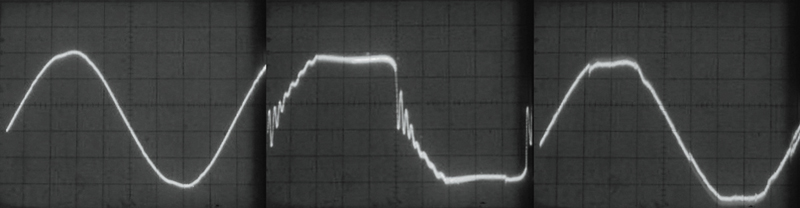
In practice, electronic square wave ballasts turned out to be a mixed blessing. Part of the problem with operating electronic HMI ballasts on portable gas generators in the past has to do with the purity of the power waveform they generate. With an applied voltage waveform distortion of upwards of 19.5%, conventional generators do not interact well with the leading power factor (current leads voltage) of the capacitive reactance created by electronic square wave HMI ballasts. The net result is harmonic currents are thrown back into the power stream, which results in a further degradation of the voltage waveform and ultimately to equipment failure or damage (for the reasons discussed in my article)

wwaveform_no-load.jpg

Left: Grid Power w/ no load and a THD of less then 3%. Center: Conventional Generator w/ no load and a THD of 17-19%. Right: Inverter Generator w/ no load and a THD of 2.5%.

The oscilloscope shots of the power waveforms below is from my article mentioned above and is typical of what results from the operation of a 1200W HMI with non-power factor corrected ballast on grid power (left), on a conventional generator (middle), and inverter generator (right.) As a comparison of the oscilloscope shots above and below indicate, the return of harmonic currents by non-PFC electronic HMI ballasts can generate severe voltage distortion in the power generated by conventional portable generators. Given the large sub-transient impedance of conventional portable generators, and the fact that the original supply voltage waveform of conventional generators is appreciably distorted (a THD of 17-19%) to begin with, you have a situation where the return of any harmonic currents by a non-PFC electronic ballast (HMI or Kino) will result in significant waveform distortion of the voltage in the distribution system. The adverse effects of the harmonic noise generated by non-PFC electronic ballasts and exhibited here in the middle shot, can take the form of overheating and failing equipment, circuit breaker trips, excessive current on the neutral wire, and instability of the generator’s voltage and frequency. Harmonic noise of this magnitude can also damage HD digital cinema production equipment, create ground loops, and possibly create radio frequency (RF) interference.

wwaveform_elec_ballast.jpg

Left: Grid Power w/ 1.2Kw Arri non-PFC Elec. Ballast. Center: Conventional AVR Power w/ 1.2Kw Arri non-PFC Elec. Ballast. Right: Inverter Power w/ 1.2Kw Arri non-PFC Elec. Ballast.

As is evident in the oscilloscope shots below of a 1200W magnetic HMI ballasts on grid power, on power generated by a conventional Generator (Honda EX5500), and power generated by an inverter generator (Honda EU6500is), the lagging power factor caused by the inductive reactance of magnetic ballasts has by comparison only a moderately adverse effect on the power waveform. Outside of causing a voltage spike in the inverter power, magnetic ballasts actually show a positive effect on the already distorted power waveform of the Honda EX5500 conventional generator. For this reason magnetic ballasts work better on conventional generators with frequency governors than do non-PFC electronic square wave HMI ballasts.

wwaveform_mag_ballast.jpg

Left: Grid Power w/ 1.2Kw Arri Magnetic Ballast. Center: Conventional AVR Power w/ 1.2Kw Arri Magnetic Ballast. Right: Inverter Power w/ 1.2Kw Arri Magnetic Ballast.

Magnetic ballasts will operate reliably on the Honda EU series generators because Honda's sine-wave inverter technology provides much higher quality power than conventional (non-inverter) generators. With a waveform distortion factor of less than 2.5%, the power generated by Hondaís EU series of generators is quite often better than what you get out of the wall outlet. The power these machines generate is rock solid with a frequency variance of only hundredths of a cycle - which eliminates the need for costly crystal governors. The Honda EU series generators provide true sine wave power with low enough distortion, and frequency stability, to power HMI's with magnetic ballasts without problems. As long as you shoot at one of the many safe frame rates, magnetic ballasts are also ìflicker freeî (where the topic of safe frame rates for magnetic ballasts is discussed extensively elsewhere in this forum I wonít get into it here.) In addition, the smaller magnetic ballasts (575-2500W) offer the distinct advantage of being less expensive and draw less power (once they have come up to speed) than the commonly available non-PFC electronic equivalents (13.5A versus 19A for a 1.2kw.)

Of course there are downsides to using magnetic ballasts. One down side is that you are restricted to using only the safe frame rates and shutter angles. But when you consider that every film made before the early 1990s was made this way, you realize it is not such a limitation. Another downside to magnetic ballasts is that you can’t load the generator to full capacity because you must leave “head room” for their higher front end striking load. When choosing HMIs to run off portable generators, bear in mind that a magnetic ballasts draws more current during the striking phase and then they “settle down” and require less power to maintain the HMI Arc. By contrast, an electronic ballasts “ramps up”. That is, its’ current draw gradually builds until it “tops off.”

For example, even though a 2.5 magnetic ballast draws approximately 26 amps you will not be able to run it reliably on the 30A/120V twist-lock receptacle on the generator’s power panel. As mentioned above, magnetic ballasts have a high front end striking load. For this reason, you must always leave “head room” on the generator for the strike. But, even though the twist-lock receptacle is rated for 30 Amps conventional 6500W generators are only capable of sustaining a peak load of 27.5 Amps per leg for a short period of time. Their continuous load capacity (more than 30 minutes) is 23 Amps per leg. And if there is any line loss from a long cable run the draw of a 2.5 magnetic ballast will climb to upward of 30 Amps. To make matters worse, the lagging power factor caused by the inductive reactance of the magnetic ballast kicking harmonic currents back into the power stream causes spikes in the supply voltage that can cause erratic tripping of the breakers on the generator or ballast. (for a more detailed explanation of why that is I, again, suggest you read my article.) In my experience the load of a 2.5kw magnetic ballast is too near the operating threshold of a 6500W generator for it to operate reliably.

HD_PP_Demo_Transformer-Distro.jpg

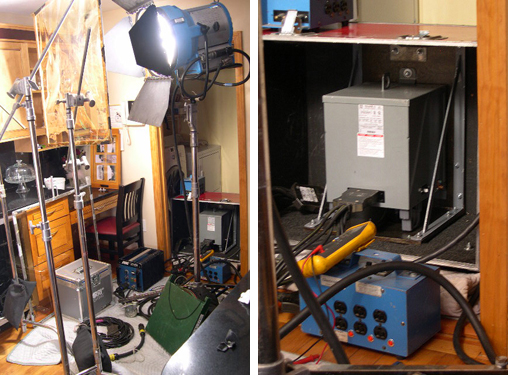
Our 60A Full Power Transformer/Distro steps down the 240V output of a generator to a single 60A 120V circuit that is capable of accommodating the high front end striking load, and even the voltage spikes, of large HMI magnetic ballasts.

The only sure way to power a 120V 2.5kw (or even a 4kw) HMI magnetic ballast on a portable gas generator is from its 240V circuit through a 240v-to-120v step down transformer like the one we manufacture for our modified Honda EU6500is (pictured above.) Our 60A Full Power Transformer/Distro will step down the 240V output of the generator to a single 60A 120V circuit that is capable of accommodating the high front end striking load, and even the voltage spikes, of either a 2.5kw or 4kw magnetic ballast at 120V.

While older HMIs with magnetic ballasts are less expensive to purchase or rent, Power Factor Correction (PFC) makes the newest electronic ballasts worth the extra money when it comes to lighting with portable generators. For example, the substantial reduction in line noise that results from using power factor corrected ballasts on the nearly pure power waveform of an inverter generator creates a new math when it comes to calculating the load you can put on a generator. In the past we had to de-rate portable gas generators because of the inherent short comings of conventional generators with AVR and Frequency governing systems when dealing with non-PFC electronic ballasts. The harmonic distortion created by non-PFC ballasts reacting poorly with the distorted power waveform of conventional AVR generators limited the number of HMIs you could power on a portable generator to 75% of their rated capacity (4200Watts on a 6500W Generator). But now, where inverter generators have virtually no inherent harmonic distortion or sub-transient impedance and power factor correction (PFC) is available in small HMI ballasts, this conventional wisdom regarding portable gas generators no longer holds true. Where before you could not operate more than a couple 1200W HMIs with non-PFC ballasts on a conventional generator because of the consequent harmonic distortion, now according to the new math of low line noise, you can load an inverter generator to capacity. And if the generator is one of our modified Honda EU6500is inverter generators, you will be able to run a continuous load of up to 7500W as long as your HMI and Kino ballasts are Power Factor Corrected.

According to this new math, when you add up the incremental savings in power to be gained by using only PFC HMI ballasts, add to it energy efficient sources like Kino Flos, and combine it with the pure waveform of inverter generators, you can run more HMI lights on a portable gas generator than has been possible before. For example, the lighting package pictured above consisted of a PFC 2.5kw HMI Par, PFC 1200, & 800 HMI Pars, a couple of Kino Flo ParaBeam 400s, a couple of ParaBeam 200s, and a Flat Head 80. Given the light sensitivity of the Red Camera we were using, this was all the light we needed to light a large night exterior. For more details on how this is accomplished I suggest you read my article on the use of portable generators in motion picture production which I mention above. The article is available at www.screenlightandgrip.com/html/emailnewsletter_generators.html.


- Guy Holt, Gaffer, ScreenLight and Grip, Boston MA
 
Thanks Guy, your site is just an overload of information.

Do you rent/use the Eu3000 Honda? I've got one of those... wondering if it's as solid a choice as your 6500, and what modifications might be worth doing to it?
 
Benefits of Inverter Generators

Benefits of Inverter Generators

Thanks Guy, your site is just an overload of information Do you rent/use the Eu3000 Honda? I've got one of those... wondering if it's as solid a choice as your 6500, and what modifications might be worth doing to it?


Your Honda EU3000is offers all the same benefits as the EU6500is but without the opportunity to enhance it's output the way we do with the EU6500is. As discussed above, one of the great benefits for motion picture production of all inverter generators is that the voltage and frequency of the power they generate is no longer linked to the engine speed of the generator. Where conventional generators, with simple two-pole cores, require "Crystal Governors" to run at a constant 3600 RPM to produce stable 60 hertz (cycle) power. Inverter generators do not have to run at a constant speed because the AC power they output is generated from high voltage DC power that is micro-processor switched according to a PWM control logic with a voltage stability of ± 1%, and Frequency stability of ± 0.01 HZ. For more details on how this is accomplished I suggest you read my newsletter article on the use of portable generators in motion picture production. The article is available on our website.

Where the AC Frequency (Hz) of the power the inverter modules of these generators generate is rock solid, they don’t require the expensive and ultimately unreliable engine governors. And, since the output frequency is no longer dependent on engine RPM, voltage and frequency are not susceptible to fluctuations because of varying loads as is case with conventional generators. A transient load has no effect on either the voltage or frequency (Hz) and so HMI ballasts won’t cut out. We have struck 6k HMI Pars on our modified Honda EU6500is inverter generator without problem. This feature of all inverter generators make them much more suited for motion picture production than conventional generators.

The benefits of inverter technology discussed above mean that inverter generators can put out 20% more power than conventional AVR generators using the same engines. In fact, the multi-pole core of an inverter generator alternator supplies so much power per revolution to the inverter module (several hundred overlapping sine waves at frequencies of up to 20’000 Hz) that the core doesn’t even need to operate at full speed to support a load. Instead, the micro processor of the inverter module automatically adjusts the generator's engine speed to produce only the power needed for the specific load in use. For this reason, inverter generators can run at much slower RPMs while maintaining frequency and power for the requested load.

Like the EU6500is, your EU3000is is incredibly quiet. What makes the Honda inverter generators incredibly quiet, as well as more fuel efficient, is what Honda calls its’ micro processor controlled Eco-Throttle. Eco-Throttle is simply the marketing name Honda uses to describe two of the characteristics of PWM inverter modules discussed above that make inverter generators considerably quieter than conventional AVR generators. First, with their multi-pole rotors and small stator, inverter generators produce more electrical energy per engine revolution than is produced in conventional AVR generators. Their greater efficiency, and the fact that the frequency of the power they generate is not linked to engine speed, means they can run at much slower RPMs for a given load than a conventional AVR generator.

honda_fuelnoisegraph_noise.jpg
honda_fuelnoisegraph_fuel.jpg


Improved Noise Level and Fuel Consumption as a result of Eco-Throttle.

The second reason that inverter generators are quieter than conventional AVR generators is that their PWM inverter modules permit their engine speed to be varied with load. Which means that, at less than full load, the engine can be slowed down which tremendously reduces the noise it generates. Put simply, an inverter generator is much quieter because the engine does not have to run at full speed constantly as is the case with conventional generators. Honda calls these two features “Eco Throttle” because it results in a substantial reduction in fuel consumption. But, what is of more importance for motion picture production is that these features make inverter generators substantially quieter than traditional AVR models.

Through a combination of innovative frame design and “Eco Throttle,” the Honda inverter generators achieve a noise reduction of ten decibels. Which makes them half as loud as the comparable EM7000is and ES6500 generators typically found at lighting rental houses. Honda's EU Series generators operate at 34 to 44 dBA at 50 ft. - well below what is required for trouble free location recording and quieter than our Crawford 1400 Amp “Movie Blimped” Generator.

60A_Transformer-Distro_Honda_WebPS.jpg


Modified Honda EU6500is Inverter Generator with 60A Full Power Transformer/Distro

Your Honda EU3000is offers all these same benefits as the EU6500is but without the opportunity to enhance it's output the way we do with the EU6500is. How we modify the Honda EU6500i Generator is proprietary information. What I can say is that our Transformer/Distro is able to provide 7500 Watts in a single circuit because the capacity is already built into the machine by Honda. Because 120 Volts/20 Amps (2400 Watts) is the standard circuit for domestic power in North America, Honda outfits the generator for this market with a power output panel that is under-rated for the power generating capacity of the machine when you compare it to how Honda outfits the same generator for the European and UK markets where the standard circuit for domestic power is 230/240 Volts and 16 Amps (3680/3840 Watts). Where England and Ireland have not entirely conformed to the European Union Standard of 230 Volts, but still generate 240V power, Honda makes a version of this generator for the UK market (the EU65i) with two 240V/16A circuits (3840 Watts/circuit).

HD_PP_Demo_Transformer-Distro.jpg

A Distro System consisting of a 60A Full Power Transformer/Distro, 2-60A GPC (Bates) Splitters, 2-60A Woodhead Box distributes power from a modified Honda EU6500is. Even though the generator is 100' away to reduce noise, plug-in points remain conveniently close to set.

To support markets worldwide, including the UK market, Honda has designed the base model of this generator to generate 7680 Watts (2x3840W/circuit = 7680W). When Honda configures this same base model with a power output panel for 120 Volt circuits for the North American Market, it is not fully utilizing the power generating capacity they have built into the machine for the worldwide market. What we do is "tap" the generator at a point that gives us access to the 7680 Watt capacity built into the machine for the world wide market. We then step it down to 120V with our a Transfer/Distro to give you the full power capacity of the generator in a single 7500W/120V circuit that is capable of powering larger lights, or more smaller lights, than it can otherwise.

HD_PP_Demo_SetUp_Night.jpg

The PFC 2.5 & 1.2 HMI Pars, PFC 800w Joker HMI, Kino Flo Flat Head 80, 2 ParaBeam 400s, and a ParaBeam 200 of our HD P&P Pkg. powered by our modified Honda EU6500is through our 60A Full Power Transformer/Distro

Our 60A Full Power Transformer/Distro not only accesses more power through the higher rated circuit, but it also automatically splits the load of whatever you plug into it evenly over the two legs of the generator on that circuit. Part of the reason the generator is capable of handling the additional load that you can now put on it is that it is a perfectly balanced load. Plugging in only through the Transformer/Distro also greatly simplifies your set electrics. As long as you plug in through the Transformer/Distro you no longer have to carefully balance the load over the generator's two 20A/120 circuits/legs. And, as long as you plug in your load through the Transformer/Distro, it is easy to load the generator to the max using the iMonitor display on the EU6500i generator control panel. Simply plug in lights. When the load wattage displayed on the iMonitor reaches 7500 Watts you are fully utilizing the power capacity of the generator with a perfectly balanced load. An overload alarm on the iMonitor display will tell you if you inadvertently overload the 60A Transformer/Distro. Now that you are able to fully load the generator in a perfectly balanced fashion, you are able to power larger lights, or more smaller lights, than you could without our Full Power Transformer/Distro. For a detailed explanation how this works, see my article on the use of portable generators in motion picture production available on our website.


HD_PP_DemoWS.jpg

Wide Shot of Night exterior scene lit with our HD P&P Pkg.

Where the Honda EU3000is generator does not generate single phase 240V power there is not an opportunity to use a step down transformer to access the full power capacity of the generator in single 120V circuit. The 30A/120V three pin twistlock receptacle on the Honda EU3000is already gives you access to the full power of that generator

Guy Holt, Gaffer, ScreenLight & Grip , Boston
 
Well, first of all, that's great -- glad to know I bought right (given that the 6500 wasn't out when I got it); I thought I knew what I was getting but I'm glad to see it confirmed.

Second, now I wish I would have gotten the 6500! :)

Thanks again for taking the time to share such detailed information.

Okay, last question -- I haven't tried this, but now I'm wondering -- could the 3000i handle striking a 2500w HMI?
 
Powering 2.5 HMI on Honda EU3000is

Powering 2.5 HMI on Honda EU3000is

Okay, last question -- I haven't tried this, but now I'm wondering -- could the 3000i handle striking a 2500w HMI?

It really depends on whether your 2.5 HMI has a magnetic or electronic ballast, and whether the electronic ballast has Power Factor Correction (PFC) or not. Only a power factor corrected electronic ballast will operate reliably on your EU3000 is. Where electronic HMI ballasts are typically auto-sensing multi-volt ballasts (with an operating range of 90 - 125 & 180-250 Volts), you can plug it directly into the 120V 3 pin twist-lock receptacle on the generator and it will draw approximately 23 Amps which is well within the rated continuous load capacity of the generator (where 2.5 kw ballasts are typically wired with a 120V 60Amp Bates Plug (Stage Pin) you will need a 120V 60A Female Bates to 120V 3 pin twist-lock adapter to plug your 2.5kw ballast directly into the generator. ) If the electronic ballast is not power factor corrected it will draw approximately 35 Amps at 120V, so you will not be able to run it off of the 30A/120V twist-lock receptacle without tripping it's fuse which is rated at 27.5 Amps (if I remember correctly.)

Even though a 2.5 magnetic ballast draws approximately 26 amps you will not be able to run it reliably on the 30A/120V twist-lock receptacle on the generator's power panel. That is because even though the twist-lock receptacle is rated for 30 Amps the EU3000is generator is only capable of sustaining a peak load of 27.5 Amps per leg for a short period of time. Their continuous load capacity (more than 30 minutes) is 23 Amps per leg. And if there is any line loss from a long cable run, the draw of a 2.5 magnetic ballast will climb to upward of 30 Amps. To make matters worse magnetic ballasts have a high front end striking load. That is, a magnetic ballast draws more current during the striking phase and then they "settle down" and require less power to maintain the HMI Arc. By contrast, an electronic ballast "ramps up". That is, its' current draw gradually builds until it "tops off." For this reason, you must always leave "head room" on the generator for the high front end striking load of magnetic ballasts.

wwaveform_mag_ballast.jpg

Left: Grid Power w/ 1.2Kw Arri Magnetic Ballast. Center: Conventional AVR Power w/ 1.2Kw Arri Magnetic Ballast. Right: Inverter Power w/ 1.2Kw Arri Magnetic Ballast.

And to complicate matters even more, as we saw in the oscilloscope shots in my post above, the lagging power factor caused by the inductive reactance of the magnetic ballast kicking harmonic currents back into the power stream causes spikes in the supply voltage that can cause erratic tripping of the breakers on the generator or ballast. For a more detailed explanation of why that is I, again, suggest you read my newsletter article. The article is available at www.screenlightandgrip.com/html/emailnewsletter_generators.html. In my experience the load of a 2.5kw magnetic ballast is too near the operating threshold of a 6500W generator for it to operate reliably.

As I explained in my previous post, the only reliable way to power a 120V 2.5kw (or even a 4kw) HMI magnetic ballast on a portable gas generator is from the 240V circuit of a Honda EU6500is through a 240v-to-120v step down transformer like the one we manufacture for our modified Honda EU6500is. Our 60A Full Power Transformer/Distro will step down the 240V output of the EU6500is generator to a single 60A 120V circuit that is capable of accommodating the high front end striking load, and even the voltage spikes, of either a 2.5kw or 4kw magnetic ballast at 120V. There are additional benefits to be gained by powering electronic ballasts through our 60A Full Power Transformer/Distro as well.

Transformer-Distro_Sam3.jpg

Our 60A Full Power Transformer/Distro steps down the 240V output of a generator to a single 60A 120V circuit that is capable of accommodating the high front end striking load, and even the voltage spikes, of large HMI magnetic ballasts.

You can maximize the power you can pull from a generator if, rather then plugging the 2.5kw electronic ballast directly into the 240 receptacle and operate it at 240V, you plug it in through our 60A Full Power Transformer/Distro and operate it at 120 Volts. This way the one light does not monopolize the whole circuit. In the case of our modified EU6500is you would still have 37 Amps left over to power additional lights through the transformer as well if your 2.5kw ballast has Power Factor Correction. And, as I mentioned previously, if you use only HMI and Kino Flo ballasts with Power Factor Correction you can load the generator to it's 7500W capacity.

The enhanced capacity of our modified Honda EU6500is inverter generator would be wasted if not for our 60A transformer/distro. Without the transformer/distro you could never fully utilize the full power of the generator because the load of a light would have to go on one circuit/leg of the generator or the other. For example, when plugging lights into the factory installed power outlet panel of a Honda EU6500is, you reach a point where you can't power an additional 1200W HMI because there is not 11.5 amps (w/ a P2L PFC ballast) available on either one of the factory installed 20A outlets/leg of the generator. With our Full Power Transformer/Distro you can still add that 1200 HMI because the Transformer/Distro not only accesses more power (7500 Watts) through a higher rated circuit (60 Amps), but it also splits the load evenly over the two legs (5.75A/leg) of the generator on that circuit. The end result is that the generator is capable of handling a larger load more easily because it is a perfectly balanced load.

Another benefit to using our Transformer/Distro is that it splits the load of what ever you plug into it automatically. Which means you no longer have to carefully balance the load over the generator's two 20A/120 circuits/legs as you plug in lights because the Transfomer/Distro does it for you. With our modified Honda EU6500is you simply plug in lights until the load wattage displayed on the generator's iMonitor reaches 7500 Watts. An overload alarm on the iMonitor display will tell you if you inadvertently overload the Transformer/Distro. Now that you are able to fully utilize the generator's available power, you are able to power larger lights, or more smaller lights, than you could without their transformer/distro. For example, I have used the combination of wall outlets, 60A step-down transformer distros, and Honda EU6500is generators to eliminate the need for tie-ins or a tow genny on many of the historical documentaries I have gaffed. For example, I have used this same package repeatedly at a historical mansion in Easton MA called the Ames Estate.

Transformer-Distro_Sam1.jpg

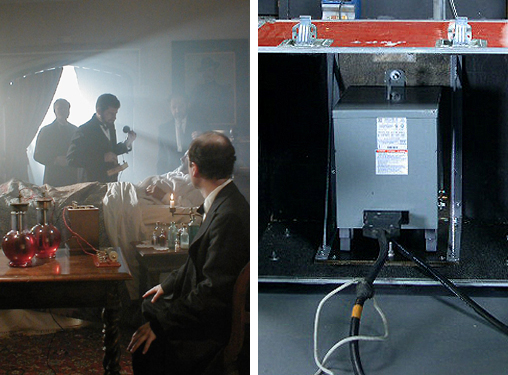
(Scene from "Unsolved History" powered from 50A/240V range outlet through step-down transformer/distro)

A popular state fee free location, the Ames Estate, like many historical house/museums, does not permit tie-ins and the electrical wiring in the house is so antiquated that it is unusable. Fortunately, they have a 50A/240 volt circuit in the carriage house for a welder they use to repair the mowers they use at the park. Our standard mode of operation when shooting there is to run 250V extension cable from the welding receptacle to a 60A Full Power Transformer/Distro placed in the entry hall of the house. Using a 60A Siamese at the Transformer/Distro, we then run 60A 6/3 Bates extensions, down to the library, to the second floor, and back to the maid’s pantry. At the end of each run we put another 60A Siamese. A 60A snackbox on one side of the Siamese gives us 20A branch circuits. The other side we leave open for a large HMI or Tungsten Light. Now we can safely plug 1200 & 2500W HMIs, or even a 5k Quartz, into our own distribution anywhere in the house.

tmfilmstrip1lg.jpeg

(Typhoid Mary in quarantine on an island in New York's East River. Note the view out the window of the East River shoreline at the turn of the century.)

To maintain continuity between shots on these dramatic historical recreations, we usually bring a 4kw HMI Par in a window on one side of the room as a sun source and a 1200 par through a window on the other side as a northern light source. We usually power both heads off of a Honda EU6500is through a second 60A Full Power Transformer/Distro. Since the Honda EU6500is can be placed right on the lawn, we are saved from running hundreds of feet of feeder back to a tow generator in the drive.

tmfilmstrip2lg.jpeg

(The exterior of the actual location used for the quarantine island. A 30' blowup of a picture of the East River at the turn of the century was rigged outside the windows of a house in Arlington MA.)

We have been able to use this same basic distribution package at numerous museums and historical houses throughout New England including Sturbridge Village. Fortunately for us, to make ends meet, many historical houses rent themselves out for events and weddings. For that reason, they usually have at least one updated service with 30 or 50 Amp 240 volt circuit for the warming ovens of caterers. I have included several production stills from these shows. Use this link - http://www.screenlightandgrip.com/html/HDPP_Transformer.html - for more production stills of PBS and History Channel historical documentaries shot entirely, or in part, with our 60A Full Power Transformer/Distro at the Ames Estate.

Guy Holt, Gaffer, ScreenLight & Grip, Boston[/QUOTE]
 
Back
Top