Barry_Green
Moderator
news
FOR IMMEDIATE RELEASE
PANASONIC AG-HMC70, INDUSTRY’S FIRST PROFESSIONAL
AVCHD SHOULDER-MOUNT CAMCORDER, SHIPS IN APRIL
** An Affordable, Second Generation Professional HD Camcorder **
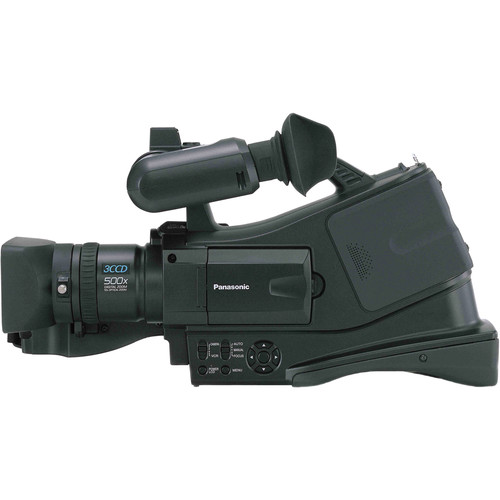
SECAUCUS, NJ (February 13, 2008) – Panasonic announced today that the AG-HMC70, the industry’s first AVCHD shoulder-mount camcorder, will be available in April at a suggested list price of $2,495. Joining the AG-HSC1U handheld in Panasonic’s professional AVCHD line-up, the HMC70 provides institutional customers, event videographers, and web content producers full high definition quality, professional audio and video connectivity, and the fast production workflow offered by tapeless SD card recording. Used to capture important events or send live widescreen video to a projector or flat screen display, the HMC70 is as easy to use as a digital still camera.
“The HMC70 is the latest product in our professional AVCHD camcorder line,” said Robert Harris, Vice President of Marketing, Panasonic Broadcast. ”AVCHD is a new industry-standard camera recording format, introduced by Panasonic and Sony, and now supported by over 30 different manufacturers.”
"This second generation HD format utilizes MPEG-4 AVC/H.264 compression and offers significant improvements in bandwidth efficiency and image quality over older MPEG-2 based systems such as HDV,” Harris said. “Implemented by Panasonic in professional camcorders using standard consumer SD cards, the Panasonic Professional AVCHD camcorder line offers a highly affordable HD video recording solution with tremendous advantages over older tape based products. Unlike HDV, AVCHD content can be captured on a standard SD card and played immediately in a growing number of inexpensive consumer products such as Blu-ray players, game machines, computers, and plasma displays. Now supported by most of the leading NLE products, AVCHD content can also be edited and rendered to almost any format or media. It is a fast and easy way for schools, churches, and businesses to enjoy the advantages of high definition video recording.”
The HMC70 utilizes the AVCHD High Profile video codec, which offers similar image quality to HDV 1080i but uses about half the bandwidth. This means longer recording times and half the storage requirement. Since the HMC70 uses standard SD cards, unlike tape, recording capacity will increase with higher capacity reusable cards, offers random access without fast forward or rewinding, and content is immediately available to editing systems without the ingest delay and additional cost of a playback deck.
The HMC70’s 3-CCD ¼” progressive image system captures 1080i HD, 16:9 images with excellent sensitivity, superb color reproduction and resolution. The camera is equipped with a 12X 38.5mm to 462mm (35mm equivalent) Leica Dicomar™ wide-angle zoom lens, one-push Auto Focus, and integrated Optical Image Stabilization (O.I.S.) that ensures stable images, critical to high definition video display. Professionals can also capture 2.1 Megapixel still images with the camcorder, even during video recording.
With the release of higher-capacity SD cards, professionals have the ability to continuously record for hours. Users can record in one of the camera’s three recording modes – 6Mbps, 9Mbps or 13Mbps. The HMC70 can record over 2.6 hours at 13Mbps, the HMC70’s highest quality mode, or up to 6 hours at 6Mbps, the camera’s extended recording mode -- all on just one 16GB SDHC memory card. In addition, solid-state SD card recording eliminates mechanical wear associated with tape, optical disc, or hard drive based systems.
The HMC70 has a professional, yet lightweight, shoulder mount design that enables exceptionally stable shooting during long recording sessions. The HMC70 is equipped with Y/Pb/Pr BNC connections for playback or live feeds to video projectors or large displays for presenter magnification use in auditoriums and other large venues. It also has high quality audio features such as two locking XLR inputs with switches for mic/line, +48V Phantom Power, Auto/Manual level, mic attenuation, and front/rear assignment. It also features a headphone volume control to match the camera’s output to the shooters’ stereo headphones.
AVCHD editing is currently supported by numerous leading NLE companies on both PC and Mac platforms.In addition, AVCHD can be easily converted to P2 DVCPRO HD for editing on existing systems using a free AVCHD transcoder available on the Panasonic Broadcast web site, or transferred as uncompressed HD video utilizing a simple HDMI to HD-SDI converter.
The HMC70 comes standard with HD Writer software and a 2GB SD card. Optional accessories include a VW-VBG260 battery pack (7.2V 2,640mAh), VW-VBG6 battery pack (7.2V 5,800mAh), VW-AD20 AC adaptor, VW-LDC102 Light, VW-LF43N Filter Kit, VW-W4307H Wide Conversion Lens and a VW-T4314H Tele Conversion Lens.
About AVCHD
Panasonic’s AVCHD camera line brings the benefits of solid-state recording to budget-conscious professionals. Based on MPEG-4 AVC/H.264 technology, AVCHD delivers twice the recording efficiency of older MPEG-2 codec technologies like HDV, ensuring crisp and clear HD images with exceptional color and motion performance. Like digital still photography, recording onto an SD/SDHC card offers a fast and simple IT-compatible workflow, with ultra-reliable performance due to resistance to shock, vibration and extreme temperatures and weather. SD and SDHC memory cards are inexpensive and widely available and can be reused repeatedly. Since AVCHD records video as digital data files, content can be transferred and stored on affordable, high-capacity hard disk drives (HDD) and optical storage media and transferred to new ones as advanced technology is introduced in the future.
About Panasonic Broadcast
Panasonic Broadcast & Television Systems Co. is a leading supplier of broadcast and professional video products and systems. Panasonic Broadcast is a unit company of Panasonic Corporation of North America. The company is the North American headquarters of Matsushita Electric Industrial Co., Ltd. (NYSE: MC) of Japan, and the hub of its U.S. marketing, sales, service and R&D operations. For more information on Panasonic Broadcast products, access the company’s web site at www.panasonic.com/broadcast.
- 30 -
EDITORIAL CONTACTS:
Stacy Moore or Pat Lamb
(201) 392-4458 (518) 692-8150
moorest@panasonic.com patalamb@aol.com