Power supply for Beachtek?

Has anyone made a mains power adapter for a Beachtek XLR box? I find that if I use it with a phantom power Mic the 9v battery only lasts an hour or two.

I've tried to find a dummy battery here in the UK which would allow me to run it on mains Power, but without any success.20170329_103135.jpg
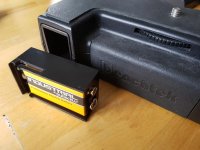
 
I looked on their website and I don't see a battery eliminator kit available. You could try using a lithium ion 9 volt battery. That will definitely give you longer life. You could also try rechargeable 9v batteries. Those should give you some extra time over a standard alkaline.

Lectrosonics makes a 9v battery eliminator kit for their wireless. I have no idea if it would work with the Beachtek, though, but it might be worth looking at.

http://www.lectrosonics.com/US/Products/product/426-iso9voltm.html.

It's not all that cheap, though. It's around $140.

Short of that, it'd be worth talking with Beachtek and see if they can either make a battery eliminator kit for their units or make a unit that could be powered off of external 12v DC. That'll really start to add to the cost of the units, though, and their whole appeal is to be lower cost at good quality.
 
If I needed one, I would make it. Just take a 9V battery apart and solder wire into the terminals through a hole in the case. Reassemble without the guts. Connect to a powersupply, or a big battery. If you know what you are doing and have the parts handy you are talking about maybe 15 minutes.
 
If I needed one, I would make it. Just take a 9V battery apart and solder wire into the terminals through a hole in the case. Reassemble without the guts. Connect to a powersupply, or a big battery. If you know what you are doing and have the parts handy you are talking about maybe 15 minutes.

I think there's more to it than that, though. You'll need some components in there to, correct? I've sold some of these battery eliminator kits, and there's always a little board in there with components on it. Units that run on 9V batteries are used to getting that and not a direct 12V. I'm not an electronics expert, though, so I could be wrong. It's not something I'd do without really knowing what I'm doing.
 
You would want to start the build process with a 9 volt DC wall wart which you can find easily on-line or at a retail audio/video supplier. But I agree that dropping an email to BeachTek is the best idea. Failing all of the above find a local electronics repair shop and bring them the parts.
 
I think there's more to it than that, though. You'll need some components in there to, correct? I've sold some of these battery eliminator kits, and there's always a little board in there with components on it. Units that run on 9V batteries are used to getting that and not a direct 12V. I'm not an electronics expert, though, so I could be wrong. It's not something I'd do without really knowing what I'm doing.

Maybe, kind of depends on the device and the supply. Whatever you do though you do NOT want to solder wires to a 9V and then run power to it. Nor do you want to take one apart, there is some nasty stuff inside.

Most devices list what they need for power someplace. If a battery is the only option you should assume it wants DC at about 9V. Generally anything between 10V and 8V would be fine. If your wall-wart outputs DC @9V you are probably fine. If not then you will need some parts. If it says DC but the symbol is a line with a dashed line over it then it needs some capacitors to smooth it out. If it's AC then you need to rectify it and smooth it out.
 
Whatever you do though you do NOT want to solder wires to a 9V and then run power to it. Nor do you want to take one apart, there is some nasty stuff inside.

Yes, that is probably good advice, if he does not know what he is doing. I tend to forget that other people have not been doing this kind of thing for almost 70 years.

However, what is inside a 9V transistor battery is six 1.5V cells stacked on top of each other. You do not want to break open the cells as they have the usual nasty chemicals in them.
 
I contacted Beachtek and their suggestion is to use rechargeable lithium polymer 9v batteries as they offer three times the length of operation compared to conventional batteries.
 
By the way, in a typical 9v battery there is zinc and carbon. Nothing scary or dangerous.


Well, the gel in them can certainly irritate the skin, and makes a nice mess if over heated.

ADDED: The gel=ammonium chloride, magnesium chloride or potassium hydroxide depending upon type of battery
 
Last edited:
You may want to do a search on "9 volt battery eliminator"

Something like this: http://www.batteryeliminatorstore.com/index.php?id_product=8&controller=product
would work with out modification.

By the way, in a typical 9v battery there is zinc and carbon. Nothing scary or dangerous.

Well that would be an old "standard" battery, and you forget the electrolyte which is some sort of acid, traditionally ammonium or zinc chloride.

But much more common in sound work would be Alkaline batteries and Lithium batteries.
The electrolyte in Alkaline batteries is usually Potassium Hydroxide (lye).
Duracell MSDS

Lithium will spontaneously combust on contact with water, so opening up a cell is highly discouraged.

And of course Zinc is toxic. Touching it is not a big deal pretty much like lead (wash your hands) but heating it can be a big health problem. Soldering temps are not going to vaporize a lot so not a big red flag but fumes can make you sick and every once in awhile a welder dies from fumes from welding zinc coated metal so not something to ignore.

With rechargeable you get other interesting stuff like cadmium in NiCad batteries.
NiCad MSDS
NiMh is a bit of a witch's brew of toxic and carcinogenic compounds.

MSDS
 
Last edited:
Back
Top