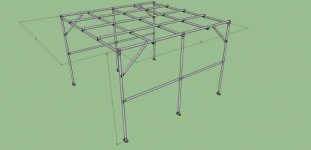
Pipe Lighting Grid for small video studio

jpthedp

New member
Hey, everybody.

I was looking everywhere for resources for installing a pipe lighting grid in my small video production studio. I found this company: http://www.simplifiedbuilding.com/ and they seem very cool. Its basically the Legos of pipe construction.

I sent them an initial design I had:
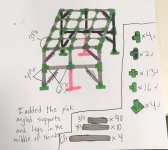
IMG_2895.jpg

Here is a crappy Mockup of what it would look like with lights:
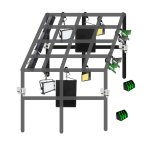
Video Room Grid.jpg

They sent me back this and quote:
Juan Ramirez Lighting Structure.jpg

So this will cost $3360.40 with delivery included. I am sure it is cheaper if I just purchase the pipe myself instead of having them cut them but I am not a handyman type at all.

I just need a solution that is sturdy and mobile because our bosses are always kicking us out of offices and moving us around.

Here was my previous solution but it is around $6000 and can only handle 165 lbs.
http://www.panther.tv/en/product/wall-spreader/

The best part is that it is completely mobile and there are no welds or permanent parts. Its literally like Legos but just a million times stronger. We will be purchasing this solution in December, I just wanted to see how much this would cost and what it would look like.

Let me know if you guys know of any cooler solutions. I thought I would share because it took me forever to find something like this. Here is a link to another "real" lighting grid I found that was made with their products: http://www.simplifiedbuilding.com/projects/lighting-grid-offset/
 
Last edited:
Maybe it's just me, but the last thing I would want to deal with if I needed a mobile solution would be a grid that I had to assemble and disassemble with as many pieces as that. I would just use stands until I had a permanent studio location. Then I would use appropriate length pipes rather then all that cobbled together.
 
Traditional pipe grids are also suspended with rigging points every 3'-6'. I would be afraid that as soon as you started putting weight on that you would get some serious sag in the center and that could potentially kick your legs out leading to a catastrophic failure of your corners. in that "engineered" drawing they only show diagonal bracing in one plane, this is a huge red flag to me.

If you want to build a proper floor support grid you are much better off using box truss for the legs and main perimeter spans and then you could use pipe or ladder truss that could be adjusted in the X/Y plane without affecting the main structure.

What part of the world are you in? Prolyte Group makes some very slick and lightweight truss with some amazing load capacity. A truss grid is really not that bad to set up and tear down once you get the hang of it and it would be MUCH safer. It may be out of your budget though so in that case going with David's suggestion of using stands would be a better option than a floor supported pipe grid.
 
As soon as you said "mobile," I thought truss, just as bclighting did. 4x 12" box truss uprights on bases with corner blocks would be far more sturdy. However, this would probably take about 2 hours to set up with a two-man team (including lighting.) If you have to move it constantly, I would rather just light from the ground using stands. Once you get a permanent location, have a pipe grid installed by rigging to the ceiling.
 
Everything you guys are saying makes sense. We do not have many lights so I don't feel like we will ever overload this. By "mobile" I meant we change rooms once a year because of changes in the office so I didn't want something permanently attached to the ceiling in any room. plus, the lease on the building wouldn't permit something from the roof. I doubt the roof would even support any kind of weight.

In terms of a truss solution, what would any of you recommend? How much would that setup cost? How long do those take to setup? I only ask having never used one.

I have been using stands but end up using a lot. I am the only one in my team who deals with lighting but no matter how much I explain to my team, they always have to film quickly, with a 5 minute notice before filming. A grid like this that has pre lit setups that they just turn on seemed the best idea for me. And it frees up more of the room that the stands usually took up.

I work for a Market Research company and am just part of the in house video department here. We are 6 in a building of 160 people. Everyone else is either a programmer or market researcher or account manager.
 
I doubt the roof would even support any kind of weight.

Any rigging company that is worth hiring will have an engineer do weight calculations.

In terms of a truss solution, what would any of you recommend? How much would that setup cost? How long do those take to setup?


Tomcat or Global are two well-known names. You will have to figure out how long your sticks need to be. A simple box with pipes on cheeseboros going across will support pretty much anything you can rig. Minimum you will need is 4 bases, 4 corner blocks, 4 uprights the height of your ceiling (minus 12" for the corner blocks) plus 2 sticks the length of your room, and 2 sticks the width of your room.
 
What part of the world are you in? Prolyte Group makes some very slick and lightweight truss with some amazing load capacity. A truss grid is really not that bad to set up and tear down once you get the hang of it and it would be MUCH safer. It may be out of your budget though so in that case going with David's suggestion of using stands would be a better option than a floor supported pipe grid.

I am in the Central Valley of California. Those Prolyte solutions look cool. You mentioned it might be out of my budget. Would much would one of their solutions cost? I want to move away from stands because my video room constantly changes but a grid like this would be able to stand up to the changing setups and stands constantly being moved. That is why it seemed appropriate for me.
 
It looks like your grid configuration is 12 x 12 x 8. Use solid lengths of 1 1/2" black pipe (schedule 40 or greater http://www.gopherstagelighting.com/docs/pipe_specifications.pdf )and cheeseboro clamps for your joints, and weighted boom bases for the uprights. You'll need solid cheeseboros for most of you joints and swivels for any braces. Your build will look like the one you were quoted on. Your biggest problem will be maneuvering 12' lengths of pipe through your offices.
 
Back
Top