Person doing golf show in Hawaii needs audio advice badly.

olindacat

Well-known member
Hi. I could really use some advice. I produce a 17 yo print publication in Hawaii and have been taping a monthly 1/2 hour SD golf show in Hawaii for the past year as an extension of the brand. The show airs on local cable and online, and is shot by me using wired lav mic and handheld mic, via a Beachbox into a Sony HVR-HD1000U camcorder. I use an iMac and CS5 Premiere as my NLE and do not own any kind of interface or audio monitors. The audio I am trying to capture is 50/50 in- and outdoors. Outside is windy run and gun style interviews, lessons with one to two people, or just one person talking to viewer. Indoors is either show host seated or standing talking with either one or two guests. I do not have anyone to hold a boom for me outdoors, but can set-up shot and get camera running and hold boom indoors when talent is seated (do others do this?). I'm also thinking maybe there is a way to have a stand to hold a boom outdoors too, like I've seen in Matt's blimp wind video on YouTube. The loaned gear I am using is very hard to get hold of and often broken down as it is shared by the entire island's public, so I am buying my own as I need to shoot at all times of day and on short notice. Renting on Maui is not an option. I used to hire pros but can't afford them as much as I need to shoot. My budget for audio is $5000 and needs to cover as much as possible in terms or mics, accessories, and monitor. I have read everything I can find from here, LAFCP Users forum, indietalk.com forum, and macrumors.com's forum but am so pathetic that I am only more confused and am now forced to reveal just how lame I am, in terms of my real lack of knowledge. Your help in answering my questions is humbly appreciated.

1. I'm buying a Sony NEX FS100 camcorder. My first concern is if an external recording device, such as a Marantz PMD661 http://www.bhphotovideo.com/c/produc...ble_Flash.html is a smart move?

2. I've never used a mixer, just a Beachbox, or are they the same thing? (believe it or not, this is not addressed in the 101 sticky :-)

3. I read Dan Brocket's article on Shotguns, and would like to shoot myself now. Will a Rode NTG-3 and Rode Blimp suffice for both in- and outdoor boom situations?

4. Wireless: I gather from the sentiments of Alex in his 'under $500 wireless' article that I'd better step it up if I want to go wireless, and spend what, $800 per track? The conventional wisdom (at least I think) is that wired is always better. Is that so? I don't care about the cables and have dealt with them before. If I can deal with the wires, is that really the best route?

5. I read in the 101 that 'good cables' were important. Can anyone tell me which ones (I know XLR).

6. Can anyone help me understand the hypercardioid/supercardioid/cardioid differences in lay terms because I didn't understand what Dan was trying to say at all! Which is for indoors, and which is for out? All I get is that I'd better buy more than one mic or capsule. I like the Rodes Lava that Chad Johnson showcased in his shootout. Would that work in- and outdoors? I also liked the Rodes Blimp http://www.dvestore.com/products/Rode-Blimp.html and NTG-3 shotgun mic http://www.dvestore.com/products/RODE-NTG%2d3-Shotgun-mic.html combo. Would this work both in- and out-doors too?

7. Can anyone suggest a reasonable and portable way for me to get a boom standing on its own above talent (which goes with which capsule/mic I should use as I'll want one that can cover several people and ceiling height isn't an issue)? Also, is this boom/shock mount combo a good choice? Gitzo1540 http://www.bhphotovideo.com/c/product/475912-REG/Gitzo_GB1540_1540_Three_Section_Carbon.html and K-Tek KSSM http://www.bhphotovideo.com/c/product/707006-REG/K_Tek_K_SSMS_K_SSM_Microphone_Shock.html

8. I read about headphone amps. What are they and I was planning on buying these Sony MDR7506 headphones, are they good enough? http://www.bhphotovideo.com/c/product/49510-REG/Sony_MDR_7506_MDR_7506_Headphone.html

9. I know my room needs more than I can ever do to it to make it right for monitoring. It is 160sq ft with 7' ceilings, four walls of plasterboard and semi-gloss paint. I am set in the middle of a busy rodeo town with lots of car noise and it is very hot during the day but we rarely run a/c because of the cost. Here is a shot of my work area attached. I was looking at audio monitoring with a Genelec 6010 5.1 package http://www.bhphotovideo.com/c/produ...RROUNDPAK_6010_SurroundPak_Nearfield_5_1.html but don't even knw how to hook it up to my iMac, if I need another device, e.g., an 'interface' whatever that is (help!).
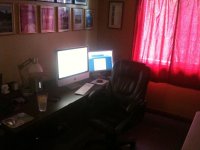
myoffice.jpg

I am sorry to ask so many questions and understand if you all tell me to drop dead, but it can't hurt to try, right?

Last point: I will be buying Barry and Matt's DVD. Today.


​
 
1. The 661 is solid from everything I've read, but the most agreed upon downside is that it doesn't work well in a bag since the control are on the top of it (vs. the side for easy access). Fostex FR2-LE is a comparable version that works well in a bag if that's a concern.
2. Kinda. A beachbox is designed as a preamp, with outputs tailored to pro-sumer cameras (1/8" if I remember right, which isn't a pro connection). Good mixers take in 3-5 channels, mix them down to 2 channels (usually lavs all on one channel, boom channel on it's own), along with being a preamp/limiter/high-pass filter for each device.
3. I actually have a NTG-3 and Rode blimp, and it works well in many indoor locations, but if you're in a smaller room, or a room with minimal curtains/couches/absorptive materials, it still has issues. A hyper is helpful in those cases.
4. Yes, wired is always better. Cheap wireless is often even worse than worthless.
5. XLR is the type of connector, and usually indicate balanced signal (i.e. it rejects interference). XLR varies all over the map. By and large, they are all the same sound quality in most cases, however paying more can get you cables that are more flexible and will last longer. (Avoid monoprice.com for cheap xlr connectors, and monster cable as they over-charge for everything)
6. Hyper/Super gets fuzzy imho, but a cardiod mic has a wider pattern than both (i.e. you don't have to be centered on the mic as much to be well heard). This means a cardiod might work better with more people (since it's wider pattern covers them) but a hyper and/or super with a tighter pattern rejects more noise. All these mics reject less than a shotgun though, but as you've probably read, shotguns can have issues when there's a lot of reverb inside.
7. Well if you get a blimp, that has it's on internal shock mounting first of all. But if you grab a hyper for interiors a KSSM is excellent for most mics. You can get a boom pole holder that attaches to a regular C-stand, but I'd personally be nervous about using one of those outdoors. Others may have more experience with that though.
8. 7506s are an industry standard, and they're good. Not perfect or mind blowing. Generally i consider them good enough to monitor accurately, yet cheap enough where they can be broken and replaced without crying first.
9. In that small a room, 5.1 monitoring just isn't possible. 2.0 monitoring, with the noise floor you'll have, honestly is even questionable. I would recommend 2.0 monitors, and check with something like the focusrite VRM box as well (from the reviews I've read it's decent for checking mixes on). If you can rent studio time as well though, it would definitely be worth it.

P.S. I'm actually on Oahu, so if you want to hear any my gear before buying, PM me and we can try to work something out.
 
no need to dive into all the other stuff, but the fs100 will be fine for recording audio. it has dual xlr inputs that can be fed from a mixer, best to use an eng breakaway cable from mixer to camera(but you can go straight in to camera, not advised, but is very common for one man band stuff). so no need to purchase a recorder.
 
no need to dive into all the other stuff, but the fs100 will be fine for recording audio. it has dual xlr inputs that can be fed from a mixer, best to use an eng breakaway cable from mixer to camera(but you can go straight in to camera, not advised, but is very common for one man band stuff). so no need to purchase a recorder.

Thanks a lot, ManglerBMX. Should I just Google the cable and buy anything?
 
1. The 661 is solid from everything I've read, but the most agreed upon downside is that it doesn't work well in a bag since the control are on the top of it (vs. the side for easy access). Fostex FR2-LE is a comparable version that works well in a bag if that's a concern.
Aloha Alex! Mahalo for the help. manglerBMX (just below your post) says I don't need an external recorder. Is that your view as well?

2. Kinda. A beachbox is designed as a preamp, with outputs tailored to pro-sumer cameras (1/8" if I remember right, which isn't a pro connection). Good mixers take in 3-5 channels, mix them down to 2 channels (usually lavs all on one channel, boom channel on it's own), along with being a preamp/limiter/high-pass filter for each device.


What would be a good field mixer in your opinion? Something can learn to use well, and not be over my head (as I usually am)....?

3. I actually have a NTG-3 and Rode blimp, and it works well in many indoor locations, but if you're in a smaller room, or a room with minimal curtains/couches/absorptive materials, it still has issues. A hyper is helpful in those cases.

Is it fine outdoors then? Just the indoors is the issue and I should buy a hyper in that case (for indoors)? Can you recommend a couple of hypers so I can test and figure out which is best, or do you have a fav? BTW: nice Delorean ;-)

4. Yes, wired is always better. Cheap wireless is often even worse than worthless.

If you were going to get a wireless set-up to build upon, what would you start with that was a good foundation?

5. XLR is the type of connector, and usually indicate balanced signal (i.e. it rejects interference). XLR varies all over the map. By and large, they are all the same sound quality in most cases, however paying more can get you cables that are more flexible and will last longer. (Avoid monoprice.com for cheap xlr connectors, and monster cable as they over-charge for everything)

Thanks. No brand in particular IYO?

6. Hyper/Super gets fuzzy imho, but a cardiod mic has a wider pattern than both (i.e. you don't have to be centered on the mic as much to be well heard). This means a cardiod might work better with more people (since it's wider pattern covers them) but a hyper and/or super with a tighter pattern rejects more noise. All these mics reject less than a shotgun though, but as you've probably read, shotguns can have issues when there's a lot of reverb inside.

Is the reverb pick-up a result of the shotguns picking up sound from behind mic, or just in general? So, the hyper is good or fuzzy and/or cardioid then is what I should get? Any recommendations on your favs?

7. Well if you get a blimp, that has it's on internal shock mounting first of all. But if you grab a hyper for interiors a KSSM is excellent for most mics. You can get a boom pole holder that attaches to a regular C-stand, but I'd personally be nervous about using one of those outdoors. Others may have more experience with that though.

Sorry. There goes my ignorance again. I saw what it looked like in the video but have never even held a shock mount so I don't know what I'm talking about. I noticed that Matt's outdoor tests had a boom so he could do everything himself. Maybe I'll see something in his video, which I just bought yesterday. So, do I 'grab a hyper' and go with a cardioid only (for indoors)?

8. 7506s are an industry standard, and they're good. Not perfect or mind blowing. Generally i consider them good enough to monitor accurately, yet cheap enough where they can be broken and replaced without crying first.


Thanks.

9. In that small a room, 5.1 monitoring just isn't possible. 2.0 monitoring, with the noise floor you'll have, honestly is even questionable. I would recommend 2.0 monitors, and check with something like the focusrite VRM box as well (from the reviews I've read it's decent for checking mixes on). If you can rent studio time as well though, it would definitely be worth it.

Thanks for the VRM box suggestion. Is the Saffire PRO 24 DSP what you are talking about? Is this something I'd want to mount to my camera and use to mix say three mics, as well as use in post to listen to what I've caught in the field? Now for a really big question: do I use Premiere to edit my audio (which is how I've done it and it is horrible) or Soundbooth or buy software? I know I'm pushing my luck here but am so out of it I have no alternative. Renting a studio is such a luxury. Obviously, you are used to working for Laird and others with real budgets, not the DIY indie (I know that isn't true ;-). If could farm out audio for what I could probably afford (e.g., no more than $200 per :30 show) I would, but that's an insult to the pros i'm sure. Hence, my need to do this post and make a fool out of myself ;-)

P.S. I'm actually on Oahu, so if you want to hear any my gear before buying, PM me and we can try to work something out.


I plan on it. Just don't shoot me (I saw that gun ;-)
 
Aloha Alex! Mahalo for the help. manglerBMX (just below your post) says I don't need an external recorder. Is that your view as well?

Well I don't have experience with that camera, but from the specs it only recorder 16-bit audio, instead of 24-bit. Not the end of the world, but especially in a one-man-band scenario where you're not solely focused on audio while shooting, the extra headroom of 24-bit may be worth it. For the moment, I would recommend just starting with the mixer, and deciding later if you want to grab a mixer though.

2. What would be a good field mixer in your opinion? Something can learn to use well, and not be over my head (as I usually am)....?
Sound Devices 302 is a very solid, 3-channel field mixer.

3. Is it fine outdoors then? Just the indoors is the issue and I should buy a hyper in that case (for indoors)? Can you recommend a couple of hypers so I can test and figure out which is best, or do you have a fav? BTW: nice Delorean ;-)

Well Schoeps cmc6 with an MK41 is an industry standard, although expensive and has issues in high humidity so I'd avoid that. Sennheiser MKH50 is good. Cheaper options might be AT 4053b, AKG S300b+CK93, Oktava MK-012. Search the forums a bit and you'll find more info on each mic.

4. If you were going to get a wireless set-up to build upon, what would you start with that was a good foundation?

Sennheiser G3 wireless is generally noted as a good starting point for wireless. Lectro's a good upgrade. Check out the Audio 101 spot for a lot more info though.

5. Thanks. No brand in particular IYO?

Well, canare star quad with neutrik connectors is common. Not sure where to buy pre-fab though as I build my own cables. B&H probably.

6. Is the reverb pick-up a result of the shotguns picking up sound from behind mic, or just in general? So, the hyper is good or fuzzy and/or cardioid then is what I should get? Any recommendations on your favs?

How to define a super and a hyper is fuzzy, as their overlap between how companies define their mics. Shotgun mic's work by an interference tube which lets in sound on the side of the barrel and cancels it out. Only the sound that comes from the front of the mic is not canceled. The issue is, the sound cancelation on the sides is not even at all frequencies. Indoors, this means echos sound weird. In acoustical absorptive spaces where there is minimal echo, this isn't much of an issue (same as outdoors where there is obviously no echo).

7. Sorry. There goes my ignorance again. I saw what it looked like in the video but have never even held a shock mount so I don't know what I'm talking about. I noticed that Matt's outdoor tests had a boom so he could do everything himself. Maybe I'll see something in his video, which I just bought yesterday. So, do I 'grab a hyper' and go with a cardioid only (for indoors)?

In Matt's video, he also knew to stay directly below the mic while talking. Normal talent you're interviewing may not be so nice. Not sure I follow your other question, general rule of thumb is "hypers for indoors, shotguns for outdoors"

9. Thanks for the VRM box suggestion. Is the Saffire PRO 24 DSP what you are talking about? Is this something I'd want to mount to my camera and use to mix say three mics, as well as use in post to listen to what I've caught in the field? Now for a really big question: do I use Premiere to edit my audio (which is how I've done it and it is horrible) or Soundbooth or buy software? I know I'm pushing my luck here but am so out of it I have no alternative. Renting a studio is such a luxury. Obviously, you are used to working for Laird and others with real budgets, not the DIY indie (I know that isn't true ;-). If could farm out audio for what I could probably afford (e.g., no more than $200 per :30 show) I would, but that's an insult to the pros i'm sure. Hence, my need to do this post and make a fool out of myself ;-)

Well the VRM is a smaller, cheaper, non-audio interface version of the Saffice PRO. This is NOT something to use in-field, only for checking mixes on while doing post. Monitor the direct signal while recording.
As for what to mix with, it all depends what you want to do. Premiere is very limited, Soundbooth does more, or something like Pro Tools especially with a bunch of plug-ins does even more.
 
I agree with manglerBMX. You haven't described anything that an external recorder would resolve. But you HAVE described several things that make me think you need better microphones and/or techniques. If you don't have a dedicated boom operator, then clip-on lavs would be my preference. For both exterior location and interior sit-down.

Perhaps out on the links you have a situation where wired microphones would get in the way or even be a safety hazard. However, mark well Gohanto's advice: "Cheap wireless is often even worse than worthless." And just for reference, "cheap" means any kit (mic, transmitter, receiver) that costs less than $550~600. The Sennheiser G3 series is widely considered the minimum price halfway-decent mic. Anything less is a cheap, fiddly, unreliable, disposable plastic toy.

Note that if you are out in the wind using headphones (like the industry-standard Sony MDR-7506), you may get some noise just from the wind through the headphone pad seal around your ears (and depending on how much hair you have!) Fuzzy covers for the headphone pads will effectively eliminate this kind of problem. In much the same way that fuzzy covers protect microphones from wind noise outdoors.

Thanks, Richard. I've seen your replies to many a thread even though I am new here. Just never posted Qs because I have borrowed gear the past three years locally. Yes, the wind can really kick up out here on our courses, and I can attest to my technique being sub-par compared to most here. It is just a reality that I must do most of this on my own. We have a lot of people in golfdom out here doing a lot of things media-wise and most on their own dimes with very little ROI, but there is potential. I am doing this mainly to address the reality of media's convergence so it is more out of necessity than any specific money pursuit. That said, I did real all of the 101s and am acutely aware of not being cheap about my investment in audio, as i get that it will last me more than 4X the life of any camera.

My Qs probably don't flush out each point as well as they should. I am prepared to go with Lectronics wireless if that is the best way to go long-run. I can tell you I have used wireless and have had good experiences but again this was borrowed gear and what brand or model number used is where I am lost (having heard all of the tests done in the 101 section here, I know there are major differences. Where I got very scared was when I started seeing frequency charts. That is just over my head!

But, I think it'd be smart for me to have the lavs that have the correct bias (I hope this is right) and are with connectors that could work on a transmitter or be hard wired, if possible. What would be a good way to go in that regard, say given a $750-$1K budget per channel?

Also, I have been concerned that I might need to 'mix' from 3+ channels into two, as Alex pointed out. Or, as I was buying an external (video) recorder, e.g., AJA Kai Pro Mini or a Atomos Ninja, these have audio recording capabilities and in the FS1000 forum on this very site, I read to NOT rely on the camera for good quality recording. So, I am a little confused (as usual).

You (Richard) have told others to give specific $ am'ts for things, so I hope that $ per channel figure is what you meant. As I have n idea what mixer costs run, I can't give you a budget and need to know what it is I need first, and how much of a rle overall it would play in the grand scheme. I am buying this gear to last me until I drop dead in another 30 or so... ;-) I am and will always be more of an enthusiast not a pro, as i know I do not have the skills or the talent or the time to master this trade.
 
A note on budgeting for projects... "Budget" does not mean saying "I can afford $XX, what can I get for that." That's how you budget your household but it's not how you budget for a project. Looking first at what you have available to spend is not a budget at all, it is a distribution of anticipated revenues. Budgeting means answering in order the questions "What equipment do I need to employ in order to achieve the desired results at the required quality level?", "How much does that equipment cost?", "Is buying or renting more cost effective?", "Do I have the assets and if not, where do I get them?" You start by determining the kit needed that gets the job done properly and work backwards from there to determine how much it will cost and where to get the needed funds.

You ruled out renting because there were no local sources but professional audio shops in the film/video industry routinely send rental gear by overnight courier to even more remote locations than yours, don't discount rental out of hand.
 
It may not be a popular opinion here, but I don't think you need full multi-thousands of dollars Lectrosonics for your application. I think that the Sennheiser G3 would provide a better cost/benefit factor for a self-funded production as you describe. Unless you are out there 100s of days a year shooting video where you might need something more rugged. But I got the impression that video is only a small part of your operation.

I wouldn't obsess on the frequency issue. Not sure exactly where you are, but if you are near a big city, you might need to plan ahead. The typical advice is to find a major equipment rental place and perhaps rent some mics before buying. Most major rental places know the spectrum landscape in their area and they know better than to stock and rent out equipment that will give their customers problems. Google says that there are several production equipment rental vendors in Hawaii (mostly in Honolulu). There are also online guides to frequency selection. For example: http://www.sennheiserusa.com/FindFrequency/

The new Rode lav (and headset) microphone range looks very good to me. It has several excellent feaatures like field-replacable cables and interchangable connectors (for wireless transmitter or hard-wired XLR connectors) So yo could use the same mics for either wireless or hard-wired. I have bought one lav and one headset mic, but I am still waiting for the interchangable connectors before I can use them. I think they have the best bang for the buck and I expect to buy more of them. http://rodemic.com/microphone.php?product=lavalier

I also have a Sign Video ENG-44 mixer which I like a lot for portable mixing. It has 4 mic inputs, but it appears to be discontinued(?) I don't know anything else that is as good at that price point ($500~600) http://www.signvideo.com/fpamxr.htm

I make my own cables and buy most of my cable and connector supplies from Redco. They also make custom cables with whatever cable and connectors you want. If I didn't make my own cables, I would probably order them from Redco. I am not a believe in "magic cables". As long as the cable and connectors are physically decent, other things like microphone selection and placement are ordes of magnitude more important than having some brand-name cable. Beware of the rip-off, snake-oil "botique" cables like "Monster" et.al. Most of your money is going for the brand name, and not for the goods. http://www.redco.com/

I also wouldn't obsess on your editing room. The people who do all the magic things to their mixing environment are doing intricate and sophisticated music mixing. You are producing more news, documentary, instructional content which doesn't significantly benefit from fancy mixing environments. Many very successful instructional and promotional videos have been edited/mixed in more modest surroundings than yours. The speakers are much more important than that last degree of sophistication of the room. And certainly Genelec is a top respected brand. But 5.1? My priorities would be much more on the front end (good microphones, mixer, etc.) than spending thousands of dollars on 5.1 speakers. You aren't really mixing 5.1 golf videos, are you?
 
Last edited:
A note on budgeting for projects... "Budget" does not mean saying "I can afford $XX, what can I get for that." That's how you budget your household but it's not how you budget for a project. Looking first at what you have available to spend is not a budget at all, it is a distribution of anticipated revenues. Budgeting means answering in order the questions "What equipment do I need to employ in order to achieve the desired results at the required quality level?", "How much does that equipment cost?", "Is buying or renting more cost effective?", "Do I have the assets and if not, where do I get them?" You start by determining the kit needed that gets the job done properly and work backwards from there to determine how much it will cost and where to get the needed funds.

You ruled out renting because there were no local sources but professional audio shops in the film/video industry routinely send rental gear by overnight courier to even more remote locations than yours, don't discount rental out of hand.

Steve: I am 48 and have been in print production for 28 years. My foray into video is admittedly only three. I am not ignorant to what budgeting means in production. I am a bootstrapper and have always managed to get what I need done for the lowest possible cost. That said, when I venture into something complete out of my realm, in this case audio, and read the same words of wisdom I already know, e.g., "not being cheap about my investment in audio", I want to make the best possible decisions I can. You need to get on a plane and come live on Maui for a few years and after you've been charged $100 to ship a box of 50 sheets of 4x5 film one-way, you tell me how I can justify renting $1000 mic with a $200 RT shipping cost (that's a worst case scenario on shipping, but not a complete exaggeration). Don't mistake my humility for complete stupidity. I have been attempting here, with this thread, to clearly get a firm grasp of what I need first. The costs I will ferret out after that has been determined.
 
It may not be a popular opinion here, but I don't think you need full multi-thousands of dollars Lectrosonics for your application. I think that the Sennheiser G3 would provide a better cost/benefit factor for a self-funded production as you describe. Unless you are out there 100s of days a year shooting video where you might need something more rugged. But I got the impression that video is only a small part of your operation.
Thank you Richard. I am shooting a monthly show. It is :30 minutes long and I probably capture 12-15 hours of footage per episode. I typically shoot for at least four days per show. A typical day: 1) 7am on course interview by seaside (show host + 1 guest) moderate gentle breeze, I lav my host and he hand-holds mic all hard wired; 2) 9am indoor (conf room) interview (show host + 1 guest) high ceilings, thin carpet, prob reverb issues, I lav both host and guest hard-wire; 3) 11am outdoor high wind golf lesson/tip (show host+golf pro+female talent) req three mics, but don't have a way to plug in two lavs + i mic so I lav the pro (as he's moving all over the place), and put my handheld mic on ground atop a folded towel to angle toward talent -- all hard wired; 1PM outdoor interview on course lanai (terrace) moderate breeze somewhat protected (I choose place where wind is blocked but it isn't perfect) with (show host + 1 guest) lav both hard wired; 3PM indoor interview (show host + 1 guest) both lav hardwire in small office with floor-to-ceiling glass windows, high ceilings, about 15x15; 5PM outdoors, on course, moderate wind (show host + 1 guest + 20 kids) host starts with intro with guest then does lecture and then interviews kids, 1 lav on host and host also holds handheld mic.; 6:30pm outdoors, lanai (terrace) busy restaurant - four people seated - I have one wired mic in middle of table and host lav. I have to pay a lot for hotel, car rental, meals, and airfare to go to each island so I cram all I can into these types of days, and will aim to do as many as 6-8 segments a day. I am doing this on four islands, every month. This is part-time and I am also scripting, editing, shooting, arranging for borrowing this gear, arranging all travel and all logistics, e.g., locations, people, etc. So, yes it is PT, but I am very active.

I wouldn't obsess on the frequency issue. Not sure exactly where you are, but if you are near a big city, you might need to plan ahead. The typical advice is to find a major equipment rental place and perhaps rent some mics before buying. Most major rental places know the spectrum landscape in their area and they know better than to stock and rent out equipment that will give their customers problems. Google says that there are several production equipment rental vendors in Hawaii (mostly in Honolulu). There are also online guides to frequency selection. For example: http://www.sennheiserusa.com/FindFrequency/


I never gave it much thought until I started looking at buying! Given the high cost, I want to be darned sure I get the right things. I can assure you that the talent is hitting golf balls and wireless is the ideal solution in most cases but technique and durability are also considerations. How I mic the talent when they are playing holes vs just putting a handheld on the ground, which I get away with but some here would barf at the notion... I am here BTW because I know my technique and probably my choice of products would be a disaster. That said, I am in Hawaii and often on the neighbor islands (Maui, Lanai, Kauai, and Big Island. I have never had a problem with wireless but then I haven't used wireless on Oahu, where we have big military bases and a 10x larger population than the other isles...

The new Rode lav (and headset) microphone range looks very good to me. It has several excellent feaatures like field-replacable cables and interchangable connectors (for wireless transmitter or hard-wired XLR connectors) So yo could use the same mics for either wireless or hard-wired. I have bought one lav and one headset mic, but I am still waiting for the interchangable connectors before I can use them. I think they have the best bang for the buck and I expect to buy more of them. http://rodemic.com/microphone.php?product=lavalier

Somehow I see that blimp with fur as being very useful. When we have tour events here the networks always have pistol-gripped blimps with huge furs on them. I don't know if they are using long or short shotguns in there, but they know what they are doing and stupid me I never bothered to ask... Thank you for the Rodes advice. I am leaning in that direction for a lav.

I also have a Sign Video ENG-44 mixer which I like a lot for portable mixing. It has 4 mic inputs, but it appears to be discontinued(?) I don't know anything else that is as good at that price point ($500~600) http://www.signvideo.com/fpamxr.htm

Is this similar to a BeachTek Beachbox? Does it mount to tripod under camera? Is this just called a ENG mixer? I can Google that if need be. How do you use this? And when the term 'mixing' is used, are you referring to the number of mics I have being used, and which mics go to what channel and how strong? If I have a dial to control input on a mixer/pre and another on the camera, how to you set each? What is your starting point?

I make my own cables and buy most of my cable and connector supplies from Redco. They also make custom cables with whatever cable and connectors you want. If I didn't make my own cables, I would probably order them from Redco. I am not a believe in "magic cables". As long as the cable and connectors are physically decent, other things like microphone selection and placement are ordes of magnitude more important than having some brand-name cable. Beware of the rip-off, snake-oil "botique" cables like "Monster" et.al. Most of your money is going for the brand name, and not for the goods. http://www.redco.com/

Is making cables a better way to go? I am not afraid of work. Do they break is that why you make them?

I also wouldn't obsess on your editing room. The people who do all the magic things to their mixing environment are doing intricate and sophisticated music mixing. You are producing more news, documentary, instructional content which doesn't significantly benefit from fancy mixing environments. Many very successful instructional and promotional videos have been edited/mixed in more modest surroundings than yours. The speakers are much more important than that last degree of sophistication of the room. And certainly Genelec is a top respected brand. But 5.1? My priorities would be much more on the front end (good microphones, mixer, etc.) than spending thousands of dollars on 5.1 speakers. You aren't really mixing 5.1 golf videos, are you?


The show has music throughout as backgrounds that gets louder in transitions. It has some sound FX lish swooshes and balls falling into cups, etc., it has people talking. I had thought the 5.1 would be good only because it had a subwoofer. If I can buy two monitors only that is great. Can suggest a pair?
 
Just a note on 5.1 monitoring, it's much more difficult than just adding a subwoofer into a room. The room needs to have a near flat response at frequencies below 80Hz, which for most rooms (unless their dimensions and wall types were designed for bass acoustics during construction) will range anywhere from expensive to outright impossible.

Mainly because if you can't accurately monitor what is in those frequencies, you risk blowing out other people's speakers and/or just having crazy amounts of bass when played over someone's personal home theater, to the point they can't even hear what's being said.

A general rule of thumb on monitors, for a professional grade mix, expect a minimum of $500/speaker. Genelec's, Event, Tannoy, JBL, Dynaudio, ect... all make good monitors, but it's largely a personal preference from auditioning them. That assumes you're in an acoustically treated space, with a low noise floor. I've seen $2000 Adams monitors in a room covered in 1" acoustical room covering 100% of the walls and ceiling (not good) and it sounded like complete junk.

P.S. Yes, shipping is absolutely ridiculous to Hawaii.
 
Last edited:
Am I wasting my money even trying to monitor then Alex? Sounds hopeless as you know my situation, and $1K for a pair of tiny Genelecs just for peace of mind when I am deluding myself isn't an appealing scenario either. The contradiction of: don't be cheap about audio vs. your room makes decent monitors junk is my frustration. Virtual room scenario on headphones + monitors was the direction I was headed, but I'm still lost. Bottom line: there has got to be a better alternative to using the 1" speaker in my iMac and I still don't know what that is or how to implement it. (Even if I have you help me buff it out, I need to know basics as I'm editing this show every few weeks!
 
Is this [Sign Video ENG-44 mixer] similar to a BeachTek Beachbox?

No. As Gohanto said, the BeachTek box is mainly a converter from pro audio standards (balanced, XLR connectors, perhaps even phantom power, etc.) to the unbalanced mini-phone connector on consumer camcorders. I have not seen any of them that are more than just two inputs feeding the stereo mic jack of the camcorder.

If you want to use more than two microphones, then you need a MIXER, not just a 2-channel converter like BeachTek makes. Certainly, you can connect almost any kind of mixer to any camcorder that has a mic input (even if it only has a mini-phone with something like a BeachTek adapter box)


IMHO, you don't need 5.1, or even 2.1 (with a subwoofer) speakers. You are NOT mixing music, you are using pre-mixed (production) music and mixing instructional/documentary kinds of productions. Frankly, I wouldn't spend more than $300 on a pair of decent powered speakers. (NOT "computer speakers"!) Don't even look at anything that calls itself a "computer speaker". The genre is trash from end to end.

Something like a pair of KRK Rokit powered speakers or several similar types of compact powered speakers made for "home studio" use. The bottom-line (the quality of your productions as viewers see/hear them) will benefit MUCH MORE from good microphones, mixer, windscreens than it EVER will with fancy speakers in your "edit suite". I know that is heresy with some people here, but the truth is that most of the kinds of videos similar to what you are doing are mixed on pretty prosaic speakers, definitely not Genelec or the high-end stuff. Don't get caught up in the equipment escalation wars of the high-end crowd. You aren't doing that kind of production. NOBODY will hear the difference whether you have $100 speakers or $1000 speakers. But EVERYONE wlll hear the difference between $100 microphones and $1000 microphones.

I make my own cables because I have been electronics DIY since I was in grade school, and besides I am cheap and I like to have exactly the kind of cables I need. My cables don't break unless somebody abuses them. I have some that have been in use for >40 years. Making XLR mic cables isn't that difficult IF you know how to solder properly. But if you don't know how to solder properly, it is probably best left to others who do. IMHO, most pre-packaged cables you find at retail stores are vastly overpriced, especially the "premium" brands like Monster. I wouldn't buy anything from Monster Cables. Their business practices are despicable.
 
Steve: I am 48 and have been in print production for 28 years. My foray into video is admittedly only three. I am not ignorant to what budgeting means in production. I am a bootstrapper and have always managed to get what I need done for the lowest possible cost. That said, when I venture into something complete out of my realm, in this case audio, and read the same words of wisdom I already know, e.g., "not being cheap about my investment in audio", I want to make the best possible decisions I can. You need to get on a plane and come live on Maui for a few years and after you've been charged $100 to ship a box of 50 sheets of 4x5 film one-way, you tell me how I can justify renting $1000 mic with a $200 RT shipping cost (that's a worst case scenario on shipping, but not a complete exaggeration). Don't mistake my humility for complete stupidity. I have been attempting here, with this thread, to clearly get a firm grasp of what I need first. The costs I will ferret out after that has been determined.

Sorry, didn't mean to offend. So many people coming here ask questions like "What's the best wireless I can get for under $500." IMHO, that's almost always the wrong question. A better approach would be "I need to record interviews with players as they walk from one green to the following tee ... what is the best way to mic that scenario? What level of gear is required to do that task properly? How much does that equipment cost?" and let the anwers define the budget.

I know what you mean about shipping, sometimes run into the same thing with cross-border shipments here in Canada. Once ordered a $50 item from a vendor in LA. They shipped UPS Ground.. Shipping charge was $10 or so but then UPS stuck on a $75 "customs brokerage fee" on top of that!
 
Last edited:
Sorry, didn't mean to offend. So many people coming here ask questions like "What's the best wireless I can get for under $500." IMHO, that's almost always the wrong question. A better approach would be "I need to record interviews with players as they walk from one green to the following tee ... what is the best way to mic that scenario? What level of gear is required to do that task properly? How much does that equipment cost?" and let the anwers define the budget.

I know what you mean about shipping, sometimes run into the same thing with cross-border shipments here in Canada. Once ordered a $50 item from a vendor in LA. They shipped UPS Ground.. Shipping charge was $10 or so but then UPS stuck on a $75 "customs brokerage fee" on top of that!

NO worries Steve! I was trying to work my questions thoughtfully and know what it is like to be on the other side ;-)
 
Back
Top