People with glasses and glare

roxics

Veteran
This is still my biggest lighting challenge, dealing with speakers in front of the camera where we see the key light (often a 2x2' softbox) reflected in their glasses. While I can raise the key up higher, I'm often restricted by standard 8' ceilings and 6' people who are standing. It's really difficult to escape that reflection as they move their head while speaking and we get that white box dancing around in various shots.

What can I do to get rid of this?
 
I try to position my key light high and off to the side, which usually gets rid of glasses reflections for most of the interview. It does pop-up from time to time as people look around the room while they are talking, but for most of the interview it's gone.

The other issue for me is the shadow on a person's face from their glasses, which also restricts where I can place my key light.
 
tilting the glasses down (raising earpieces up) a little. not too much to look silly, but generally works...if you can get the glasses to stay in place.
 
I've heard of DP's masking a fake window frame with black tape on a large key light source. Seems that our brains don't mind seeing a window reflected in glasses as much as a big light.
 
A far-side key light will tend to reflect more than a near-side key light just based on the angle of reflection of they are turned slightly 3/4 angle. You might try working with a near-side key. Or, if the interviewee is facing straight on towards the camera and they don't need to read anything, maybe just aske them to wear contacts that day ;)
 
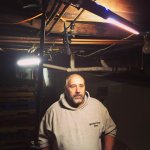
Not sure if this helps you or not, but for small spaces and interview subjects with glasses (or in general), I've been placing an Ice Light horizontally directly over the subject. It can also be hung from the rafters in a basement. Works great at avoiding the glare, and even when they tilt their head up and you see the light briefly, it's a thin light band that doesn't call much attention to itself.

madurbanbeesinterview-icelight.jpg

madurbanbeesinterview.jpg

musiccityleather-icelight.jpg

northbrewery-icelights.jpg

northbreweryinterview.jpg
 
Thanks for the advice everyone. This client has been pretty nitpicky. They hate shadows with a passion, pointing out even the slightest light variation from one side of the face to another. Plus they had to read the teleprompter. So this made everything a little difficult during my last shoot. Most clients aren't nearly as anti-shadow. I did end up with some light reflections but the client was there seeing the shot and didn't say anything about them. But I figure, for future shoots I really want to nip this one in the bud if I can because it's something I personally have an issue with.
 
Thanks for the advice everyone. This client has been pretty nitpicky. They hate shadows with a passion, pointing out even the slightest light variation from one side of the face to another. Plus they had to read the teleprompter. So this made everything a little difficult during my last shoot. Most clients aren't nearly as anti-shadow

So you too have clients who like bad lighting? You should try to educate them that the absence of shadows is not good lighting, it's boring, flat, non-dimensional lighting. I have had clients like that before, the best way to educate them is NOT on the day of the shoot but beforehand, send them some samples of good interview lighting and bad interview lighting and try to show them what modeling and dimension look like. Show them screen grabs from respected media sources, a TV show they may like and you will find that other than Access Hollywood type of drivel, flat lighting is kind of "out". Audiences like seeing images that have some modeling and dimension and the only way to get that is to use shadow and light. Heck, even Joni Mitchell wrote a song about it!

https://www.youtube.com/watch?v=fO-aSVFCDxw

Wish I could but this isn't a freelance job for me, this is my day job. I work for a company that has a corporate structure that does not allow me interaction with the client until the day of the shoot. All contact goes through project managers who don't always ask the right questions from the client or get all the information needed. Believe me, it gets incredibly frustrating. But in this case, we're also dealing with a client that doesn't know what they want up front, only what they don't want after it's all done.
 
Ughh, does not sound fun, sorry for you, although hey, you have a job that pays you a regular paycheck to shoot video so that balances it out! I've produced corporate media for two decades so I have been in your shoes and don't miss it. Although different types of broadcast clients with lighting can be a PITA too when they don't know what they want, don't know what will work for the goal of the project, yet they want to dictate how you should perform your job as a cinematographer. Can be very frustrating. Keep at it and you will get better clients who will listen to you and take your advice. The glasses thing is tough. I shot interviews for years with Peter Bogdanovich and if you know who he is and what his glasses look like, I've been down the exact same road. Except it was impossible to hide any lights, anywhere, because his glasses are 70's style convex bug eye lenses and they reflect everything in the room, no matter what I did. And of course, these glasses are part of his normal "look", so contacts or other glasses were off the table. I would end up keying him from almost directly overhead, not flattering, and any fill sources down lower were reflected in his glasses no matter the size or location. Just did the best I could but I was never happy with his lighting.
 
A quick google image search of Peter Bogdanovich shows pretty much every other photo of him has light reflected off his glasses. So hey, I guess that's just his look!
 
I suggest a different approach.
Instead of seeing the flat lighting as "bad" lighting, instead of being frustrated by having to execute that sort of lighting ( and risking your client sensing your displeasure or reluctance ), embrace it. Get into it.

A professional is enthusiastic in regard to what the clients wants. A professional makes themselves get into what the client likes. If the client likes flat, then flat it is and I shall have great enthusiasm in executing flat lighting. It's their product. They are the ones who are paying.


As a wise DP once told me when I was starting out- There is no such thing as bad lighting. There is lighting that you find inappropriate for the content and setting. There is lighting that isn't to your own taste. But there is no "bad lighting". Lighting is subjective.

Next time instead of walking in their with a begrudging mindset of "oh no, here we go again with the damn flat lighting." walk in their with the mindset of "Alright! Flat lighting! fukkin' A! Love me some flat lighting.". After all, the client is paying you to like what they like. If you were the one paying, would you want a cameraman who likes what you like or a cameraman who doesn't like what you like and only does it begrudgingly? It is your job to like what the client likes and be enthusiastic about executing what they like. At least for that day and while working on their dime. :)
 
A quick google image search of Peter Bogdanovich shows pretty much every other photo of him has light reflected off his glasses. So hey, I guess that's just his look!

I thought I was better! I thought I was a contender! Ha, ha. I nagged him for years to just get some anti-reflective lenses, but all for naught. Seems strange considering that a large portion of his career has been appearing on-screen in docs and BTS about all of his wonderful relationships with John Ford, Howard Hawks, etc. You can lead a horse to water...BTW, if you haven't seen it, his Tom Petty doc, "Runnin' Down a Dream" is on Netflix and is excellent. He is a very talented filmmaker.
 
Back
Top