Overcoming Reflective Glare - Polarizing Filters?

Jeffsteez

Member
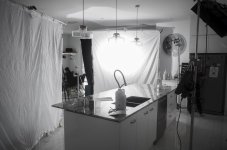
I'm trying to shoot some recipe/cooking videos. Unfortunately the kitchen we are using has semi-glossy white cupboards. I was intending to use an Aputere Lightdome II modifier as a key, but I'm getting a massive lightdome shaped reflection from the gloss cupboards that cover the wall behind the talent. I've tried playing with angles, adding the grid to the Lightdome but I can't find a combination that both avoids significant glare and adequately lights the subject.

I'm shooting with a Sony A7C and A7SIII. I was wondering if adding a polarising filter might eliminate (or significantly reduce) glare? Does anyone have experience of this? And if so, I'm wondering if a "linear" or "circular" polarising filter would be best.

Thanks!

Yes, a pola might help some. You want a circular pola. I don't recall why, but the general rule is that circular polarizers are always better than linear. That's all you need to know: circular pola always, never linear.

In lieu of a pola filter, or even in addition to a pola filter, an old trick is to use something called "dulling spray" to reduce shine / glare. As a substitute you can use regular aerosol hairspray, mindful of the sticky mess it will make, mindful that it can be flammable.

Another approach altogether would be to re-work your lighting so that it is more top-light or "toppy". Along with flagging the key off the cabinets as best you can. Trying aiming you keylight into the ceiling, halfway between the fixture and the talent ( actor / performer ). Do you still have enough light after doing so? Is the glare on the cabinets less? How is the quality of light on the face of the talent? Acceptable?

Another trick is to open the offending cabinet door a bit in order that it changes the angle and reduces or eliminates the glare as seen from the camera position. Stick a small wad of paper towel behind the door frame, hidden from camera, that pitches the cabinet door open a bit and changes the angle of things. This can sometimes work with the glass front door of microwave ovens, to eliminate unwanted reflection / get the crew out of the reflection.
 
I'm trying to shoot some recipe/cooking videos. Unfortunately the kitchen we are using has semi-glossy white cupboards. I was intending to use an Aputere Lightdome II modifier as a key, but I'm getting a massive lightdome shaped reflection from the gloss cupboards that cover the wall behind the talent. I've tried playing with angles, adding the grid to the Lightdome but I can't find a combination that both avoids significant glare and adequately lights the subject.

I'm shooting with a Sony A7C and A7SIII. I was wondering if adding a polarising filter might eliminate (or significantly reduce) glare? Does anyone have experience of this? And if so, I'm wondering if a "linear" or "circular" polarising filter would be best.

Thanks!
You can make your key source larger by shooting through diffusion, which will change the look of the refelctions. Take a common car shoot in a studio where the softbox (as a loose rule) needs to be much larger than the car to eliminate unwanted light reflections.

Whether a reflection looks good is completely subjective though. For example, I remember reading a DP loving the reflection of a DMG lumiere SL1 mix with light dome when shooting cars, due to its somewaht unique shape/RGB function (compared to astera tubes, easily recogniseable softboxes). However, there's probably more room for completely unmotivated lighting with cars vs. the kitchen scenario I'm assuming is more realistic and serious.

Here's a corporate video I shot in an entirely white kitchen:

-
https://www.youtube.com/watch?v=hvnZXbpd-GI

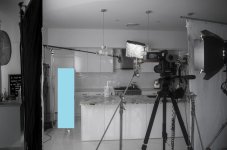
BTS lighting set up

precise BTS 1.2.jpg

precise BTS 2.jpg

The key light was an m18 bounced into an 8x8 ultrabounce. Behind the ultrabounce is a 12x12 black solid taking care of a large window. There wasn't enough distance for a lamp to be diffused and we eneded up with a pretty awkward set up where the light was aimed across the camera hitting the ultrabounce. I was operating a laptop on top of the lens as a poor person's teleprompter. To keep me from getting blasted, the Gaffer panned the light away for the teleprompter reset then back into position before the delivery started - not ideal!

The diffusion opposite the key light spread out light from glass doors we couldn't black out.

You might still end up with various hot spots but chances are they'll be a lot more pleasing than the dome alone. Even professional diffusion fabric is pretty cheap and there are all sorts of low budget alternatives (shower curtain, bed sheets etc). Taking light away will let you get more out of your aputure light.

You can experiment with polarizers too but it's not either/or - the best result could be a combination of lighting/filtration.
 
Thank-you very much for the advice above. I'm going to get hold of a circular polariser in the next couple of days and will see how far it gets me. The location isn't too dissimilar to that shown in the BTS pics above, but my most powerful light is an Aputure 300x followed by a Falcon Eyes TDX24. I'll have a play about, but I won't have the space to bounce, but might be able to direct shoot through a shower curtain. I'll have a think and see if I can get some top down lighting as well - there is a "drop down" ceiling box with protruding extractor hood which complicates any direct over-head mounting

Will let you know how it goes!
 
I doubt a polarize filter would help. I had a job filming reflective objects and the lights were reflected in similar fashion. I ended pointing the lights us at the ceiling. Something has to be done about the lights. Shooting through a large curtain like diffuser or bouncing it off the wall or ceiling is the only other way I could think of.
 
Last edited:
Yes, a pola might help some. You want a circular pola. I don't recall why, but the general rule is that circular polarizers are always better than linear. That's all you need to know: circular pola always, never linear.

You have to use a circular pola if you are using anything with a mirror inside the camera, like with autofocus and metering on a standard DSLR, a video tap on film, or on 3 chip sensors (like B4 mount cameras). I don't know for sure, but some types of autofocus on mirrorless camera may still be affected by linear polas. Also, from what I've briefly read, OLPFs can be bypassed when using linear polas.

More info here: https://www.lindseyoptics.com/blog/linear-polarizer-vs-circular-polarizer-whats-the-difference/

And here: https://www.revarcine.com/blogs/news/polarizers-for-motion-picture-capture

The main benefit to linear polas are that they are cheaper, sharper, and don't have to be oriented the correct way to work.

My main biggest evidence of their sharpness is this test: https://www.lenstip.com/115.4-article-Polarizing_filters_test_Results_and_summary.html . A linear pola was accidentally mislabeled (mishoused in the ring) and it beat every other circular pola in the testing.
 
This will sound like a pat response, it's not intended to be. A light ray incident upon a reflective surface will be reflected at an angle equal to the incident angle.
Understanding the physics involved can be more productive that trying to problem solve something that likely will still look compromised no matter what solution
you invoke. Learn about how and why reflections occur and then before you set a single light, you'll understand what you are up against.

https://www.physicsclassroom.com/class/refln/Lesson-1/The-Law-of-Reflection

Dulling spray and polas have been put forth as solutions since I became a DP decades ago. They are both compromises designed to minimize that big, nasty reflection, but it will
still be there. Work with the physics of the setup and see what you can minimze before trying to mitigate that ugly reflection.
 
Good point about the angle. If you have ever done portrait photography or interviews with someone wearing glasses the angle is the most important factor in seeing reflections. Normally you adjust the angle of their glasses down. In portrait scenario it’s easier to adjust the glasses than the lights and often you don’t want to change the lights because they’ve been positioned for a desired result. In this scenario it’s not possible to change the cabinet angle so that leaves light and camera angle. The other approach of shooting through large fabric diffuser eliminates the hot spots allowing you film at the angle you want.
 
Back
Top