Outdoor scenes in changing sunlight

joobny

Member
Hi folks,

Looking for a bit of advice on a shoot that I have coming up.

We'll be shooting outdoors in the same location all day and basically we're filming a scene that involves a bit of back-and-forthing from one end of a small garden to the other.

The garden is south facing, and the sun will obviously rise in the east and set in the west. That means when I'm shooting towards the back of the garden (south), my subjects will be backlit. And when I'm shooting towards the front of the garden (north), the sun will be hitting the talent's face. That's all fine!

My worry is that if I have to shoot some stuff at the the front of the garden at the beginning of the day (facing north so the sun is hitting the talent's face) and some at the end of the day, the stuff shot in the morning will be lit from the opposite side than the stuff in the afternoon. So if something that was shot at the front of the garden in the morning is cut with something shot in the same spot in the afternoon it'll be very jarring to see the light swap from one side of the face to the other.

Kit-wise, I have 2 x M18s, 2 x 8x8 ultrabounces and 1 x 8x8 frame for diffusion/silks. Any advice for tackling this situation would be greatly appreciated!

Thanks in advance.
 
If your two primary shooting directions are north and south you won't be into a backlit/frontlit situation, that will be half-light in the beginning and end of day, which is somewhat unfortunate as you never really get the pretty light.

I'd suggest shooting your wide shots early on (and again late afternoon if you haven't finished) and cleaning up closeups in the middle of the day. Use your ultrabounces for the wide shots, probably both of them next to each other for extra punch and size of source. When you go in for coverage, again work the bounces and when the sun gets overhead add in the 8x8 as a butterfly with a medium diffusion (light grid for example).

I wouldn't see much use for the M18's unless you keep shooting towards sundown and you start loosing ambience, when you can push them into the ultrabounces. You could add edges if you liked--depends on what shooting style you are going for but unmotivated backlight for day exteriors is pretty stylized looking these days. And they aren't powerful enough to work bounced until the light level starts dropping.

One thing to watch out for is trees, if there are any in the garden (structures, buildings etc). A comprehensive sun survey will be important to plan out a shoot like this. You want to make sure you don't end up with unexpected shade because of scheduling.

Overall, I find that you can play fast and loose with sun direction quite a bit throughout a scene. See any Bob Richardson exterior--people on either side of a conversation are both backlit! The trick is keeping your ratios and overall look somewhat consistent. Going from harsh direct sun on faces to smoothed-out diffusion look tends to jump a little (more acceptabl from wide shots to closeups).
 
If the audience is noticing lighting cheats they’re looking at the wrong thing.

Ahhh the number of times we've used that sentiment for one thing or another in the course of production!

And is true. But what can be tricky to figure out is just how much one can cheat before it becomes apparent. And to whom it is apparent. A director can get stuck on a cheat that I know from past experience will work just fine, but I must defer to their preferences. And audiences are getting more and more sophisticated. Working on a TV show years ago with Larry Hagman, he told me that back in the day they would shoot a master shot that moved around a set, then when they went in for coverage they would shoot all of it in one spot, cheated for the various places in the room. Don't think we could do that today!

While much of an audience (except for actual filmmakers) may not be able to articulate why they find a particular aspect of a visual jarring, they may still be jarred by it. Or it may make the product feel cheap, or amateurish if it is too cheated or mismatched.
 
How high are you expecting the sun to be over the course of the day? That can have a big impact on how you need to grip things to maintain consistency.

Here in the land down under, especially during summer, the sun gets so high (and directly above you) that large fabrics (my go to is half soft frost overhead for daytime exteriors, and ultrabounce for fill, though sometimes I'm forced to put silver through half soft frost is it's really harsh out) are really your only option for maintaining a consistent feel over the course of a long day.

Having to do this can also force your shots quite a bit. Full shots aren't really possible (as you can't get big enough fabrics to cover them) so you're kinda forced to use very wide wides, mixed with mediums and close-ups employing overheads.

Since you're shooting in a garden, you might consider shooting under trees (and then using your bounce and M18s for fill or edge lights). The dappled light through the leaves can look gorgeous.

I'd strongly agree with Charles though - shoot all of your wides first, at both ends of the garden (in the nicer morning light), and then come in with light and fabrics to replicate that morning light as best you can for the mediums and close-ups for the rest of the day.
 
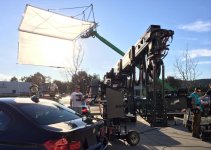
Hate to make you folks jealous but I regularly get to use "flyswatters"-- 20x20 diffusion on a condor lift--to help control things. Here seen with an extra 12x20 "tail" to increase the size of the covered area:

truecar.jpg

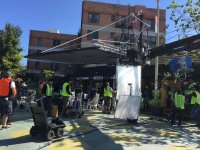
And here with my typical package to simulate shade: light grid with a double net on the bottom. The net breaks up the diffusion and keeps it from reflecting as a hot white source, and the percentage of light that is transmitted is roughly the same as shade.

trianglesmall.jpg

If we can't get a condor into the area or the job can't afford it, we'll go with a 20x on stands, but with two cameras it can be tricky to keep the stands out so a lot of dicking around.
 
Hate to make you folks jealous but I regularly get to use "flyswatters"-- 20x20 diffusion on a condor lift--to help control things. Here seen with an extra 12x20 "tail" to increase the size of the covered area


Which is why I have long said, only half-joking, that the "big time" DP's have it comparatively easy.

Not that I am unaware of the pressures placed upon them and the challenges. But I think you know what I mean, Charles. There is something rewarding about having made chicken-salad from crackers that isn't quite there when making chicken-salad out of the ingredients for chicken-salad. Accomplishing the expected vs accomplishing that which was wholly unexpected and as a result impressive.
 
Last edited:
Charles- what diffusion are you using on the flyswatter?
Then the same diffusion with double black net? With what size HMI through the 8x8?
And how many shots for this setup, over how long? Thanks as always.
 
Which is why I have long said, only half-joking, that the "big time" DP's have it comparatively easy.

Not that I am unaware of the pressures placed upon them and the challenges. But I think you know what I mean, Charles. There is something rewarding about having made chicken-salad from crackers that isn't quite there when making chicken-salad out of the ingredients for chicken-salad. Accomplishing the expected vs accomplishing that which was wholly unexpected and as a result impressive.

Having made chicken salad out of crackers, packing peanuts, pencil shavings...yeah I get it. There were many years of shooting before I got to play with the big guns.

Yes, it is easier to make your days when you have the right tools. You don't have to be as resourceful and make as many split second decisions. Usually along with the right gear comes larger crews and more time to get it done, which is kind of weird if you think about it. I shoot plenty of projects where I don't get what I'd like and it can be frustrating. Guess I'd rather just make the chicken salad out of chicken these days!

Case in point: the series I shot last year for Youtube Red. Never got a flyswatter on that. We pushed a 20x20 around on stands a lot of times. One day we had to shoot an extensive day exterior scene and I knew we wouldn't have time for the rolling 20x, and we couldn't organize the day into avoiding coverage during the overhead sun. And we shot from morning until sundown on the one scene, as the sun traveled from one side of the street to the other, very much like the OP described. To keep us on schedule I decided to limit myself to a 12x ultrabounce and let the sun do its thing. Can't say as I loved the results, especially the toplight on our actress, but we made the day and I think it's seamless enough unless you go looking for the mismatches (and there are many). Unfortunately it's behind the paywall on Youtube Red, but if you happen to be a subscriber, check it out: https://youtu.be/db5HOqf3hbM. The whole opening from the Snapchat recreation through 4:50 was that day (plus a flashback scene from later in the epsiode, shot high ISO on the Varicam at dusk for day).
 
Last edited:
Charles- what diffusion are you using on the flyswatter?
Then the same diffusion with double black net? With what size HMI through the 8x8?
And how many shots for this setup, over how long? Thanks as always.

Those pix were from two separate jobs and both were a few years ago, so I can't say for sure. But it's a good chance we are light grid on both, with the addition of the double for the second one. (the first one was a commercial: https://www.ispot.tv/ad/7RL4/truecar-the-future-of-car-buying-is-here).

I'll often do half frost on a flyswatter if the intention is to just take the harsh edge off the sunlight but still need it to play as sun. Light grid will "smoosh" it out more, reducing the directionality and softening overall for a more stylized look.

For the second shot, I'd say that was an 18K. Couldn't say how many setups were in that particular scene, but I did look at the call sheet from that day and we shot 5 separate locations on that section of street--lots of little scenes. Best part for me was that it was walking distance from my house (only the 2nd time in 17 years of living there that that's happened)!
 
Yes, it is easier to make your days when you have the right tools. You don't have to be as resourceful and make as many split second decisions... I shoot plenty of projects where I don't get what I'd like and it can be frustrating....Can't say as I loved the results, especially the toplight on our actress, but we made the day...

Charles - as always your posts are super informative - much appreciate your sharing & the pics always help. I don't want to derail the OP's thread... but if you can - can you elaborate a tad more on this "frustration" / politics of "budget" part - because I find myself in this situation with practically all jobs at this juncture in my "career". In my corporate / small broadcast productions (certainly smaller scale & budgets to begin with) I'm constantly asked to do more with less - and budgets get put in place without any regard to the shooting situation. And while I enjoy a challenge, having the opportunity to have a detailed discussion with either the "director", producer or client - in pre-production - about those challenges and specifically how they might alter the finished result have also become rarer. Do you at least have an opportunity to raise/voice your concerns when budgets get trimmed and have a frank dialogue about how cutting corners can influence the final results?
 
joobny, forgive us for the sideline here but I think it's a great question from markfpv.

There is a bit of thinking out there that DP's can be a little "precious", that they are engaged in making pretty pictures without regard to the big picture of production needs, that they are more concerned with their work looking good than making sacrifices for the bigger good. And that may often be the case, and in fact we do often need to fight to get what we need. The reality of modern day budgets is that every department gets slashed to one degree or another and chances are the department heads are all fighting for their piece of the pie.

Politically, I have to pick my battles and only really engage in fighting for things that will make a significant difference, and be prepared to articulate exactly what that will be. I also come prepared with alternatives, and can describe what the compromises may be in each circumstance. Case in point the Youtube Red clip above. In that scenario, there were three ways I could have attacked the light control concerns that would have delivered satisfactory results:

1) the top-end solution would have been to pre-rig multiple rags of diffusion between the two buildings on either side of the street, creating an overhead canopy that would have given us diffused and effectively uniform light all day. We would have been able to move fast and it would have looked the most balanced. The cost would have been significant, between the additional manpower for the rigging, the dry goods, the permitting and fees paid to the two locations etc. I'd guess $10K for something like this. This is the kind of solution you'd be able to approach in a studio feature or national brand commercial, very rare for television.

2) Most typical solution would be the 20x20 on a flyswatter that would allow for a certain amount of control on the actors, while still leaving the background open to raw light and/or changing levels throughout the day. If you are able to watch the clip, keep an eye on the brown cafe building in the background--it goes from sun to shade virtually every other shot. Flyswatters are great but there is still a certain time hit to move the base around and then trimming the position of the diffusion as the sun moves. Cost is around $2000 for condor and extra manpower. These are standard on network TV shows ( on my current NBC show I am given one any time I need it; I was not allowed one on the YTR series, very different budget level).

3) Roling 20x20 stand. Gear is already on the grip truck, no additional personnel needed so no added cost. However, slow to position as noted in previous posts above--you are always fighting the stands and sliding them around on the frame.

In this instance, I realized that nothing short of a flyswatter would allow us to make our day, and thus I decided to go raw. I did have a conversation with the producers about this decision and what the effects would be on the closeups. On the day, I pointed out to them on the monitor the effect of the raw mid-day sun on our actors and re-affirmed that in order to make our day, this was something we all needed to be comfortable with. They signed off on it. Weeks later, in the cool and comfort of the color suite as we finished the project I pointed out one last time what the compromise was and why we made it. One might look at this as essentially "covering your ass", but really, it's making it clear that I indeed have the big picture in mind--on that day I compromised the look and my own aesthetic purely in the name of making a tough schedule and getting all the coverage the director wanted.

I'm be no means an expert at all this, but over time I've learned that the key ideas are to be able to present your requests rationally and be prepared to elaborate on why they are needed and what the result will be if you don't get what you are asking for. And if it becomes a concern later, to calmly remind that this was adiscussion we had in prep. Some producers will of course still find a way to turn it back on you--such is life (not the case with my YTR producers, they were great).

Actually, the best answer I can give is to watch this and do the opposite.
https://youtu.be/gXuFu9L-OlU?t=15m17s
(continues into the next episode: https://youtu.be/tOREe0vs-DE)
 
Last edited:
Thanks again Charles. Good stuff - I wish all the producers I dealt with were as gracious & frankly as honest as your YTR's. I'm trying to have patience to find more of them. And apologies again to the OP for the sidetrack.
 
Back
Top