outdoor lighting

The number of lights you would need to make any noticeable difference is so extreme (during the average day) that it generally isn't worth the expense. Reflectors and the like fill in for that role much more commonly and cost effectively.
 
I see what your saying... but what if you hit a bad streak of cloudy days , do you delay your shoot or try to recreate the lighting?
 
The reason artificial lights aren't generally recommended for outdoor is that the wattage that's actually needed is excessive, so it's expensive to rent and bulky to set up. The absolute minimum is about a 1200W HMI PAR (about 5kw tungsten equivalent). That's probably several hundred dollars in rental cost per day (close to $10k if you want to buy) and the whole setup is probably about 50 lbs. If you're not near a power source and have to use generators, the cost goes up and you're screwed for sound. If you have the money and the manpower, then go for it, but if not, the only alternative is to reschedule.
 
Even under heavy cloud cover you should still have enough sun light to get an exposure. The sun is pretty bright and there would have to be some pretty heavy clouds to completely darken it out. Overcast skies are nice to shoot under, just a massive diffuser.
 
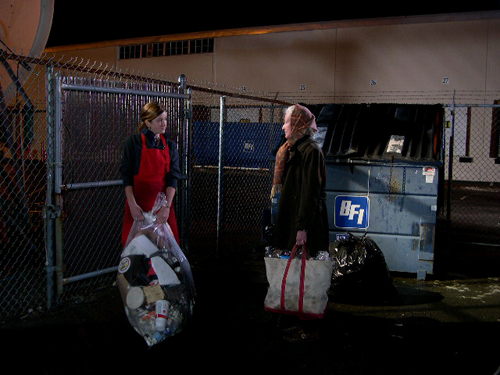
well the thing is I was going for that dusk look... it is based around supper time and that dusk lighting is amazing... the problem im having is this month has been raining almost everyday and if not rain then cloudy..I can't hold off for ever so I was thinking of artifical lighting some orange gels and 800 watt lights... is it really not possible?
 
800w is no where near enough, and slapping a gel on it will further sap the amount of output coming out.
 
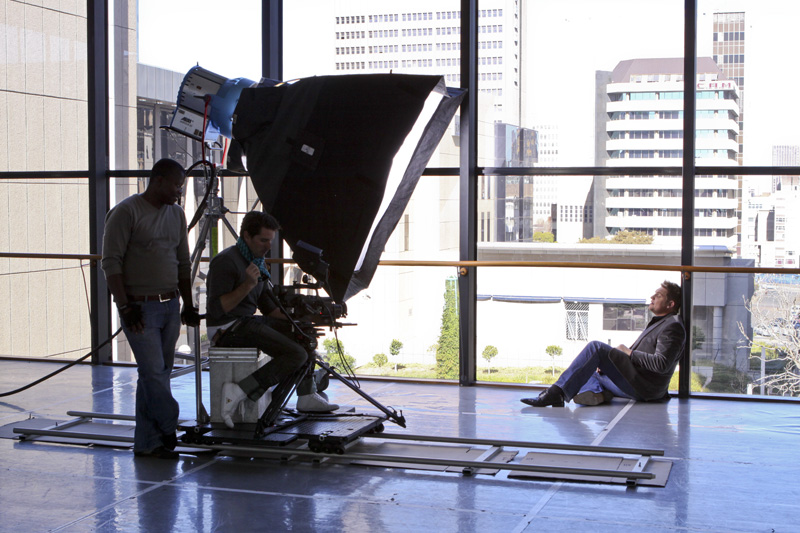
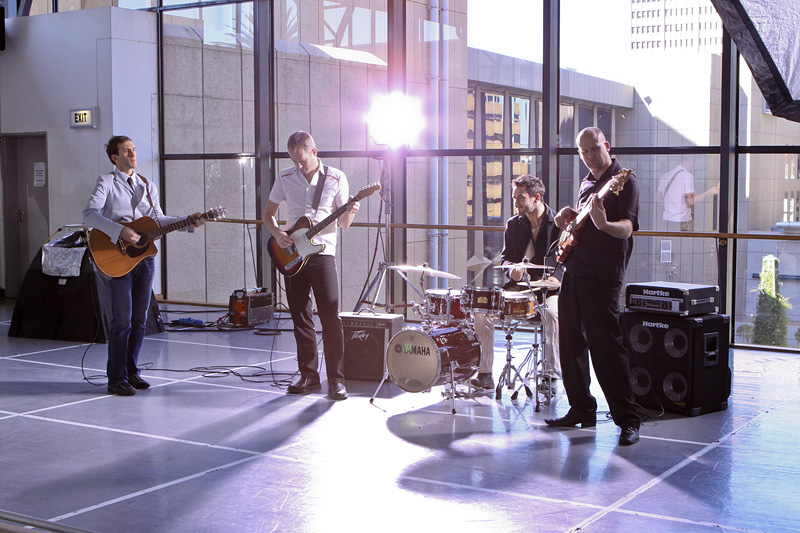
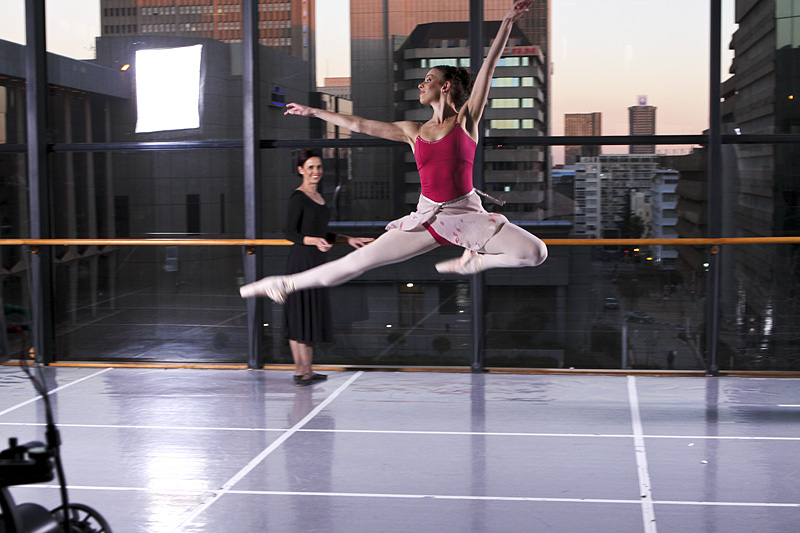
We used a 4K and Arrisun 60 6000 Watt Arri HMI's (with softbox) the other day on a music video shoot at a ballet theatre (the whole front is glass. to help match the outside light, it barely made a difference until about 4pm when it became more usable. Needed a generator truck to rum them.

It's scary how much light you need. Relfectors are your friend (and your wallets) when shooting outdoors! We couldn't cause there was no strong light coming in to reflect.

sample_3.jpg


sample_2.jpg


sample_1.jpg


- Derrick
 
Last edited:
I have used a daylight balanced kino as fill light for an interview setup (slightly overcast and under a tree). Served its purpose because the framing was tight and the amount of fill needed was minor. Otherwise, I always bounce / reflect. I have even used mirrors to get light to the reflectors.


Jason
 
Last edited:
I went with the reflectors for the shoot... came out pretty well , it would have been good to have fill light for some cloudy shots just alittle more light would have made a difference... I thank everyone for their advice...Derrik your stuff looks really good man.
 
As a gaffer in New England (about which Mark Twain famously quipped “If you don’t like the weather, just wait five minutes and it will change”) I don’t go outside without a lighting package – especially if we are shooting a dramatic scene that will take all day. If you pre-plan your shots you can get away with nothing more than a 4k Par and 1.2 Par which you can run on one of the new modified Honda EU6500is gen-sets that provides a single 60Amps/120V circuit.

If possible I arrange to shoot the establishing master shot when the sun position offers the best modeling or effect. I then shoot the coverage under a full silk and/or when the sun has moved into a backlight position. Shooting under a silk offers a number of advantages. It takes the directionality out of the sun and knocks down the ambient level by two and half stops, which enables you to use smaller lights to model your talent to mimic the establishing shot. The ideal situation is to wait to shoot the coverage until the sun has moved around to a back light position. When in this position, you are shooting into the shadowed side of the talent so smaller HMI lights will have even more of a modeling effect. Shooting into talents down side under a silk, I find that a 4k Par through a diffusion frame is a sufficient key source for a two shot. And, if the sun does goes behind a cloud for a time, a 1.2 kw is usually sufficient to bring back the edge
that was lost.

In this position, your background is also back-lit so it does not over expose because of the discrepancy in levels under the silk and outside the silk. Also, your background looks better because it is not flatly lit, but has some contrast. Finally, with the sun in a backlight position all the shadows of the silk frame and stands are thrown forward, which enables you to frame wider before picking up the shadow of the hardware.

An example of this approach is a scene I lit for a low budget feature that took place around a grill in a backyard surrounded by woods. We knew the scene was going to take all day to shoot because of its’ extensive dialogue, so we figured out where the sun was going to be throughout the day and where it would look best for our establishing wide shot. Where it was a two shot, mostly over the shoulder of one character talking to the second character who was standing with his back to the grill with the woods behind him, we decided to wait until the sun had moved into a near back light position. Surrounded on three sides by woods, we knew that we would lose the sun altogether at some point and would need lights. So we shot our close coverage first with nothing more than a 4k Par and 1.2k Par under a 20x silk. The 4k was heavily diffused and positioned so that it gave the talent the most attractive modeling. The 1.2kw was positioned where the
sun would be when we would shoot the wide so that there was always an edge.

When the time came to shoot the establishing shot, the shadow of the overhead silk frame and stands were thrown forward and did not interfere with the wider framing. Since we were still shooting under the silk, we were wider open on the iris and so our exposure dug into the dark woods and brought out more detail. As an added bonus the smoke from the grill drifted into the woods, creating shafts of light where the sun broke through the tree canopy. What could easily have been a plainly lit scene, turned into a beautifully lit scene, and was accomplished without a lot of amps. The whole scene was lit with nothing more than a 4k and 1.2k Par and powered by nothing more than a 60A/120 circuit from one of ScreenLight & Grip’s modified Honda EU6500is Inverter generators. If you can’t wait for the optimum sun position, the same modified generator will run a 6kw par that you can use to fill direct sun.

HD_PP_DemoWS.jpg

Wide Shot of Night exterior scene lit with a pkg. consisting of PFC 2.5 & 1.2 HMI Pars, PFC 800w Joker HMI, Kino Flo Flat Head 80, 2 ParaBeam 400s, and a ParaBeam 200 powered by a modified Honda EU6500is.​

In fact, we shot a whole film on the Red with nothing more than one of their modified Honda EU6500is. A dual wattage 2.5/4k Par was our one big light. Not only did the Par configuration give us more output but it was also more versatile. When we needed a lot of light for day exteriors we lamped it with a 4k globe. When we didn’t need the punch of a 4k Par, like on a night exteriors, we swapped the 4kw globe for a 2.5kw globe giving us more power to run additional lights on the generator. When you consider that a Kino Flo Parabeam 400 uses only 2 Amps , the 15 Amps we saved by burning the smaller 2500W globe enabled us to power quite a few more Parabeam lights on the small generator.

HD_PP_Demo_SetUp_Night.jpg

PFC 2.5 & 1.2 HMI Pars, PFC 800w Joker HMI, Kino Flo Flat Head 80, 2 ParaBeam 400s, and a ParaBeam 200 powered by a modified Honda EU6500is through a 60A Full Power Transformer/Distro​

For example, on night exteriors we ran a package consisting of a lighting package that consisted of a 2.5kw HMI Par, 1200, & 800 HMI Pars, a couple of Kino Flo ParaBeam 400s, a couple of ParaBeam 200s, and a Flat Head 80. Given the light sensitivity of the Red Camera, this was all the light we needed to light even large night exteriors. Use can this link - www.screenlightandgrip.com/html/hdfilmstrip4lg.html - to see the final results which are showcased on ScreenLight & Grip’s website, and to get more detailed information on the lighting package we used.

Eileen Ryan, Boston Gaffer
 
The reason artificial lights aren't generally recommended for outdoor is that the wattage that's actually needed is excessive, so it's expensive to rent and bulky to set up. If you're not near a power source and have to use generators, the cost goes up and you're screwed for sound. If you have the money and the manpower, then go for it, but if not, the only alternative is to reschedule.

In my experience it is possible to use small portable gas generators and get clean audio tracks. It all comes down to what generator you use and how you use it. My company, ScreenLight & Grip, supplied the Honda EU6500is inverter generator with 240V-to-120V step down transformer that Eileen used on her Red production she mentions above (we showcase it on our website.) We highly recommend the Honda EU6500is inverter generator because it is much quieter than the older movie blimped Honda EX5500. Part of what makes the new Honda EU6500is so quiet is it's "Eco-Throttle." The Eco-Throttle's microprocessor automatically adjusts the generator's engine speed to produce only the power needed for the applied load. It can do this because the inverter technology of the Honda EU6500is enables it to run at different RPMs and maintain a constant frequency and voltage. Where conventional generators like the Honda EX5500 and ES6500 have to run full speed at a constant 3600 RPM to produce stable 60 hertz (cycle) electricity, a Honda EU6500is only needs to run as fast as required to meet the load demand. Since their engines do not have to run at full speed, and given the fact that an inverter generator generates 20% more power per revolution of the engine, makes the Honda EU series of inverter generators substantially quieter than conventional models.

The net result is that the EU6500is operates between 34 to 44 dBA at 50 ft. - half as loud (ten decibels) as the comparable EM7000is and ES6500 generators and comparable to a Crawford 1400A movie blimped generator. But, where you wouldn't try to park a Crawford right on set and record sound, you shouldn’t try to record sound with a Honda EU6500is right on set. To record sound without picking up generator noise all you need is a distro system that will allow you to move the EU6500is off set (like you would a Crawford), minimize line loss over a long cable run, and provide plug-in pockets conveniently close to set. That is where the transformer comes in.

As Eileen mentioned in her post, we have developed a Gen-set that is designed to provide clean quiet set power from a modified Honda EU6500is. What we do is tap the Honda EU6500is inverter generator as it is designed for 230/240V markets like the UK, EU, Australia, & India (to name just a few.) By doing so, we gain access to the full 7650 Watt power capacity designed into the generator for these 230/240V markets, but not available in generators manufactured for 120V Markets like the US. We then use a proprietary step-down transformer/distro we have developed to convert the full 240V power into a single 60A/120V circuit (7500Watts) capable of powering large lights. And, where PWM inverter generators, like the Honda EU6500is, generate a nearly pure power waveform, our modified Honda EU6500is is capable of reliably powering more lights than has been possible before.

Finally, to record sync sound without picking up any generator noise, all you need to do is add 100' - 150' of heavy duty 250V twist-lock extension cable between the generator and our Full Power Transformer/Distro. This is usually enough cable to place the generator around the corner of a building, or to run it out of a van or truck - which is usually all the additional blimping you need with these generators. The heavy-duty 250V twist-lock cable eliminates multiple long cable runs to the generator; as well as, eliminates the voltage drop you would have using standard electrical cords.

HD_PP_Demo_Transformer-Distro.jpg

A Distro System consisting of a 60A Full Power Transformer/Distro, 2-60A GPC (Bates) Splitters, 2-60A Woodhead Box distributes power from a modified Honda EU6500is. Even though the generator is 100' away to reduce noise, plug-in points remain conveniently close to set.​

To assure full line level (120V) on set, our 60A Full Power Transformer/Distro is designed to compensate for the slight line loss you will have over an extended cable run. That is, it is designed to slightly boost the voltage on the load side (secondary) so that if you were to feed the supply side (primary) of the transformer 240 volts from the generator, 127 volts would come out on the secondary side where you plug in the lights. This slight boost enables you to place the generator further from set where you won't hear it, yet assure that the supply voltage on set does not drop too low. Our 60A Full Power Transformer/Distro is equipped with a 60A Bates and three 20 A Edison circuits so that you have plug-in pockets conveniently on set.

HD_PP_Demo_Distro.jpg

60A GPC (Bates) Splitters and Woodhead Box.​

Our new 60A Full Power Transformer/Distro offers a number of other benefits as well. Without our Transformer/Distro you can never fully utilize the full power of the generator because the load of a light has to go on one circuit/leg of the generator or the other. For example, when plugging lights into the factory installed power outlet panel of a Honda EU6500is, you quickly reach a point where you can't power an additional 1200W HMI because there is not 11.5 amps (w/ a PFC ballast) available on either one of the factory installed 20A outlets/leg of the generator. With our Full Power Transformer/Distro you can still add that 1200W HMI because the Transformer/Distro not only accesses more power (7500 Watts) through a higher rated circuit (60 Amps), but it also splits the load evenly over the two legs (5.75A/leg) of the generator. The end result is that the generator is capable of handling a larger load more easily because it is a perfectly balanced load.

HD_PP_Demo_P2L.jpg

60A Woodhead Box running Power-to-Light PFC 800W ballast (left) and PFC 1200W ballast (right.)​

Another benefit to using our Transformer/Distro is that it greatly simplifies set electrics by splitting the load of what ever you plug into it automatically. This means you no longer have to carefully balance the load over the generator's two 20A/120 circuits/legs as you plug in lights because the Transfomer/Distro does it for you. With our modified Honda EU6500is you simply plug in lights until the load wattage displayed on the generator's iMonitor reaches 7500 Watts. Now that you are able to fully utilize the generator's available power, you are able to power larger lights, or more smaller lights, than you could without a transformer/distro. For more details on the use of transformers for set power, I suggest you read the article I wrote for our company newsletter (mentioned above) on the use of portable generators in motion picture production. Use this link -
www.screenlightandgrip.com/html/emailnewsletter_generators.html
for more information about using inverter generators with transformers for motion picture lighting.

Guy Holt, Gaffer, ScreenLight & Grip , Boston
 
Back
Top