
Navigation
Install the app
How to install the app on iOS
Follow along with the video below to see how to install our site as a web app on your home screen.
Note: This feature may not be available in some browsers.
More options
You are using an out of date browser. It may not display this or other websites correctly.
You should upgrade or use an alternative browser.
You should upgrade or use an alternative browser.
Okay, I have not lit anything like this before...
- Thread starter DDirector
- Start date


Bern Caughey
Veteran
It's hard to make recommendations without scouting photos. Not sure if you posted some, as there appears to be two broken images in the first post.
Check if tie-ins are legal where you live. In Los Angeles tie-ins invalidate your insurance, & are rarely done, while in NYC you can tie-in almost anywhere.
On another note, see if ARRI's M18 is available in your area. They're currently the brightest source that can be run off a 20 amp circuits.
http://www.arri.com/lighting/lighting_americas/arrimax_m18/m18.html
There are pictures on the first page.. I can see them up there.It's hard to make recommendations without scouting photos. Not sure if you posted some, as there appears to be two broken images in the first post.
Check if tie-ins are legal where you live. In Los Angeles tie-ins invalidate your insurance, & are rarely done, while in NYC you can tie-in almost anywhere.
On another note, see if ARRI's M18 is available in your area. They're currently the brightest source that can be run off a 20 amp circuits.
http://www.arri.com/lighting/lighting_americas/arrimax_m18/m18.html
M18 plugged into a wall? Hmmmm......?
Bern Caughey
Veteran
I can't see the pictures on my Mac, or iPad.
All I get is blue icons of a question mark.
All I get is blue icons of a question mark.
How about now?I can't see the pictures on my Mac, or iPad.
All I get is blue icons of a question mark.
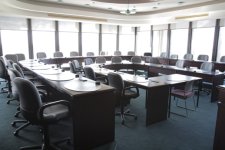
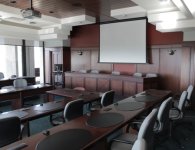
So, if my only resort comes down to shooting with blinds down or night time, im still not sure how id be able to manage to light the whole set and not make it look dull looking.
Im hoping I can get some overhead pipes and attach some tungsten lights to that, but im not 100% sure if it would be possible. Im not sure on the name, but the pipe can wedge between walls. it extends and is tightened. Then you can hand some clamps and lights from it.
I was thinking of doing that if the pipes are long and strong enough. The lights would be more frontal lighting. Using approx 1 light for 2 people if it works out. or 1 light per person. We can remove some seats.
Last edited:
Bern Caughey
Veteran
I can see the pictures now. Thanks!
Don't understand the North, & South, orientation as they're L shaped, so one should be East, or West.
Not sure how you plan on attaching ND, but the North orientation will help as you generally don't want direct Sun hitting ND. If the ND can't be flagged from direct Sun then you'll want to stick it to the glass, which can be a pain. The technique is to spray a little water to the window to hold the ND in place, then careful squeegee out any air bubbles. Not fun!
If needed it looks like the Grips could build a grid in that room as there seems plenty of nooks to attach to, but it might be earlier to use Menace Arms, or Matthews MAXine(s).
I'd stick to daylight sources unless you want to do some mixed lighting, & even then the heat could get tiring, so I'd prefer sources other than Tungsten hot lights.
I don't mind blown out windows, & consider embracing them, especially in a wide master shot. Don't know if it work with your concept, but as it's SciFi I'd also consider keying the subjects with a source halfway between tungsten, & daylight, somewhere in the 4500* range. WB to that, & let the daylight go blue.
Last edited:
Bern Caughey
Veteran
M18 plugged into a wall? Hmmmm......?
The M18 is shockingly brighter than a 1.2k PAR, & more versatile. If I had to guess I'd say it's output is closer to a 4k.
Same is true of ARRI's 4k M40, & 18k ARRIMAX. They all punch way above their weight.
I'd also consider Kino Flo Vista(s), & Tegra(s). There's no comparing these to 4Banks, & Image 80s, as the reflector is optimized for throw. They're fast to move about, & don't pull a lot of juice.
Last edited:
Sorry, that was a dumb mistake! Its North & West - not South.I can see the pictures now. Thanks!
Don't understand the North, & South, orientation as they're L shaped, so one should be East, or West.
Not sure how you plan on attaching ND, but the North orientation will help as you generally don't want direct Sun hitting ND. If the ND can't be flagged from direct Sun then you'll want to stick it to the glass, which can be a pain. The technique is to spray a little water to the window to hold the ND in place, then careful squeegee out any air bubbles. Not fun!
If needed it looks like the Grips could build a grid in that room as there seems plenty of nooks to attach to, but it might be earlier to use Menace Arms, or Matthews MAXine(s).
I'd stick to daylight sources unless you want to do some mixed lighting, & even then the heat could get tiring, so I'd prefer sources other than Tungsten hot lights.
I don't mind blown out windows, & consider embracing them, especially in a wide master shot. Don't know if it work with your concept, but as it's SciFi I'd also consider keying the subjects with a source halfway between tungsten, & daylight, somewhere in the 4500* range. WB to that, & let the daylight go blue.
North being the side of the room, and the West being the back of the room.
The sunlight is visible on the West side after 3ish as it starts to set (guessing right now, but it should be approx at that time). So, its like being key'd from behind, and not from the North (side).
Yup, we'd have to put ND on the windows. Long process, yes, but if that's the case (and if we can afford it) then we would have an extra day for lighting to do everything.
*Dont want sun hitting ND directly??
The Menace Arms seem pretty cool. I've used some boom arms before for lighting, but this seems to be much longer than what I used before. I thought about that too, but i though that attaching some rig above would be better as we wouldnt need to bother with moving any equipment when doing any reverse shots towards the front if the audience is still in the shot.
The shots towards the back (audience) wont be THAT long. So, it shouldn't be that big of a heat issue. It may get hot yes, but they wont be sitting under the lights for half a day or more.
I probably do want to do a lighting mix. I was thinking of shooting in between 4500 as mentioned, or gel the tungsten lights to 1/2 CTO or mixed kino lights (if they are strong enough to work). I dont want blue windows, nor orange interior. A mix would be what I am looking for.
Grahamrobbins5
Active member
Ok if Shooter is referring to doing a legitimate TIE IN to a buildings out box, it legally requires a certified electrician, in the film world we refer to as a Journeyman electrician. People do it illegally all the time but its dangerous if you dont know what your doing, so I would not look to much into that.
Secondly, my question is why not play it a bit dark. Currently the setup you described would with a more fronty soft source would take out most of the contrast on your talents face. I personally am a believer that less is more, maintaining a consistent level of contrast ads a mood and a tone to your film. Aside from brightly lit comedy most dp's usually have a least a 1-2 stop loss on the contrast side of the talent. It gives direction to your camera placement, and gives the lighting a single motivation which feels much more natural to an audience. Taking into account It always depends on the style of the film and not knowing that what I say might not be right for this particular project. However here is what I would do in your situation.
I would take that 1.2k HMI or if you can afford it try to get a M18 its a newer Arri hmi, that's about 80 dollars more to rent than the 1.2k. Its 1800watts so it can be juiced off of house power but it gives out about as much light as a 4k sun par. I use them all the time on commercials, and short films with smaller budgets.
I would take the HMI and break it through the largest frame of half soft frost you can fit in that room, 6x6 or 8x8 if you can. I usually set my Key at a very sidey angle, and always set it opposite the side you plan to set your camera line on. In essence you will notice great cinematographers almost always shoot from the opposite side their key light is placed so you are shooting the contrast side of your talents face, the shadow brings out the texture and helps humanize them. Personally I dont believe in fill light unless I am shooting cars, or product. I use passive fill on films, Ie. Bead Board bounce, or Negative fill. So in your situation I would experiment with both of those things. You can try dropping a 8x8 or 6x6 solid off the fill side of your talent and pull some extra light off of their fill side. Or if your not getting enough light, put up a show card bounce on the fill side and raise the ambiance level and the exposure on talents fill side. Now dancing around the difficulty of wanting to see out those windows, I want you too do an experiment for me haha. when you walk onto set, turn off all the practicals, and lights in the room, set the cameras exposure to where those windows look best and you can see out them. Then open up 1 stop, so its just a bit brighter. Then light the scene with that 1 diffused HMI, and some bounce or whatever you think is best. While keeping your window exposure set. You could also drop some ND in the mattebox, and open up if you want some added Depth of field. Then show your director. The talent will probably be about 1-2 stops under the windows, but I bet your director will love it.
Anyway this has always been my personal experience, but I have for the last year professionally shot most narrative's about 1 or 2 stops under and never had a director complain they usually love it, disclaimer never rate a commercial 1 or 2 stops under haha.
I love being challenged with a low budget on a film because it forces me as a dp, to get creative and learn to turn a single source into multiple. It also teaches you how to control the ratios in a room. If you do get a few extra units I might recommend getting 3 4x4 kino single tubes and the harnesses for them. Use HMI color globes to match your key and the windows. Then rigging the bare tubes to the edge where the ceiling meets the wall to raise the rooms ambiance, I would wrap each tube in 250 diffusion which should match the soft frost of your key before you rig them. They are pretty easy to just paper tape the bulbs to a wall if you cant afford proper rigging. I like to call that a poor mans HMI covered wagon haha.
Cheers,
Graham Robbins
Depending on how much this will cost us it may be a big issue. But this isn't a big budget shoot, it is more of an indie shoot. So it may be.
But its good to know its possible to do such a thing.
I'm wondering, if it was done, how much power would I be able to get roughly? Like, how big of an HMI would I be able to power?
We have two budget breakdowns; equipment & misc.
The equipment budget is a big budget, so I can rent out bigger HMI lights and other accessories if needed for a day or two.
But the misc budget is small. And this budget includes everything but equipment rentals.
Because the misc budget is small, having hundreds of dollars worth of gel up on those windows (which will probably be taken out of the misc budget) will cut down a severe amount of our budget, and that wont be possible. If its equipment budget (which I doubt) then it may not be THAT bad of a problem.
The over exposed look may not be that bad of a problem though. In other parts of the film there will be times where we will want to push highlights a big giving it more of a contrasty look, so if the windows are a bit blown, it may not be so bad. But then again, we could always block off the windows for a night scene or interior scene as if there were no windows. But, were hoping to have them if possible.
*Im not saying this is government meeting, or something secretive. It was just an example i used. Its that formal, and that important, but its not actually government stuff where its secretive and should be kept indoors or whatever. Its as formal as a government meeting, but more of an unveiling of a product? Its hard to explain, but it doesnt really matter really.
I think you kind of missed my point for the gels.. You're taking a room and filling it with tons of hot light and having to add a lot of power, and lots more gear down to get the shot... That eats up more time, which eats up WAY MORE money than just $200 in gel...
I think you're trying to attack this with overpowering with light... thats much more expensive to production in time management. It takes 2 competent guys to gel a room that size perfectly in AT MOST an hour?? How long is the prep and people used to get a big tie-in, move the larger lights in... have the larger lights flagged like crazy so they dont go where you dont want them too. Using more silks, using up more space in the room, restricting movement, ADDING MORE HEAT which stresses talent, who then asks for AC which you cant do because the sound guy will have a heart attack, which means the talent sweats, which means their craft suffers, which means your takes aren't as strong, which means more takes to get it right... Which means the actors need to be patted down more between each take, which means makeup has to do more touchup work, which means more time wasted..
These are NOT over exadurated... This is the reality of trying to overpower 2 large walls of light. You're fighting the sun. This is not outdoors where the heat from large lights just escapes up and away. This is in a confined area.
I think going crazy with large lighting is the most expensive and time consuming way of going about this, instead of the quickest and cheapest which is checking your exposure of the windows vs room, and just knock it down with ND6 or ND9 and be done with it. Use your regular lights, no extra power needed, cooler set, no larger lights to heat things up, actors are more comfortable... yadda yadda yadda... To me as a DP you need to be thinking passed your lighting all the time. You need to realize the effect your lighting will have to the whole of the production.
I am shooting an exterior night scene on a large stretch of road that we are closing for the night, theres an overpass that will be active, and all kinds of things happening. We dont have the budget for big balloon light in the sky, but I wanted good lighting.. I wont go into details but the long story short is, I designed a lighting design that would be great looking, but in the end it made the whole shoot MUCH more of a pain in the ass and for not much results, so I killed the whole lighting setup and came up with something equity as good, but without the hassle of what I came up with originally. Sometimes you have to realize overlighting takes time, power, and money, regardless of what budget its coming from... In the end the producers are still paying one way or another. A simple explanation to production to give you some extra cash for a quick and proper fix is much more important than going overboard.

William_Robinette
Shallow Member
Have you tried pulling those blindes down? I shot something a couple months ago against large windows with those type of blindes and pulled them down to cut the light and really liked the look.
This was also shot on a Scarlet.

This was also shot on a Scarlet.
morgan_moore
Major Contributor
-

Shooter
Veteran
I hope you had words with the art director who presented you with that huge ugly white table cloth! Nightmare lighting scenario.
Have you tried pulling those blindes down? I shot something a couple months ago against large windows with those type of blindes and pulled them down to cut the light and really liked the look.
This was also shot on a Scarlet.
William_Robinette
Shallow Member
I hope you had words with the art director who presented you with that huge ugly white table cloth! Nightmare lighting scenario.
No doubt, but you work with what you got.

maranfilms
Veteran
sounds like you could make it much easier if you shoot it in the eve around magic hr. At least this way you could put your HMI on a 10 ft stand, either reflect it up, or diffuse it angled down ward for ambient light. Then bring in some halogen to give it a warm look and flag it to make it as the sun is creating strips of light coming through the window. Also wouldn't be a bad idea to bring in a tiny bit of atmosphere to help with the light beams coming through the windows. These may or may not work. But just a few ideas that came to mind.

Liam Hall
Veteran
That wouldn't allow for a particularly long shoot.sounds like you could make it much easier if you shoot it in the eve around magic hr.
Maybe, shoot at night.
Shooter
Veteran
No doubt, but you work with what you got.
Not me. (Lighting and art department are a team effort.)

starcentral
Veteran
I'm confused with your shot list and not sure how much coverage you need with the actual windows in view of specific shots, but if its "not many" then you can just shoot those shots within one hour of sunset where outside will be much less bright, maybe in the f2.8 to f5.6 range (24p @ 800ISO) and at that point a couple 1.2k HMI's can be spaced out and pointed to the top corners to the opposite walls/ceiling to boost ambient and even out the interior with the exterior. I agree with many others that trying to get f45-f65 on your interior to match your exterior is crazy thing to even talk about, let alone try.
If that opposite wall is too far from where your people are sitting in chairs then you can use muslin or large foam boards or whatever reflectors to bring your fill lighting closer to your set and bounce your light off-camera rather than think about shooting through diffusion where you might not have the room for it either. Either way any talent sitting closest to light source or bounced light will be hotter than the people in the center so you will need additional overhead soft lights to match your exposure.
Depending how wide your shot against the windows are, you might even be able to put your camera and lights on either side of the camera on a large dolly and move the entire rig for any camera moves. If done right it will not be noticeable to the viewer and it will also prevent film crew shadows from appearing on your talent. Again it all depends on the shot list and discussion with director on what compromises can be made given this is a low-budgeted film shoot.
The big problem with that "magic hour" is the light goes fast, so you have to use it wisely. ND gels would definitely let you shoot for longer periods, but cost you the additional money and if you're wrong about the forecast that day if can mean the difference between f45 and f8 so you need to be prepared for that. It may not be "$900" after all, it can be far more.
Last edited:

CharlesPapert
Director of Photography
You have two stated goals here: to see outside the windows, and create the ambience of a government meeting with a high-end feature look. A lot of the suggestions here are about simply balancing the levels, but not a lot towards the ultimate look of the room and the characters--it won't look high end if the interior lighting is units bashed in there simply to lift exposure, regardless of what it looks like outside.
Given that you are on a limited budget, here's a scheme that will help you use the existing light, get a good look and minimize your extra costs. You will have to use ND, but only on half the windows.
Working backwards from the space itself: you have windows on two sides, the north and the west. As you stated, a lot of the scene takes place looking east, towards the front of the room. I'm not sure which view you need to preserve specifically, but if it was dealer's choice, I would concentrate on photographing primarily east and west.
When shooting east, close the blinds (I do see blinds in the stills, but can't tell--are they mesh which cut down light, or actual venetians that close completely?) on the west aka opposite side so that the ambient daylight is only coming in from the north side. This will give you some nice sidelight modeling, rather than the flat light seen in the reference still. You can expose to this as needed, just avoid windows on the north side--if you had to see a few, perhaps pull the blinds or ND just the ones you see. Having some foreground heads in the frame may work well as they will be virtually silhouette. Given the length of the room, the light may actually wrap around more than desired but you can start closing blinds from the far side of the north wall as required.
When you turn around to shoot the west wall, you are still using the north windows as your light source. You may again want to close down blinds on what is now the far side (by the podium) to eliminate wrap. However, you are now up against the hot windows, so here you will have to apply ND. What flavor of ND, you can determine on the scout. Take spot readings and do the math (I would estimate at least N9). Plan for sun; if you get an overcast day you can always close more blinds on the north side to knock down your inside exposure. And I would also schedule to shoot that direction in mid to late afternoon, although it will get dodgy once the sun starts to get particularly low.
OK, so all well and good...but what if you want to shoot characters along the north wall? If they are to be tight shots, i.e. no more than one or two people wide, I would recommend cheating them into the seats along the west wall and shaking up your angles accordingly. You need to be very conscious of your eyelines--it can get confusing--but done right, no-one will ever know. If the director absolutely insists on a wide shot that shows a large expanse of the north wall, you can either wait until late afternoon, which will require lighting (given that you have to stick with house power, I'd do two 1200's into bleached mus along the west wall) or move your ND from the west to north wall, which would open up the west wall as your lighting source for that shot. Otherwise, you'd have a good chance of shooting the whole scene just using the natural window light, and it should look rich and full of gravitas, as desired.
Oh and regarding the still that William Robinette posted: I agree 100% with Shooter. If there was an art dept. person on that shoot: fail. If not, it's a good reason to have one. Those booths look pretty nice--can't imagine the bare table would have been preferable to that un-ironed white monster. I work very closely with the production designer on my jobs, going over color schemes and discussing practicals etc.
Last edited:
CharlesPapert
Director of Photography
One other thing I thought of: if you are able to very specifically shotlist to accomodate this, you may be able to get away with running the ND gel only about 2/3 of the way up the windows. You would need to make sure that it is well above the heads of anyone seated, and ideally it would be pure sky seen above this line. Your closer coverage would be within the ND'd area. The idea would be to shoot the wide shots with a separate exposure pass stopped down to approximate the values seen in the ND'd part of the windows, to be subsequently comped in (since the idea is to digitally add elements out there, this is child's play in comparison). Obviously a bit tougher in moving shots, as it would require tracking, and anyone moving in front of the windows would need rotoscoping, so this should all be taken into account.
The benefit of this is that you save a certain amount of ND, but mostly that you can also get a nice soft wraparound top/back edge on the folks sitting with their backs to the windows. Do consider that at a certain o'clock you will get hard sun coming through and the line of demarcation might start to screw with you. All things considered, it may not be worth it. But another example of thinking outside the box, saving a few pennies etc.
Everything comes down to planning. On a limited budget, a director (especially inexperienced) may want a lot of things that just aren't practical and it falls to the DP to come up with creative solutions that will deliver a great look within those parameters. It may mean having to shoot in a wacky order, or cheating the room around as noted above, or losing that one shot that he has visualized since before he wrote the script (or god forbid, in a storyboard--these are often dangerous for low-budget shoots as directors fall madly in love with something impractical). But if you can make the whole scene look great rather than compromise everything else just to be able to see buildings outside, it will pay off.
Last edited: