
combatentropy
Veteran
Another NAB, and again this camera was not announced, even though technically possible for some time:
[TABLE="width: 500"]
[TR]
[TD]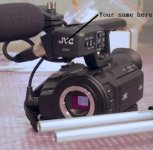 [/TD]
[TD]handicam style
4K
S35
µ43 lens mount
global shutter
12+ stops
time lapse - 120 fps
10-bit 4:2:2
SD or CF cards
dual XLR[/TD]
[/TR]
[/TABLE]
Breakdown:
handicam style: More comfortable than an SLR yet more flexible than a shoulder rig. Furthermore, unlike a shoulder rig, the ergonomics of this style are a delicate balance. A few extra inches and a few extra pounds can ruin it (I'm looking at you, AF100 and FS700). Needs to be about the size of a Sony NEX VG900.
4K: because, I give up, and it makes for some pretty sweet 2K
S35: the sweet spot. You feel like Roger Deakins, yet you use grandpa's lenses.
µ43: There are adapters for the mount you really want: EF, F, PL. Or just screw on an actual Four Thirds lens and (insert math here) the S35 4K sensor becomes a 4/3 3K sensor. Or put on a C mount adapter and (insert math here) it becomes an S16 2K sensor.
global shutter: because motion purity is as important as 4K (more so, actually)
12+ stops: smooth tones are as important as 4K (more so, actually)
120 fps: the more the merrier
10-bit 4:2:2: without specifying a codec, let's just say, gradable, visually lossless, easy on the editing system. It may be Prores, it may be MJPEG now that JPEG supports 10 bits, it may be CinemaDNG, given that it allows JPEG compression and like I said JPEG now can do 10 bits. Needs to be loggish gamma, though, to take full advantage of bits.
SD or CF cards: fast, cheap, ubiquitous, pick all three. Now if your codec is something like Prores, it'll probably have to be CF, because 120 fps would be about 110 MB/sec. If you want to use SD cards, you'll have to use one of the newer codecs like H.264 or H.265, with the corresponding hit in editor-friendliness.
dual XLR. Because we aren't doing silent movies, and we aren't using $5 mics from Radio Shack.
Added bonii:
- neutral density filters
- 1920x1080 5" OLED flip-out screen - because my $500 smartphone already has it
- Sony L series battery mount - small, cheap, ubiquitous, pick all three
- detachable handle - for when we're willing to shoot MOS for added stealth (or just to pack easier).
- USB 3.1 - not quite out yet, but it will be before you get your cam done. The size of MicroUSB, but goes in either way, and carries up to 100 W of power. No other power jack required.
- minimalist - hard to describe. Like a Leica, or a MacBook, or a beautiful knife, not a fancy food processor. Capisce?
Price:
$5,000 (+/- $2,000)
because you can
and if you do this, you will sell so many of these, because people will be buying it instead of the DSLRs, the Cx00's, the Arri's, the F55's, etc. (dependent upon build quality, polish, and overall design and workmanship)
[TABLE="width: 500"]
[TR]
[TD]
[/TD][TD]handicam style
4K
S35
µ43 lens mount
global shutter
12+ stops
time lapse - 120 fps
10-bit 4:2:2
SD or CF cards
dual XLR[/TD]
[/TR]
[/TABLE]
Breakdown:
handicam style: More comfortable than an SLR yet more flexible than a shoulder rig. Furthermore, unlike a shoulder rig, the ergonomics of this style are a delicate balance. A few extra inches and a few extra pounds can ruin it (I'm looking at you, AF100 and FS700). Needs to be about the size of a Sony NEX VG900.
4K: because, I give up, and it makes for some pretty sweet 2K
S35: the sweet spot. You feel like Roger Deakins, yet you use grandpa's lenses.
µ43: There are adapters for the mount you really want: EF, F, PL. Or just screw on an actual Four Thirds lens and (insert math here) the S35 4K sensor becomes a 4/3 3K sensor. Or put on a C mount adapter and (insert math here) it becomes an S16 2K sensor.
global shutter: because motion purity is as important as 4K (more so, actually)
12+ stops: smooth tones are as important as 4K (more so, actually)
120 fps: the more the merrier
10-bit 4:2:2: without specifying a codec, let's just say, gradable, visually lossless, easy on the editing system. It may be Prores, it may be MJPEG now that JPEG supports 10 bits, it may be CinemaDNG, given that it allows JPEG compression and like I said JPEG now can do 10 bits. Needs to be loggish gamma, though, to take full advantage of bits.
SD or CF cards: fast, cheap, ubiquitous, pick all three. Now if your codec is something like Prores, it'll probably have to be CF, because 120 fps would be about 110 MB/sec. If you want to use SD cards, you'll have to use one of the newer codecs like H.264 or H.265, with the corresponding hit in editor-friendliness.
dual XLR. Because we aren't doing silent movies, and we aren't using $5 mics from Radio Shack.
Added bonii:
- neutral density filters
- 1920x1080 5" OLED flip-out screen - because my $500 smartphone already has it
- Sony L series battery mount - small, cheap, ubiquitous, pick all three
- detachable handle - for when we're willing to shoot MOS for added stealth (or just to pack easier).
- USB 3.1 - not quite out yet, but it will be before you get your cam done. The size of MicroUSB, but goes in either way, and carries up to 100 W of power. No other power jack required.
- minimalist - hard to describe. Like a Leica, or a MacBook, or a beautiful knife, not a fancy food processor. Capisce?
Price:
$5,000 (+/- $2,000)
because you can
and if you do this, you will sell so many of these, because people will be buying it instead of the DSLRs, the Cx00's, the Arri's, the F55's, etc. (dependent upon build quality, polish, and overall design and workmanship)
Last edited:
