Observation about filmmakers going digital

Not perfect. But I was working from an 8-bit JPEG and did it fast. I think it looks more like film, although not perfect. As you can see I curve each color individually. Video often has too much red, for some reason.

(I also take down the saturation a little bit, since an S curve raises saturation, since it raises contrast.)

If I had shot it with a recent videocamera with decent dynamic range and in log or something to give me room to grade, it theoretically could be made indistinguishable from film.

There are differences in the way the light/Photons interact with the capture medium, silver based film or silicon sensors. Silver is more sensitive to Blue, and it took a while to develop 'panchromatic' B&W film that has better response in the reds. Silicon sensors on the other hand have better response in the reds... almost the opposite of silver... ok not really but sort of...

As the silver based film exposes, the response is non-linear, aka logrithmic in the first place... silicon sensors on the other hand are like buckets and will 'fill' linearly until saturated... which point they just... uh... well... saturate.

But that does not mean that Film film could take any amount of photons... highlight exposed areas would developed a 'scatter' response and so the highlights would have a haze when 'overexposed' (that in addition to any flare from the lens elements or filters...

So, there was an optimal exposure in any case.

For Still Film one could 'burn and dodge' areas of the print to compensate for a wide DR range. This sort of technique was very limited, if available at all to the motion picture Film photographer. One could change development times to compensate, or the 'print lights' and that's about it without serious work, and often not part of the budget...

Development times and type would change the grain structure, and how it was perceived in the final print. In the late 60's when the young directors and cinematographers, a number who are now part of the Hollywood Panteon, began to move out of the 'studio' and onto the streets, especially at night, would push process their film and the results were 'major grain' fests relative to the nice clean images produced by the slick Hollywood productions.

What happened was the 'grain' was developed into an aesthetic of 'realism'...

I really see no difference in at least 'sentiment' of the modern digital camera person using high ISO and resulting 'noise' aka 'grain'. Although I thin it has only been in the last 6 or so years that Digital has progressed to the point where 'noise' is not an issue for a wide range of camera prices, and now dynamic range is becoming a non-issue as well. There seems to be sufficient DR to match the expected 'market', and these days most of that market will be mobile or similar viewing, or in any case 'home' viewing.
 
All other things being equal, there's no difference in motion cadence. Pictures taken 1/24th of a second apart are pictures taken 1/24th of a second apart, no matter the medium.
There is a big difference with global shutter cameras where you get a complete time coherent image over the exposure time. Rolling shutters give you non coherent incomplete slices of an image over the exposure time when camera or subject are moving.
 
There is a big difference with global shutter cameras where you get a complete time coherent image over the exposure time. Rolling shutters give you non coherent incomplete slices of an image over the exposure time when camera or subject are moving.

It doesn't affect the motion cadence, though.
 
It is nasty, though.

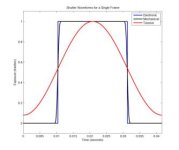
Aside from that, I used to want the soft shutter like in Red's Motion Mount. It was also known as the Tessive Time Filter. But after spending more time pixel peeping at freeze frames, and by reading Tessive's literature more closely, I realized that film's mechanical shutter is more like the standard electronic shutter than the soft shutter.

Shutter-waveforms.jpg

Here you see the black line (film) dovetails only slightly from the blue line (video) and honestly I don't think I would notice a difference in normal viewing. The red line (tessive) does indeed reduced motion aliasing (like wagon wheels and helicopter blades turning backward) but looking over and over the footage I think it might actually be too loosey goosey, and I'm fine if one day soon we at least get just GLOBAL SHUTTER!!!!
 
It is nasty, though.

Aside from that, I used to want the soft shutter like in Red's Motion Mount. It was also known as the Tessive Time Filter.

The only thing I wanted from the 'tessive' filter was not even a temporal filter... but because, at least how the guy at the booth explained it several years ago... the 'filter' was a matrix of essentially 'lcd' tiles which when controlled by the electronics allowed for the 'smooth' filtering from 'opaque' to 'transmissive'... in any case it occured to me that one could use this to compensate for 'bright areas' of an image vs dark, and create a much better neutral density filter with region control...

In any case, the filter provided by the 'tessive' allowed for better cutoff in the temporal domain, reducing long well known 'artifacts' such as the apparent reversal of wheel spokes...
 
Back
Top