Observation about filmmakers going digital

this is the perspective in L.A. from D.P.S to a Producer...and from Colorists..

from Colorists"you save a lot of money with film because it's good right out of the can while a digital job can take months to correct..".


Lets be honest, when we are talking about talented folks like the OP mentioned, Lucas, Cameron, Raimi, Scott, Jackson, Fincher, and the very talented DPs they use, it doesn't make a rats ass if the acquisition format was film or digital. It's not the camera. It's the crew behind the camera. In the same regard, a director, DP, and crew that is lacking the talent and knowledge can F-Up film to the point that it needs more help than a well shot digital clip. Hell, I probably shot more crappy F-Up'd film the first year I owned my Eclair CM3 than you will ever shoot in a lifetime. When a crew reaches the above level, digital vs film is of no consequence.


from the Producers...(again in general what they said) Film is cheaper for them then renting a high end digital camera (most film cameras are super cheap).....

Have you ever looked at the budget breakdowns from a large budget film? The camera rental line item, digital or film camera is small compared to things like craft services and catering. Film camera vs digital camera rental cost is of no consequence on a larger budget production. So why have many of the filmmakers the OP finds as his favorites gone digital vs film? Because film is inconvenient!


when you look at a can of film you are also looking at your archival material and coloring...that saves a lot $$$.

Film decays. Half of all films made before 1950, and over 80% made before 1929 are lost forever.

How does cold climate controlled storage, or the lack there of and then restoration save money?


Not trying to rag on you, I just have a different perspective after working with film for a very long time.

All the best!

Dave
 
Last edited:
A lot of the nostalgia for film stock comes from being encultured to associate the magic of cinema with film. The "video" alternative at the time (70's onward) was in contrast objectively inferior from a technical point of view. As a result, "real movie" look was further bound to film - you knew that was what was preferred. But two things happened - video started catching up with film technically (it's almost completely there in some respects, and outpaces film in other respects), and as digital improved it got disconnected from the "video look" associated with an inferior medium; so now you're having a generation grow up on digital without the same enculturation to automatically associate film = movies. That means everything will come down to what it should have always been (and in some ways always was) - which medium best translates the artistic vision of the filmmakers.

This.
Also, have you noticed that it's called "digital" now instead of "video"?
 
This.
Also, have you noticed that it's called "digital" now instead of "video"?

Well... sure... I've always used the terms 'digital film' since my orientation is to use a digital camera in the same situations with the same considerations that I would have using Film film. The technology may not have been up to delivering the scene values to the same 'range' as Film film... but that was the goal.

Video for me means ugly NTSC (or PAL...), analog, or its digitized equivalents. It also means a limited dynamic range, as well as color renditions, as displayed on NTSC or PAL TV sets... often broadcast such that the received signal is filled with fading, ghosting, noise, or just plain no signal at all...

Then there's 'wedding videos'...
 
For the masters that can pretty much shoot anything they want, the choice of film or digital, or even a particular digital camera or film stock or format, can reflect sophisticated consideration of what is appropriate for a given film project. Sometimes the choice driven by purely aesthetic considerations. Ed Lachman chose S16 film for Carol for complex aesthetic reasons. https://filmmakermagazine.com/96594-why-ed-lachman-chose-to-shoot-carol-in-16mm/#.VpnwelIjGSo
 
Last edited:
Well... sure... I've always used the terms 'digital film' since my orientation is to use a digital camera in the same situations with the same considerations that I would have using Film film. The technology may not have been up to delivering the scene values to the same 'range' as Film film... but that was the goal.

Video for me means ugly NTSC (or PAL...), analog, or its digitized equivalents. It also means a limited dynamic range, as well as color renditions, as displayed on NTSC or PAL TV sets... often broadcast such that the received signal is filled with fading, ghosting, noise, or just plain no signal at all...

Then there's 'wedding videos'...

Modern cameras can capture very wide DR ranges compared to older NTSC cameras, but the dynamic range of all but the most expensive OLED TV's has not improved over what a CRT is capable of. The DR and color space limitations of analog NTSC are still encoded in the REC709 HD standard. The new REC2020 color space developed for UHD 4k is much broader in color gamut and DR but no current generation display can reproduce it. New generation premium HDR OLED 4k TV's coming to market this year will get a lot closer.
 
Roxics,

I can see where you are coming from as we often have some guiding lights as we cut our teeth in any artistic profession. When I was a musician, I often picked apart all aspects of gear, approach lifestyle etc to try and improve my craft. I remember some guys wanting to do drugs so they could relate to the burnout many musicians had... I don't know about that but as I look back, all of that stuff kind of goes by the wayside once your are actually in your career.

To a large part, the film vs digital debate already took place and what we have now is the new standard. When I watched "The Force Awakens" I thought it was filmed digitally until the end credits said it was shot on film. Outside of many people not caring, you would have to put together a Powerpoint presentation to show people why the movie was better than if it was shot on an F65, Red or Alexa. I just don't think it matters anyore and certainly does not warrant any more thought than should go to learning the craft itself.

Whatever anybody does, please don't ever be like the dweeb in "Project Greenlight" last year who traded three additional production days for the opportunity to shoot the project on film. What he ended up with was not improved by using film and needed a lot more than three extra days of production...

I digress. I do not know your background or pursuits but I will say from my experience to let go of preconceived notions or nostalgia. They can only take you so far then you have to carry the torch forward. Strive to make people remember you or hire you because of what you do or how you make them feel, not your gear or technical choices. I am not saying you are doing this, but just trying to point out that all of this reverent feeling toward film is more down the path of wasted energy imho.

Just be great. Then choices won't matter that much.
 
Last edited:
Whatever anybody does, please don't ever be like the dweeb in "Project Greenlight" last year who traded three additional production days for the opportunity to shoot the project on film. What he ended up with was not improved by using film and needed a lot more than three extra days of production...

I have a strong suspicion that particular story point was fabricated to appease Kodak, who have been a Project Greenlight sponsor since season one.
 
Maybe but he was quite adamant from the get go about film and being a purist.

And Kodak was sponsoring from the get go. The short film that got him picked was shot on the Alexa. They even did an article about it--http://www.arri.com/news/news/the-bleeding-edge-of-digital-cinematography/ The whole thing seems bogus.
 
Here is an interesting quote from Roger Deakins on shooting Hail Ceaser on Film: " ...We had some stock issues and stuff like that, which was really disconcerting. And I’ve heard that’s happened to a lot of people lately, you know, stock and lab problems. That’s unnerving. I mean I never really remember having those kind of problems before. But it makes me nervous now. I don’t want to do that again (shoot film), frankly. I don’t think the infrastructure’s there. As I say, just the technical problems with film, I’m sorry, it’s over"
 
Last edited:
You know, people have long said film is dead, and indeed it is being abandoned. But this is the first time I feel like it just got stabbed in the heart.

Here's the original article: "Film, I’m Sorry, It’s Over": Roger Deakins Talks 'Hail, Caesar!,' Working With Coens, And Going Digital (Variety).
 
It was interesting to watch Steve Jobs, as you got to see 16mm, 35mm and Alexa footage back to back. While the Alexa was undoubtedly the cleanest and sharpest of the three, I could easily see that the color detail did not match 35mm film. There was less range, with colours looking more pastel-like than the subtle gradations film had. But its only a matter of time before digital matches and surpasses film in all respects. I think a lot of the old timers jump ship either because they want to stay current, or as with Lucas and Cameron, the extensive effects work in their films benefits from it.
I bet that was a conscious decision by the film maker to enhance the difference in the footage, why else shoot it that way? I'm sure it would have looke totally different if they were actually trying to match the Alexa footage to film.
 
There are beautiful things about film.

Nostalgia is likely a big part of things. There is also the idealism of capturing an image in a more "pure" way (whatever that really means, if you really stop to think about it).

In 50 years film will be relegated to old school hipsters and a niche crowd (probably more like 20, in some ways it already is, being conservative here).

Saw Hateful Eight in 70mm at a special roadside showing. Enjoyed it. Appreciate the beauty of the format. My dad LOVED it, reminded him of the good old days where everything flickers a little bit, etc. I can appreciate the mindset behind it.

In the end nostalgic emotion plays a bigger role than I think many might care to acknowledge. The future is digital. It's only VERY recently been able to match/surpass film (a still arguable point for a minority, soon to be impossible to argue outside of nostalgia or preference for impurities, both well and good in their own way.)

I'll take a clean image with better low light and better DR any day. In 10 years I believe the gap between film/digital in all of those regards will be quite wide, in digital's favor.
 
I'll take a clean image with better low light and better DR any day. In 10 years I believe the gap between film/digital in all of those regards will be quite wide, in digital's favor.

Digital has already surpassed film in DR and low light response... I would not even remotely think of shooting 'film' at ISO 800, or think about 1600, and forget 3200... and expect anything but a very grainy image.

Even with Kodak's latest Vision series, one may hear using 800... but not 1280/1600... at least for standard Hollywood productions.

With that in mind, one can use 'practicals', still using cinemagraphic techniques to 'shape' the light, but one does not need to bring in major high wattage lights...

I realize some people think 'oh gosh Film film has 12-13 stops of 'DR''... yet at the moment the output displays only do 7 stops worth, perhaps in the near future, that will be pushed to 8-9... but for 99% of the time the way people will be 'viewing' media is on a device that will be in conditions that only allow for perhaps 5-7 stops worth of 'display DR'.

To be sure with more 'capture' DR one can work to match that to the display DR 'better', but at the moment, the current Digital Film cameras are delivering a good amount of DR, especially for the 'professional' level cameras, and even many cameras not usually part of the standard Hollywood Production equipment set.
 
Where digital video cameras still have a way to go compared with film is quality of color reproduction, motion cadence, and freedom from aliasing, compressed video or rolling shutter digital artifacts.
 
Where digital video cameras still have a way to go compared with film is quality of color reproduction, motion cadence, and freedom from aliasing, compressed video or rolling shutter digital artifacts.
But these issues vary or are non existent from camera to camera right? There is a huge difference from a 5D which would suffer from said problems to an Alexa which will have none.
 
Where digital video cameras still have a way to go compared with film is quality of color reproduction, motion cadence, and freedom from aliasing, compressed video or rolling shutter digital artifacts.

All other things being equal, there's no difference in motion cadence. Pictures taken 1/24th of a second apart are pictures taken 1/24th of a second apart, no matter the medium.
 
I bet that was a conscious decision by the film maker to enhance the difference in the footage, why else shoot it that way? I'm sure it would have looke totally different if they were actually trying to match the Alexa footage to film.

No, I don't think so. It was only a subtle difference, but the kind that is obvious when seeing them both stacked up against each other. The color fidelity of digital just isn't as high as 35mm film. I'm not saying it's bad, but it isn't quite equal...yet.
 
I realize some people think 'oh gosh Film film has 12-13 stops of 'DR''... yet at the moment the output displays only do 7 stops worth, perhaps in the near future, that will be pushed to 8-9... but for 99% of the time the way people will be 'viewing' media is on a device that will be in conditions that only allow for perhaps 5-7 stops worth of 'display DR'.

Film's S curve is a clever way to squeeze its 12 or more stops of DR into a display's 5 or so stops of DR.

Your first guess to squeeze 12 stops into 6 is to cut off the top or bottom. This is crushed blacks or clipped whites.
Your second guess might be to reduce the contrast by half to 2:1 ratio. This wouldn't clip anything, but everything would be foggy looking.

Film keeps the contrast of the mids at 1:1, so faces look real. But it makes the lows and highs --- or at least the highs --- low contrast.

You can simulate this by playing around with the Curves in your editing program and literally just bending them to something like this:

charcrv.gif


I'm pretty sure this little tutorial was shot on film. It lacks the grain and gate weave that's nostalgic to some, but still looks more appealing than standard video, at least to my eye:


What most people mean when they say they like the film look is actually good, clean, telecined video. So what's the difference between just video and a clean transfer of film to video? In my mind, it is 24 frames per second and the S curve.

Here is my quick-and-dirty application of an S-curve to a soap-opera freeze frame.

soap-opera.jpgsoap-opera-graded.jpg
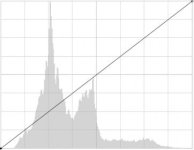
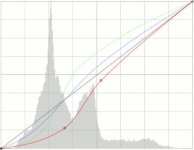
curves-normal.jpgcurves-graded.jpg

Not perfect. But I was working from an 8-bit JPEG and did it fast. I think it looks more like film, although not perfect. As you can see I curve each color individually. Video often has too much red, for some reason.

(I also take down the saturation a little bit, since an S curve raises saturation, since it raises contrast.)

If I had shot it with a recent videocamera with decent dynamic range and in log or something to give me room to grade, it theoretically could be made indistinguishable from film.
 
Last edited:
Back
Top