Nikon V1 – shooting 4K 60fps RAW for $200

that will only work for 1 sec of video or .5 sec @60fps........ Its cool, but not that useful.

I agree that it's not that useful, however, I'm sure people will find uses for it - perhaps for breif moments of slow-motion.

I guess it also shows that manufacturers are rather "full of it" when they try and tell us that 4K RAW is a ridiculously expensive thing.

All the Aptina sensor in the V1/V2 needs is a larger memory buffer, faster/more intelligent CPU, and cooling of some sort to make it capable of shooting continuous 4K. An Nvidia Terga 4 CPU, for example, is said to be easily capable of processing the CPU intensive HVEC (H.265) at 4K 60FPS - RAW, being raw, is supposedly not CPU intensive at all. The rumored price for Tegra 4 is said to be around $40 or so per CPU - I would love to see someone attempt to use the Aptina sensor in a 4K 1-60FPS camera. The dynamic-range looks phenomenal. As Andrew suggested in his article, perhaps Ikonoskop may buy and use this sensor for their next camera?

I think what would be great is if Blackmagic used this sensor to release an even cheaper model for people on even lower budgets, or to compliment people that own the current BMCC and would like slow-motion of some sort. Wishful thinking, but if it's being used in a $300 Nikon V1, I'm sure it's possible :)
 
someone is going to make a lot of money if they make a fully useful version off of this (maybe $400 for a 12s burst model)
 
Interesting.... i've been making money with the frame burst off the Casio FX1 for many years now (60p/1 sec/3k). It has very limited usage... but occasionally, something like a waterfall or slow moving river can be shot, looped and extended into a usable clip
 
All the Aptina sensor in the V1/V2 needs is a larger memory buffer, faster/more intelligent CPU, and cooling of some sort to make it capable of shooting continuous 4K. An Nvidia Terga 4 CPU, for example, is said to be easily capable of processing the CPU intensive HVEC (H.265) at 4K 60FPS - RAW, being raw, is supposedly not CPU intensive at all.
Any processor that can do H.265 could also do Cineform RAW. HDMI 2.0 could probably handle the data rate for just about anything.
 
the issue with 4k isnt sensor resolution. It's dealing with the massive amounts of data PER SECOND and the HEAT that is generated by such computers.

I bet you could hack this Nikon to sustain longer record times, and end up with a melted piece of plastic.
 
Your degree in microsensor thermodynamics notwithstanding, the actual problem is efficiently handling the bandwidth generated with that much data for 4K. Which is why Aptina's HiSPi transmission of 2.8 GB/s (700 Mb/s per lane) is the reason Sony & Nikon both are so interested in their chips.

Aptina HiSPi to Parallel Sensor Bridge


the issue with 4k isnt sensor resolution. It's dealing with the massive amounts of data PER SECOND and the HEAT that is generated by such computers.

I bet you could hack this Nikon to sustain longer record times, and end up with a melted piece of plastic.
 
Last edited:
This sensor, Aptina's AR1011HS, is predicted to be in the next round of the Nikon 1 series. Mass production of the sensor was scheduled for the first quarter of this year. Nikon hasn't confirmed a new model, yet. While shooting 1080p @ 120fps, it is also capable of shooting 4K footage @ 60fps.

Aptina unveils 1-inch sensor with 1080p video at 120fps

Aptina AR1011HS Sensor flyer

If Nikon doesn't use the sensor, somebody will.
Rumor has it that the AR1011HS is essentially the for-sale version of the sensor Aptina developed for the V1.
 
I read that also, that Nikon had an exclusive 1 yr production run and now this is the general release. NAB's only three weeks away, I'm sure we'll find out then.

Rumor has it that the AR1011HS is essentially the for-sale version of the sensor Aptina developed for the V1.
 
I read that also, that Nikon had an exclusive 1 yr production run and now this is the general release. NAB's only three weeks away, I'm sure we'll find out then.
Yeah, it might be interesting to see something from GoPro with an AR1011HS at 4K and Cineform RAW. But maybe the form factor would be too big for what GoPro does.
 
Agreed, but, I personally would only be interested in a RAW camera, even if it was 1080p and interchangeable mount with a S35 or APS-C size sensor. The GoPro Hero 2 and the Hero3 - Silver edition use the 14mp Aptina MY9F002. But, the Hero3 - Black Edition uses Sony's do everything well Exmor chip. Would be nice to see them create a new product line of interchangeable lens cameras. $1000 Aptina chip model & $2000 Sony chip model with an interchangeable mount.

Because if GoPro releases a Hero that allows interchangeable lenses and they use the Aptina Sensor, Nikon has to release a competing product because it's using the chip, or a newer derivative, that's in their V1.:)

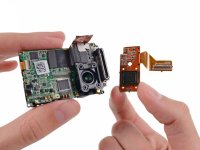
ifixit GoPro Hero3 teardown

Sony IMX117CQT brochure

Yeah, it might be interesting to see something from GoPro with an AR1011HS at 4K and Cineform RAW. But maybe the form factor would be too big for what GoPro does.
 
Last edited:
Today on Canon Rumours there was another mention of the small DSLR (possibly called "EOS-b"), this time including some specs. Assuming this spec list is correct, I was wondering what "4 seconds of continuous shooting frames / video" meant? Does it mean: be able to shoot 4 seconds of continuous stills? Unlikely, for an entry-level camera, but if unexpectedly this does mean that, it gives a few more precious seconds of shooting compared to the Nikon 1 cameras (though probably jpeg, not raw, and no indication what framerate it would be).

http://www.canonrumors.com/
 
Back
Top