New NVIDIA RTX 2080 with Turing Architecture

groveChuck

U-matic Member
NVIDIA has announced new Turing architecture GPUs

https://www.nvidia.com/en-us/design...s/turing-architecture/?nvid=nv-int-sh28-52949

"The greatest leap since the invention of the CUDA GPU in 2006, Turing fuses real-time ray tracing, AI, simulation and rasterization to fundamentally change computer graphics.

It features new RT Cores to accelerate ray tracing and new Tensor Cores for AI inferencing which, together for the first time, make real-time ray tracing possible.

Turing resets the way content is created and enjoyed across industries, opening amazing creative possibilities that until recently were assumed to be years away."

From https://www.pcgamer.com/rtx-2080-release-date/

"GTX branding is out, RTX (for real-time ray-tracing) is in; 11-series numbers are out, and 20-series numbers are in. Nvidia also recently trademarked both GeForce RTX and Quadro RTX. The new cards apparently start with the GeForce RTX 2080.

The Turing architecture is where Nvidia really kept some surprises hidden from the rumor mill. The Volta architecture has some features that we weren't sure would get ported over to the GeForce line, but Nvidia appears ready to do that and more. The Turing architecture includes the new Tensor cores that were first used in the Volta GV100, and then it adds in RT cores to assist with ray-tracing.

The top Turing design allows for up to 4,608 CUDA cores, an increase of 20 percent relative to the GP102, and
29 percent more than the GTX 1080 Ti. Turing can deliver 16 TFLOPS of computational performance from the CUDA cores (FP32), which indicates a clockspeed of around 1700MHz.
That's also about 35 percent faster than the GTX 1080 Ti.

Turing will use GDDR6 memory. Based on the Quadro RTX models, there are two chip designs, one with a 384-bit interface and 24GB/48GB of GDDR6, and the other with a 256-bit interface and 16GB GDDR6."
(did they just say 24 and 48GB of memory???) :shocked:

"Nvidia states that Turing will use Samsung 16Gb modules for the Quadro RTX cards, so it looks like it's going whole hog and doubling VRAM capacities for the upcoming generation of graphics cards."

And from https://wccftech.com/rumor-nvidia-l...2080-ti-with-4352-cuda-cores-11gb-gddr6-vram/

"According to at least three separate sources NVIDIA is said to be looking to surprise everyone with the launch of an absolutely monstrous RTX 2080 Ti graphics card and not just an RTX 2080 as was previously thought."


I have no idea what ray tracing is, but I understand fast and powerful... :grin: :thumbsup:
 
NVIDIA has announced new Turing architecture GPUs

https://www.nvidia.com/en-us/design...s/turing-architecture/?nvid=nv-int-sh28-52949

"The greatest leap since the invention of the CUDA GPU in 2006, Turing fuses real-time ray tracing, AI, simulation and rasterization to fundamentally change computer graphics.

It features new RT Cores to accelerate ray tracing and new Tensor Cores for AI inferencing which, together for the first time, make real-time ray tracing possible.

Turing resets the way content is created and enjoyed across industries, opening amazing creative possibilities that until recently were assumed to be years away."

From https://www.pcgamer.com/rtx-2080-release-date/

"GTX branding is out, RTX (for real-time ray-tracing) is in; 11-series numbers are out, and 20-series numbers are in. Nvidia also recently trademarked both GeForce RTX and Quadro RTX. The new cards apparently start with the GeForce RTX 2080.

The Turing architecture is where Nvidia really kept some surprises hidden from the rumor mill. The Volta architecture has some features that we weren't sure would get ported over to the GeForce line, but Nvidia appears ready to do that and more. The Turing architecture includes the new Tensor cores that were first used in the Volta GV100, and then it adds in RT cores to assist with ray-tracing.

The top Turing design allows for up to 4,608 CUDA cores, an increase of 20 percent relative to the GP102, and
29 percent more than the GTX 1080 Ti. Turing can deliver 16 TFLOPS of computational performance from the CUDA cores (FP32), which indicates a clockspeed of around 1700MHz.
That's also about 35 percent faster than the GTX 1080 Ti.

Turing will use GDDR6 memory. Based on the Quadro RTX models, there are two chip designs, one with a 384-bit interface and 24GB/48GB of GDDR6, and the other with a 256-bit interface and 16GB GDDR6."
(did they just say 24 and 48GB of memory???) :shocked:

"Nvidia states that Turing will use Samsung 16Gb modules for the Quadro RTX cards, so it looks like it's going whole hog and doubling VRAM capacities for the upcoming generation of graphics cards."

And from https://wccftech.com/rumor-nvidia-l...2080-ti-with-4352-cuda-cores-11gb-gddr6-vram/

"According to at least three separate sources NVIDIA is said to be looking to surprise everyone with the launch of an absolutely monstrous RTX 2080 Ti graphics card and not just an RTX 2080 as was previously thought."


I have no idea what ray tracing is, but I understand fast and powerful... :grin: :thumbsup:

Its a form of computer rendering where a ray is cast out to accurately create lighting, shadows and realistic transparent materials. Basically its vastly better realism and typically very very slow to render in 3D graphics.

This new card sounds awesome and should be one heck of a GPU.
 
Its a form of computer rendering where a ray is cast out to accurately create lighting, shadows and realistic transparent materials. Basically its vastly better realism and typically very very slow to render in 3D graphics.

This new card sounds awesome and should be one heck of a GPU.

Thanks for sharing that, Thomas. Do you have an engineering background, or you just pick this stuff up in your spare time? :grin:
 
I have no idea what ray tracing is, but I understand fast and powerful... :grin: :thumbsup:

To expound a bit on Tomas' post...

In ray tracing, the renderer fires rays into the scene from the point of view (i.e. the camera), and follows those rays as they are reflected, refracted, absorbed, or some combination thereof until they're either deemed irrelevant (not enough contribution) or strike a light source.

It's computationally intensive to be sure, but it's also very effective for rendering lighting effects like specular highlights (e.g. the bright patches of light reflecting off of a car) similar.

Additional reading for those so inclined:
https://www.tomshardware.com/news/ray-tracing-definition,37600.html

I spent a lot of time hanging out with Doc Mojo (Kenton Musgrave) before moving to the west coast... if you don't know who he is, you ought to be a bit curious. He developed several very interesting rendering methods, and procedural volumetrics, other pretty slick stuff that's now more or less routine.

What's going to be REALLY cool is seeing how Turing affects hybrid physically-based renderers, especially when it's teamed with ThreadRipper2 monsters.

A lot of the algorithms that make ray tracing work also support things like photon mapping (firing virtual photons into a scene from each light to determine where the light's going to create secondary light sources -- i.e. global illumination). And with enough horsepower and R&D, realtime procedural volumetrics...

It's going to be an interesting time for 3D animation and rendering, both realtime and production.
 
I have the GTX 1080 TI I got about a year ago. Thought I'd keep it for ages, and really, I could.

But the 2080 TI sounds incredible for VR, gaming, and hopeful improved utilization on the next update to Adobe and plugins.
 
What price does everybody think it will come in at? $1299? $999?

I have to say, I was quite disappointed with NVidia over the whole bitcoin miner price blowup. I thought they should have offered some kind of 'discount to normal pricing' for system builders but they chose the path of greed as expected. Many folks who have purchased a lot of cards from them over the years just got shoved out in the cold imho.
 
I have the GTX1080Ti and Decklink 4k mini. In the Resolve System Configuration, should I check the box for 'Use Display GPU for Compute'?
 
I have the GTX1080Ti and Decklink 4k mini. In the Resolve System Configuration, should I check the box for 'Use Display GPU for Compute'?
If you have one GPU it does not matter, Resolve will use that GPU for computing regardless.

If you have more than one it depends. Generally, you should have equal powered GPUs if you want all of them to work for computing as the lowest performing card sets the allover performance. In the case you have equal performing GPUs you would want to check 'Use Display GPU for Compute'.

However if you have a situation where you have one strong card and one lower performing card you may want to opt to have the low performing card be used for the UI exclusively and then you would uncheck the 'Use Display GPU for Compute' to not create a bottleneck.
 
If you have one GPU it does not matter, Resolve will use that GPU for computing regardless.

If you have more than one it depends. Generally, you should have equal powered GPUs if you want all of them to work for computing as the lowest performing card sets the allover performance. In the case you have equal performing GPUs you would want to check 'Use Display GPU for Compute'.

However if you have a situation where you have one strong card and one lower performing card you may want to opt to have the low performing card be used for the UI exclusively and then you would uncheck the 'Use Display GPU for Compute' to not create a bottleneck.

Excellent, Thank you.
 
Thanks for sharing that, Thomas. Do you have an engineering background, or you just pick this stuff up in your spare time? :grin:

No I studied VFX and 3D animation in college which is how I fell into a deep passionate love of all things digital imaging. I initially bought cameras solely to make VFX a reality and shoot footage for background plates or 3D texture maps but once I learned I could earn a living with said cameras it turned more into a passion for video production. I'm still one heck of a nerd when it comes to image processing however. It will likely be a curse of mine until the day I die.
 
What price does everybody think it will come in at? $1299? $999?

I have to say, I was quite disappointed with NVidia over the whole bitcoin miner price blowup. I thought they should have offered some kind of 'discount to normal pricing' for system builders but they chose the path of greed as expected. Many folks who have purchased a lot of cards from them over the years just got shoved out in the cold imho.

I was thinking the GTX line... The RTX Quadro cards will start at $2,000 and go up to $10,000. Hopefully the gamer level cards will be in the 'old normal' price ranges.
 
The latest rumors claim that the GTX 2080 Ti will sell for 1.000 USD and the GTX 2080 for 800 USD (edit: messed up GTX and RTX too ... ).
 
Last edited:
I'm seriously considering building a new editing system around a new RTX 2080ti card and the new Threadripper chips..... but then I wouldn't have any free time for when my system is rendering.
 
Newegg has a bunch of third party 2080's up for pre-order already. Very tempting. I might wait for actual benchmarks, as most of the giant leaps in processing power are with regard to ray-tracing, which most programs aren't utilizing yet.
 
Thomas, interesting way to back into shooting!
jcs, VERY cool!
Tamerlin, thanks- I knew algorithms HAD to be involved (I speak no code).
Bassman, agreed on the bitcoin inflation factor, but that's capitalism for you- what the market will bear. And now the bottom has fallen out of mining, and cards are available again.
filmguy, we could hear you salivating down here and see that upgrade coming from 3000 miles away, lol!
I want one, but am maxed out with a meager 980 Ti, need a new computer... :badputer:

Another question for you ray-tracing experts- since GPUs (and NVIDIA) are in data centers, AI and autonomous cars, is the Turing and ray-tracing the sort of technology that would help in those areas?
 
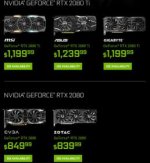
The RTX 2080 was (semi) released today (third party, as Batutta noted), with prices:

RTX.jpg

I got the Newegg email, the 8GB EVGA and Zotac show as available for pre-order:

https://www.newegg.com/Product/Prod..._p1=&email64=ZmFycmlzY2h1Y2tAaG90bWFpbC5jb20=

https://www.newegg.com/Product/Prod..._p1=&email64=ZmFycmlzY2h1Y2tAaG90bWFpbC5jb20=


The three 11GB Ti cards show ETA 9/20 (today) but Currently Out of Stock
https://www.newegg.com/Product/Prod..._p1=&email64=ZmFycmlzY2h1Y2tAaG90bWFpbC5jb20=

https://www.newegg.com/Product/Prod..._p1=&email64=ZmFycmlzY2h1Y2tAaG90bWFpbC5jb20=

https://www.newegg.com/Product/Prod..._p1=&email64=ZmFycmlzY2h1Y2tAaG90bWFpbC5jb20=

Question is (and Batutta asked) what will the benchmarks show? And where are the alleged 24 and 48GB versions?
 
Its a form of computer rendering where a ray is cast out to accurately create lighting, shadows and realistic transparent materials. Basically its vastly better realism and typically very very slow to render in 3D graphics.

This new card sounds awesome and should be one heck of a GPU.

I remember doing basic Ray Tracing with my personal PC back in the early 2000's, it was a very very very very slow process!
 
Back
Top