New generation LED efficiency

chris_f

Active member
Hi All,

I have been following some of the latest developments in the world of LED lighting and have noticed a trend toward lower efficiency in LED arrays. i.e less light output for the given power draw.

This seems to come about due to either the miniaturisation of the LED COB (in the pursuit of better optics for hard light applications) or because manufacturers are choosing to use a mix of saturated colours to create white instead of using a white phosphor LED chip in the mix. Sometimes it is a combination of both factors.

I have included some photometric data of some of these new generation fixtures below. All of them either have miniaturised LED COB designs or use saturated colour mixes to create white light.

The ETC FOS4 panel was quite a surprise. The stated lumens per Watt is only slightly better than a low voltage halogen bulb.

Now obviously there are some benefits to these new technologies but are the trade offs in brightness worth it? Honestly I have never been dissatisfied with the colour accuracy or brightness of a high quality RGBWW panel like a litepanels gemini for example… it also seems like the colour quality is not that much improved with 6, 7 or even 8 different colour chips vs the traditional 5 chip RGBWW.

I will say though, the Fiilex lights really do show some strong benefit to a very small COB in terms of optical quality - would be great to see more of that style chip in the market.

Would be great to hear some other opinions on this. Cheers!

ETC - Click image for larger version  Name:	45C815D3-BD8C-4BF1-917D-B4BB2899016C.jpeg Views:	0 Size:	76.9 KB ID:	5674079
~450w
ETC - Click image for larger version  Name:	45C815D3-BD8C-4BF1-917D-B4BB2899016C.jpeg Views:	0 Size:	76.9 KB ID:	5674079
~320W
ETC - Click image for larger version  Name:	45C815D3-BD8C-4BF1-917D-B4BB2899016C.jpeg Views:	0 Size:	76.9 KB ID:	5674079
300W
ETC - Click image for larger version  Name:	45C815D3-BD8C-4BF1-917D-B4BB2899016C.jpeg Views:	0 Size:	76.9 KB ID:	5674079
 
Last edited:
photometrics.jpgAhem, may I add to the mix the Prolycht Orion 300 FS? It is an RGBACL light but the illumination levels are not lower than some other LED emitter configurations. In fact it rather blows some of them away while increasing color saturation and accuracy.
 
This may be an easier way to consume & compare some of this data. It's a slide I already had handy. Note that with a similar beam angle and only around 65% the power draw the Orion 300 FS is about 1/3 brighter than the ARRI Orbiter at 5600K and 3-meters. If you want to compare it to a traditional Bi-color light than it's around twice the brightness of the Aputure 300X.

The issue with RGBW, RGBWW or any other such light that uses a white emitter is that the red, green & blue emitters only cover just so much of the spectrum. In particular most blue emitters have a serious deficiency around 490nm, so no Cobalt Blue. The concept with the white emitters is that they will then fill in the color gaps, but this comes at the expense of saturation. Turn on a white emitter and it blanches out the entire spectrum, at least it does to the extent that any single-color or bi-color white LED fixture will. So you just "can't get there from here" and having just the three color nodals means that the full spectrum isn't covered either. But if you add in color emitters such as Lime or Cyan then they can both expand the spectral range as well as fill in the gaps where the other colors may have deficiencies. In the case of the Orion 300 FS, we use a Blue Safire direct emitter that also uses blue phosphorescent materials to expand its range to cover around 450nm-490nm very well, and then the Cyan emitter covers into part of the same spectral range to help fill in where there would otherwise be deficiencies.

Slide1.jpeg - Click image for larger version  Name:	Slide1.jpeg Views:	0 Size:	46.7 KB ID:	5674162
 
Ahem, may I add to the mix the Prolycht Orion 300 FS? It is an RGBACL light but the illumination levels are not lower than some other LED emitter configurations. In fact it rather blows some of them away while increasing color saturation and accuracy.

Hi Mitch,

Thanks for responding - some good insights there. I was actually planning to do a follow up post with the photometrics of some other lights to compare further - the Orion 300 is definitely one to consider as bucking the trend of lower output with these multi-colour LED arrays. Actually I think it may be the only one I have come across that hasn’t sacrificed output when adopting the 6 colour LED array.

I suppose I was trying to highlight that some of these established big brands such as Arri, K5600 and ETC haven’t really been able to achieve the output of previous generation LED technologies that we were starting to get used to in terms of output per watt (like the single colour COB lights or RGBWW panels I mentioned).

From the spectrum graphs I have seen of LEDs that do not have any white emitters at all, I can’t help but feel that the ultimate solution for white light reproduction would be to have warm white, cool white and then the 6 colours on top of that. the spectrum just doesn’t look quite as linear without the white chips. But I’m assuming the benefit of doing something like this may completely blow out the cost of producing the fixture and may only provide a a few % difference in colour render which may not even be perceivable to the human eye?

Out of curiosity, do you believe the Orion 300 would be even brighter in white light mode if it had at least one white chip in the mix? Or with your product it wouldn’t make a difference?

Thanks :)
 
A few different spectrum graphs below..

The Orion 300 does look quite good so let’s start with that (source: Gaffer and Gear):

77C84059-FC4F-4CAD-9A4B-C3A730477BF3.jpeg - Click image for larger version  Name:	77C84059-FC4F-4CAD-9A4B-C3A730477BF3.jpeg Views:	0 Size:	39.2 KB ID:	5674171

77C84059-FC4F-4CAD-9A4B-C3A730477BF3.jpeg - Click image for larger version  Name:	77C84059-FC4F-4CAD-9A4B-C3A730477BF3.jpeg Views:	0 Size:	39.2 KB ID:	5674171

Next is the Fiilex Q5 which apparently uses a broad spectrum blue and three other colours in a miniaturised LED COB for very sharp shadows. It also achieves the best daylight SSI score I have seen (due to the special blue chip perhaps).

04B6A54F-6033-4580-AC39-247F77B63864.png - Click image for larger version  Name:	04B6A54F-6033-4580-AC39-247F77B63864.png Views:	0 Size:	58.4 KB ID:	5674172

3A660638-594B-4FEC-A4E8-F28CACFF41CE.png - Click image for larger version  Name:	3A660638-594B-4FEC-A4E8-F28CACFF41CE.png Views:	0 Size:	56.9 KB ID:	5674173
Next is the ETC fos4 LED mix which uses 8 different colours including a broad spectrum red:

E7B15783-49A3-4E47-9BAA-91FFF181A6EC.jpeg - Click image for larger version  Name:	E7B15783-49A3-4E47-9BAA-91FFF181A6EC.jpeg Views:	0 Size:	32.0 KB ID:	5674174

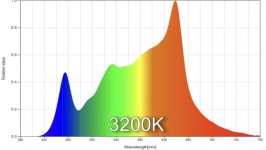
Finally we have a couple of traditional RGBWW panels:

E11C7CC5-E188-4352-B90F-E67C7A63D939.jpeg - Click image for larger version  Name:	E11C7CC5-E188-4352-B90F-E67C7A63D939.jpeg Views:	0 Size:	39.9 KB ID:	5674175
48D7F5D1-0D8D-470C-A1AF-C91330FBB4CA.jpeg - Click image for larger version  Name:	48D7F5D1-0D8D-470C-A1AF-C91330FBB4CA.jpeg Views:	0 Size:	40.5 KB ID:	5674176
 
Obviously the above graphs don’t tell the full story in any way… just posting out of interest. The SSI scores, TLCI scores, TM-30 scores vary amongst this field with no one light winning every measurement in every colour temp category.
 
Hi Mitch,

Thanks for responding - some good insights there. I was actually planning to do a follow up post with the photometrics of some other lights to compare further - the Orion 300 is definitely one to consider as bucking the trend of lower output with these multi-colour LED arrays. Actually I think it may be the only one I have come across that hasn’t sacrificed output when adopting the 6 colour LED array.

I suppose I was trying to highlight that some of these established big brands such as Arri, K5600 and ETC haven’t really been able to achieve the output of previous generation LED technologies that we were starting to get used to in terms of output per watt (like the single colour COB lights or RGBWW panels I mentioned).

From the spectrum graphs I have seen of LEDs that do not have any white emitters at all, I can’t help but feel that the ultimate solution for white light reproduction would be to have warm white, cool white and then the 6 colours on top of that. the spectrum just doesn’t look quite as linear without the white chips. But I’m assuming the benefit of doing something like this may completely blow out the cost of producing the fixture and may only provide a a few % difference in colour render which may not even be perceivable to the human eye?

Out of curiosity, do you believe the Orion 300 would be even brighter in white light mode if it had at least one white chip in the mix? Or with your product it wouldn’t make a difference?

Thanks :)

I actually don't think it would make much of a difference. I mean, if you just start adding emitters then yeah it's brighter, but if there was the same number as now just divided up differently then no I don't. The thing is, when you have a full complement of multicolored LEDs each covering a chunk of the spectrum then no matter what the color temperature you will ALWAYS be using all of the emitters, just at varying intensities. But if you have a bi-color light then unless you're right down the middle of the range fully half of your emitters will be dimmed if not switched off. When you do the math you can see that at the most common color temperatures (3200 & 5600) you are likely using more of the emitter potential in an RGBACL than you are in a bi-color. Depending how all of this is regulated in the light engine it can be pretty close to a wash.

So why are so many of these units underwhelming in their output levels? Because they are using various mixes of colored emitter & phosphorescent doping to attempt to get the best color. The better the color the weaker the output, usually because you're clamping down the output of certain frequencies.

When you add a white LED into the mix you add both the benefits and the negatives. An LED emitter that tries to cover the entire visible spectrum will always have some deficiencies. LEDs that only try to cover a specific rane of frequencies can be far more accurately controlled. Better color is better color, even when you're shooting "regular" 3200K or 5600K. I'd rather sacrifice a bit of output for quality color, but you can see that we manage to do rather well with both.
 
I actually don't think it would make much of a difference. I mean, if you just start adding emitters then yeah it's brighter, but if there was the same number as now just divided up differently then no I don't. The thing is, when you have a full complement of multicolored LEDs each covering a chunk of the spectrum then no matter what the color temperature you will ALWAYS be using all of the emitters, just at varying intensities. But if you have a bi-color light then unless you're right down the middle of the range fully half of your emitters will be dimmed if not switched off. When you do the math you can see that at the most common color temperatures (3200 & 5600) you are likely using more of the emitter potential in an RGBACL than you are in a bi-color. Depending how all of this is regulated in the light engine it can be pretty close to a wash.

So why are so many of these units underwhelming in their output levels? Because they are using various mixes of colored emitter & phosphorescent doping to attempt to get the best color. The better the color the weaker the output, usually because you're clamping down the output of certain frequencies.

When you add a white LED into the mix you add both the benefits and the negatives. An LED emitter that tries to cover the entire visible spectrum will always have some deficiencies. LEDs that only try to cover a specific rane of frequencies can be far more accurately controlled. Better color is better color, even when you're shooting "regular" 3200K or 5600K. I'd rather sacrifice a bit of output for quality color, but you can see that we manage to do rather well with both.

That all makes a lot of sense, thanks for the detailed reply.

Luckily LED efficiency started very high so I suppose you do have more room to play in terms of sacrificing output for colour tunability and accuracy.

At this stage the Orion 300 seems to be perhaps the only hard light with the RGBACL mix that hasn’t compromised output too much…

For me personally, multi-colour LED tech is most appealing when used in a panel light design. If the shadow quality isn’t perfectly sharp, I’m only going to be bouncing or diffusing it anyway so may as well start soft with a very wide beam spread to fill up those 8x8’s with less required distance. But hey! If you want to use an optical projector attachment with full colour tunability… then it would tip the balance again…
 
That all makes a lot of sense, thanks for the detailed reply.

Luckily LED efficiency started very high so I suppose you do have more room to play in terms of sacrificing output for colour tunability and accuracy.

At this stage the Orion 300 seems to be perhaps the only hard light with the RGBACL mix that hasn’t compromised output too much…

For me personally, multi-colour LED tech is most appealing when used in a panel light design. If the shadow quality isn’t perfectly sharp, I’m only going to be bouncing or diffusing it anyway so may as well start soft with a very wide beam spread to fill up those 8x8’s with less required distance. But hey! If you want to use an optical projector attachment with full colour tunability… then it would tip the balance again…

Understood. There's certainly need for both panels and spotlights. I do have a general rule of thumb that you can soften a hard light but you can't harden a soft light. But I also recognize that there are good reasons for wanting a light that's soft to begin with.
 
Understood. There's certainly need for both panels and spotlights. I do have a general rule of thumb that you can soften a hard light but you can't harden a soft light. But I also recognize that there are good reasons for wanting a light that's soft to begin with.

For sure. And thanks very much for providing a link to your presentation... it was really interesting and well worth watching.
 
Back
Top