New flywheeled, DSLR dolly system

Postmaster

Dark Side of the Camera
A friend of mine here in Germany just developed this amazing DSLR dolly system called Polly.
It is flywheel driven and can be outfitted with an arm.
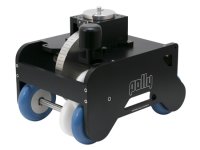
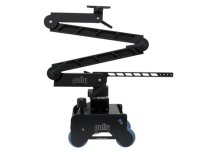
polly-engine_01.jpg polly-system_02.jpg

There are videographers who like the compact size of modern camera systems or DSLRs, but don’t want to lose this advantage by using additional large equipment. Polly is designed with this expectation in mind - an ultra compact, portable and flexible solution for smooth tracking shots. The flywheel gear allows you to move the camera extra smooth on every flat ground. Tracking shots which would usually require at least one assistent or even a motion control system can now be executed by just one person and in almost no prep time. (At this very moment, a portable running surface and a suitable case for polly are in development)

Flywheel driven and stabilized
Ultra Portable and built like a tank
No electricity needed
Runs super smooth on every flat surface
Almost no prep time
Flexible and extendable system
Stopmotion scale for accurate tracking sequences
High quality engineering

http://www.pollysystem.com/

Frank
 
Haven´t seen it in real life, but I get my hands on it soon for a review on my blog.
The flywheel is not only for drag, but also for smooth operation and repeatable shots.

Thomas was putting a ton of thought into this baby, can´t wait to give it a test spin (pun intended).

Frank
 
the flywheel is for inertia: once it's moving, it will have a greater tencency to keep its speed constant (downside: it will take a lot more force to make it start moving, or stop) - depending on how much that flywheel weights, and how it's geared to the wheels -how fast it spins for a given dolly speed- the effect will be stronger or weaker; in the extreme, with a heavy flywheel geared to spin very fast, pushing the dolly becomes like pushing a car on an ideally smooth surface: it takes a lot of force to get it moving, but once it's there it keeps on and on at absolutely constant speed
 
the flywheel is for inertia: once it's moving, it will have a greater tencency to keep its speed constant (downside: it will take a lot more force to make it start moving, or stop) - depending on how much that flywheel weights, and how it's geared to the wheels -how fast it spins for a given dolly speed- the effect will be stronger or weaker; in the extreme, with a heavy flywheel geared to spin very fast, pushing the dolly becomes like pushing a car on an ideally smooth surface: it takes a lot of force to get it moving, but once it's there it keeps on and on at absolutely constant speed

great descriptive explanation!

david
 
Anyone know why there are not more flywheel type stabilizers, they were used in the shooting of Slum Dog Millionaire - bulk and expensive and limited run time. But smooth shots guaranteed. Here is a link to the article - http://www.siliconimaging.com/DigitalCinema/News/PR_01_31_09_Slumdog.html


H
ere is the actual beast used - http://www.kenyongyro.net/kenyongyro/

Those gyros are a serious pain in the ass and are not at all worth the trouble.

Don't even get me started on the SI2k POS. Worst camera ever.
 
Those gyros are a serious pain in the ass and are not at all worth the trouble.

Don't even get me started on the SI2k POS. Worst camera ever.

Really? A friend bought one was seems to be liking it quite well (the SI2k I mean). What don't you like about it?

I notice it's not talking about a lot on here...
 
What don't you like about it?

The whole concept. A camera sensor tethered via ethernet to a PC - it belongs in a laboratory, not on a movie set. It's exactly the horror story it sounds like. There are so many things that can go wrong that inevitably something does, nearly every day that I was forced to use the thing.

All that and the image isn't any better than any of the competition. I really don't understand the appeal. The only situation where it even halfway works is when you need an incredibly small handheld camera, are going to be doing very long takes, and have lots and lots of qualified support personnel - exactly the situation I was forced to deal with it in, and I still hate it.
 
I'm also not a fan of the camera. We had to blackshade every time we rebooted the camera, which is hard to do on a 3d rig. Also, we ran into problems with the backfocus, apparently the SI2K has a pretty thick "filter stack" in front of the sensor, which can cause problems with some lenses. I just felt it wasn't worth the trouble just to have a slightly more compact rig...
 
Also, we ran into problems with the backfocus, apparently the SI2K has a pretty thick "filter stack" in front of the sensor, which can cause problems with some lenses.

You just answered a question that's been bugging me for 2 years. Had I had this answer before we surely could have saved Fox Searchlight thousands of dollars in airfare from Utah to LA. Nobody seemed to know this bit of information, from Stefan Ciupek all the way up to Ari Presler. This issue screwed us repeatedly.

We put lenses on projectors all over LA and confirmed the lenses were shimmed correctly. We double, triple, quadruple checked the camera heads and knew those were set up "correctly". Yet we still couldn't get all our lenses to focus right.

I hate those cameras.
 
Wow, looks like u had the exact same issue as we did. I finnaly decided to just pull of the large monitor by our workstation, which was not my preference but what can you do...
 
Back
Top